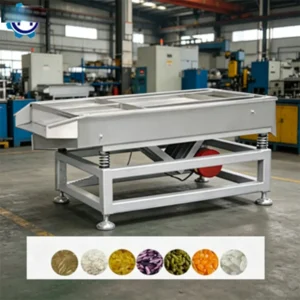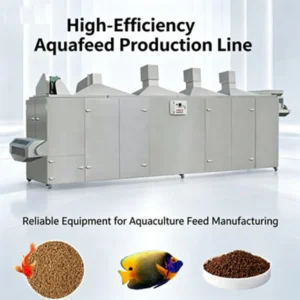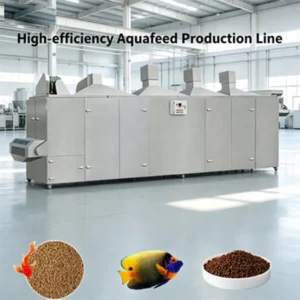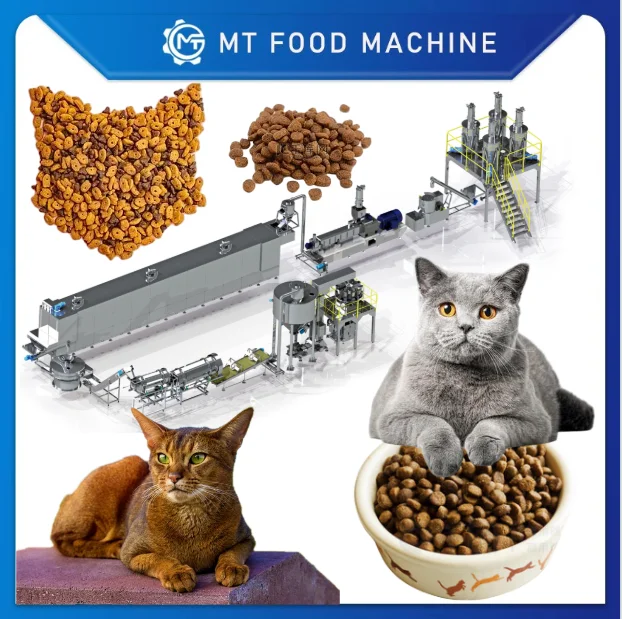
Matched Station Capacity — every supporting unit from mixing through packing is rated to the extruder’s output range rather than assembled from mismatched standalone machines.
Technical Specifications
| Parameter | Value |
|---|---|
| Product Type | Pet Food Processing Line |
| Output Capacity | 250–300 kg/h (basis not stated in source — confirm raw material, moisture, kibble size) |
| Control System | PLC |
| Automation Level | Full Automation |
| Product Formats | Dry kibble, semi-moist, treats |
| Line Configuration | Complete processing line from batching to packing |
| Certification | CE |
Application Suitability
| Application | Material or Output |
|---|---|
| Dry kibble production for cats and small pets | Poultry meal, fish meal, corn flour, grain blends |
| Semi-moist pet food manufacturing | High-moisture meat slurries, glycerin-based formulations |
| Multi-species treat production | Fresh meat inclusions, starch binders, palatant coatings |
Why the Dryer Matters More Than the Extruder Nameplate
A pet food processing line full equipment range only performs as well as its weakest downstream station.
I once watched a producer in West Africa lose an entire shift because the dryer on their kibble line could not keep pace with the extruder. The extruder ran at its rated output, but the drying stage bottlenecked everything downstream, forcing the operator to throttle back and produce damp kibble that moulded within days. The full equipment range of a line must be surveyed station by station, not assumed from the extruder spec sheet alone. [NEED_CITE: moisture content tolerances in dry pet food storage]
Surveying Every Station Before Specifying the Line
When buyers evaluate a pet food processing line full equipment range, the extruder often dominates the conversation. Yet the mixer upstream must batch at a rate that feeds the extruder continuously, and the flavouring drum downstream must coat every kibble before the product reaches the cooling conveyor. Each station carries its own rated throughput, power draw, and footprint. Missing any one of those details during the specification phase creates a gap that only shows up on the factory floor.
How Throughput Matching Prevents Hidden Bottlenecks
A twin-screw extruder pushing 250–300 kg/h of kibble demands a dryer with sufficient bed area and residence time to bring moisture down to a safe shelf-stable level. If the dryer is undersized, operators either slow the extruder or accept under-dried product. The coating drum must handle the same mass flow while distributing fat or palatant evenly. When every station in the pet food processing line full equipment range is matched, the line runs at a steady state rather than cycling between surges and idle periods. [NEED_CITE: steady-state extrusion and downstream drying balance]
Reading the Specs That Actually Matter
The PLC control system integrates monitoring across every station, so an operator can track barrel temperature, screw speed, dryer zone temperatures, and drum rotation from a single interface. Twin-screw extrusion provides the shear and mixing intensity needed for high-meat formulations that single-screw machines struggle to gelatinise. Full automation reduces the manual transfer points where contamination or product loss typically occurs. The CE certification covers the full assembly, meaning electrical safety and guarding requirements apply to every conveyor and rotating drum, not just the extruder motor.
The Cost of Skipping the Line-Level Survey
I have seen producers purchase an extruder that matched their target output, only to discover the dryer they already owned could not handle the moisture load from a semi-moist recipe. They ended up running two drying passes, doubling energy use and cutting effective output in half. Others have installed a coating drum too small for the fat application rate their market demanded, leaving kibble under-flavoured and rejected by distributors. These mismatches are expensive to correct once the line is bolted to the floor. [NEED_CITE: common post-installation line rebalancing costs]
Why Sourcing the Full Range from One Supplier Matters
Every station in this line is configured so throughput aligns from batching through packing, eliminating the finger-pointing that happens when separate vendors supply mismatched equipment. The screw and die configuration is specified to your raw material and target kibble density rather than copied from a generic build. An in-house testing workshop runs your actual formulation before shipment, so you see real output data instead of nameplate promises. PLC integration across all stations means a single control language and alarm logic rather than a patchwork of standalone panels. Documentation covers the full sequence, from line layout and capacity calculation to wear parts lists for every machine in the range.
Documentation & Verification
- Line layout showing throughput calculation at each station from mixer to packer
- Screw and die configuration record matched to your raw material formulation
- Trial run report produced on your actual ingredients before dispatch
- Electrical schematic confirming voltage, frequency, and PLC I/O mapping
- CE declaration of conformity covering the complete line assembly
- Operation and maintenance manual with station-specific service intervals
Installation, Commissioning & Support
- Foundation plan accounts for extruder mass and dryer length across the full line footprint
- Dedicated power circuit sized for combined PLC cabinet and heater load
- Stations shipped in modular sections for sequential assembly inside the facility
- First-run parameter logging through the PLC to establish baseline recipe settings
- Operator training covers each station from batching through packing
- Wear parts list specifies screws, dies, and dryer belt spares for initial stock
What to Include in Your Inquiry
Provide the raw material composition you intend to run, including meat-to-grain ratio and target moisture content. Share your workshop dimensions and ceiling height so the line layout can be drafted around existing columns and doors. Confirm the local voltage and frequency along with the control language your operators need. If you already own upstream or downstream equipment, list each unit’s make and rated capacity so the new stations can be matched accordingly.
Frequently Asked Questions
Q: What stations are included in the full line and where does each fit?
A: The sequence typically starts with a batching and mixing system, followed by the twin-screw extruder, a multi-pass dryer, a flavouring or coating drum, a cooling conveyor, and finally a packing station. Each unit is positioned so product flow is continuous, and the PLC monitors every transition point to flag rate mismatches before they cause downtime.
Q: How is throughput matched between extruder, dryer, and coating drum?
A: Every station is rated against the extruder’s output range using your target kibble size and moisture content. The dryer bed area and residence time are calculated to handle the full mass flow at the required moisture reduction, while the coating drum volume and rotation speed are set to apply fat or palatant at the rate your recipe demands.
Q: Can individual stations be sourced separately?
A: Yes, individual stations can be ordered on their own, for example when replacing an undersized dryer or adding a second coating drum to an existing line. The PLC architecture allows new stations to be integrated into the existing control network, provided the voltage and communication protocol match.
Q: What footprint and utility requirements should I plan for?
A: The total footprint depends on dryer length and conveyor routing, which vary with your target output and moisture reduction. You will need a three-phase power supply matching the combined heater and motor load, compressed air for pneumatic gates, and water supply for barrel cooling zones on the extruder.
Q: How does the PLC integrate monitoring across all stations?
A: The PLC collects temperature, speed, and weight signals from every station into one HMI screen. Operators can view real-time trends for barrel zones, dryer temperatures, and drum speed, and set alarms that stop the line if any station drifts outside its configured range, preventing off-spec product from reaching the packer.