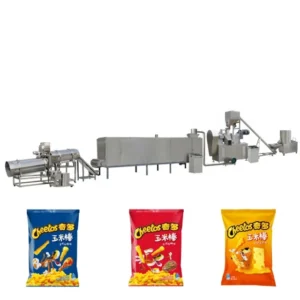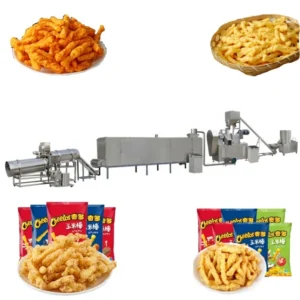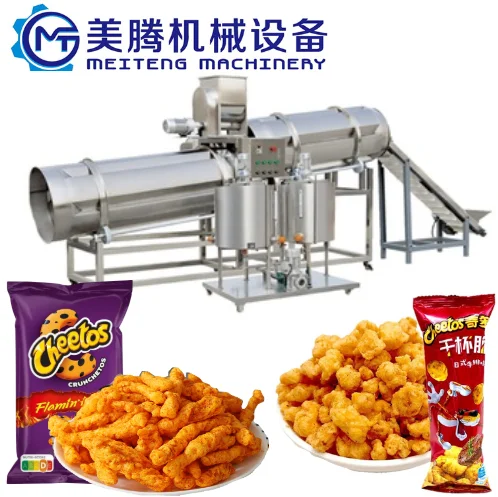
Throughput matching across stations — each segment from extrusion to packing is specified together so one station never starve or choke the next.
Technical Specifications
| Parameter | Value |
|---|---|
| Product Type | Cheetos Kurkure Extruded Snack Processing Line |
| Output Capacity | 120–350 kg/h (basis not stated in source — confirm raw material, moisture, product format) |
| Heat Source | Electric |
| Construction Material | 304 Stainless Steel |
| Net Weight | 80 kg (source value — verify against manufacturer catalog) |
| Automation Level | Fully Automatic |
| Control System | To be confirmed (PLC / MCC / manual) |
| Voltage & Frequency | To be confirmed |
| Rated Power (kW) | To be confirmed |
| Screw Type | To be confirmed (single / twin) |
Application Suitability
| Application | Material or Output |
|---|---|
| Rotary-die extruded curl snacks | Corn grits, corn flour, rice flour blends |
| Kurkure-style masala curls | Corn-based formulations with seasoning coatings |
| Cheetos-style puffed snacks | Cereal-based raw material with moisture conditioning |
| Co-extruded or hybrid snack formats | Multi-grain blends adapted to die configuration |
What "120–350 kg/h" Actually Means for Your Raw Material
Capacity numbers without raw material context are marketing placeholders, not engineering commitments.
I have watched buyers sign contracts based on a headline throughput figure, only to find on commissioning day that their specific corn grit formulation — different moisture, different granulation — drops actual output well below the brochure number. The extruder barrel may handle the volume, but if the downstream dryer cannot remove moisture fast enough at that feed rate, the whole Cheetos Kurkure snack processing line full equipment range backs up. Snacks sit hot and humid, losing the crispness the market expects [NEED_CITE: moisture removal rates in convective dryers for extruded snacks]. A line is only as fast as its slowest station, and the slowest station is usually the one nobody calculated properly.
Station Matching Across the Extrusion-to-Pack Flow
When the extruder pushes product at a rate the dryer cannot handle, you get texture degradation rather than a mechanical fault — the machine runs, but the snack does not meet specification. Every Cheetos Kurkure snack processing line full equipment range must balance extrusion output against drying residence time, flavouring drum throughput, and cooling belt speed. Mismatch shows up as sticky product, uneven seasoning adhesion, or condensation inside packaging.
Where Bottlenecks Hide in Rotary-Die Snack Lines
Rotary-die extrusion produces a continuous curl that must be cut, conveyed, dried, and seasoned without mechanical damage. If the conveyor between extruder and dryer is too short, product piles up while still hot and pliable, deforming under its own weight. If the flavouring drum runs faster than the dryer discharges, seasoning coats some pieces twice and others not at all [NEED_CITE: rotary die extrusion line synchronization principles]. These are not extruder problems — they are line integration failures that only surface during production.
Decoding the Specification Sheet for Kurkure Production
The screw type directly controls shear intensity and residence time inside the barrel, which determines how completely the corn starch gelatinises before exiting the die. Incomplete gelatinisation produces a dense, hard curl; over-gelatinisation at excessive shear creates a fragile structure that shatters during drying. The construction in 304 stainless steel ensures food-grade contact surfaces that withstand the acidic and salty residues common in masala-coated snack production. Electric heating gives operators direct zone-by-zone barrel temperature control, critical when switching between corn grit formulations with different moisture starting points. The fully automatic operation reduces the manual adjustments that introduce batch-to-batch variation in curl diameter and expansion ratio.
The Cost of Skipping Dryer and Flavouring Capacity
A buyer once ordered a standalone extruder, reasoning that the dryer and flavouring drum could be added later or sourced locally. The extruder performed as specified, but hot puffed curls accumulated on the conveyor with nowhere to go — moisture trapped inside the product turned the crisp texture soft and chewy within minutes. By the time a temporary drying solution was improvised, the seasoning would not adhere properly to the cooled surface. That experience shaped how I approach every inquiry now: I ask to see the whole line before quoting a single machine. Undersizing downstream stations costs more in product waste and downtime than the station itself [NEED_CITE: snack line throughput bottleneck case studies].
Why Source the Full Lineup from One Equipment Catalogue
Every station — extruder, dryer, flavouring drum, cooler, packer — is specified against the same throughput target, eliminating the finger-pointing that happens when separate vendors supply mismatched equipment. The screw and die configuration is selected for your raw material and target curl geometry, not copied from a generic build. An in-house testing workshop runs your actual formulation before shipment, so product development happens at the factory rather than on your production floor. Electrical schematics and voltage confirmation are completed before manufacturing, preventing the commissioning delays that arise when control panels arrive wired for the wrong frequency. Pre-sales consultation extends through installation, commissioning, and operator training, keeping one technical team accountable from first drawing to first saleable bag.
Documentation & Verification
- Line layout drawing with throughput matched across extruder, dryer, and flavouring stations
- Screw and die configuration record matched to your corn formulation and curl target
- Electrical schematic with voltage and frequency confirmed for your facility
- Trial run report on your raw material produced in the testing workshop before dispatch
- CE declaration of conformity for export market compliance
Installation, Commissioning & Support
- Foundation plan specifying load points for the extruder, dryer, and flavouring drum assembly
- Dedicated electrical circuit sizing based on confirmed rated power and voltage requirements
- Pre-shipment factory test on your raw material to validate die configuration before installation
- On-site commissioning with barrel temperature profiling for your specific corn grit moisture level
- Operator training covering screw speed, feed rate, and drying temperature coordination
- Wear parts list identifying screws, dies, and dryer belt sections for first replacement cycle
What to Include in Your Inquiry
Share your raw material formulation — corn type, granulation, moisture content — and the target curl dimensions so the die and screw can be specified correctly. Confirm your facility voltage and frequency, along with the control language your operators read, to avoid panel rewiring on arrival. Provide workshop floor dimensions and ceiling height so the line layout fits without compromising dryer ventilation or conveyor access.
Frequently Asked Questions
Q: How is the 120–350 kg/h capacity verified, and on which raw material?
A: That range is a reference figure that must be validated against your specific corn formulation, moisture content, and target curl geometry. Before shipment, a trial run in the testing workshop uses your actual raw material to confirm real throughput and product quality.
Q: Which stations are included, and is throughput matched across them?
A: The line covers extrusion, drying, flavouring, cooling, and packing. Each station is sized so the extruder output does not exceed what the dryer can handle, preventing the hot-product pile-ups that destroy texture.
Q: What voltage and control language options are available?
A: Voltage and frequency are confirmed during the specification phase to match your facility supply. Control panel language is set before manufacturing so operators can read all HMI prompts from day one of commissioning.
Q: Can the line produce other rotary-die snack formats?
A: Yes. The extruder accepts different die assemblies and screw configurations, allowing production of various curl shapes and sizes beyond standard Cheetos and Kurkure formats when the correct tooling is specified.
Q: Is a trial run on my raw material possible before shipment?
A: Yes. The in-house testing workshop runs your formulation through the configured extruder and dryer, generating a trial report that documents actual output, product texture, and any parameter adjustments needed before the line ships.