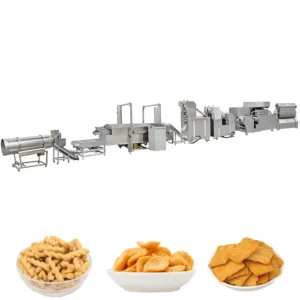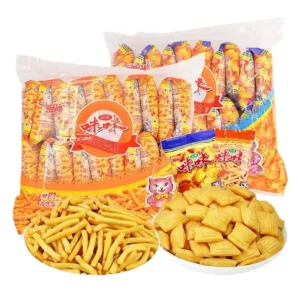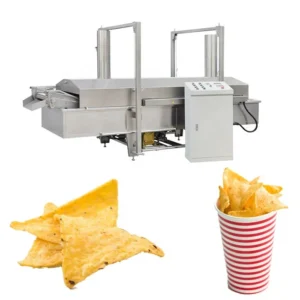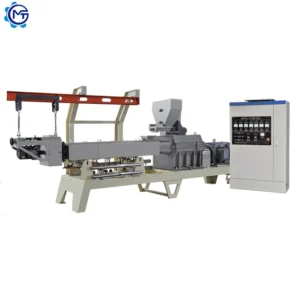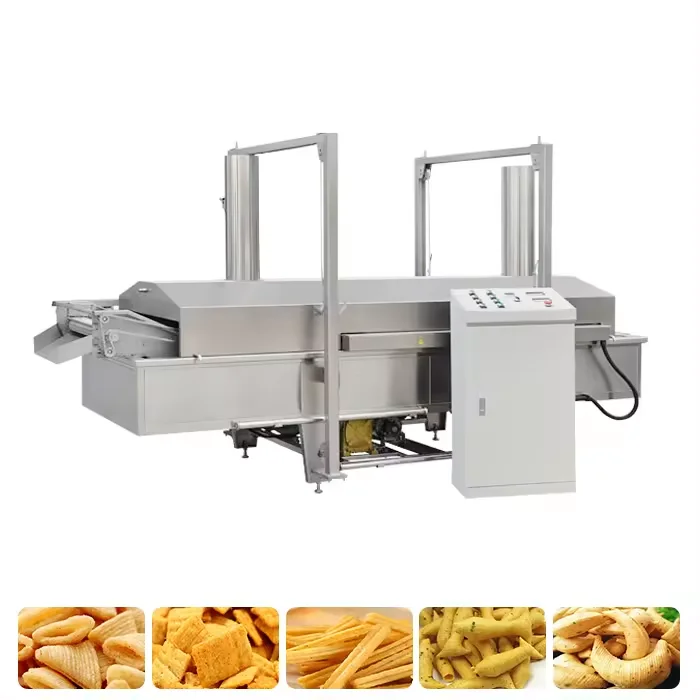
Integrated Line Throughput Matching — Every fryer station we quote is sized against the actual upstream extruder output and downstream cooling capacity, preventing bottleneck situations where one machine idles while another chokes.
Technical Specifications
| Parameter | Value |
|---|---|
| Product Type | Continuous Deep Fryer for Snack Food Production |
| Power Source | Electric / Gas (dual option) |
| Rated Power (Drive/Control) | 2.6 kW |
| Heating Tube Power (Electric Option) | 60 kW |
| Voltage & Frequency | 380V / 50Hz |
| Control System | PLC |
| Overall Dimensions (L×W×H) | 6700 × 2200 × 1200 mm |
| Net Weight | 2000 kg |
| Oil Capacity | 320 L |
| Output Capacity | 100–1000 kg/h (basis not stated in source — confirm product type, moisture content and pre-fry condition) |
| Conveyor Type | Upper and lower double-layer mesh belt with frequency conversion stepless speed regulation |
| Heating Method | Electricity heating / Gas heating |
| Construction Material | Food-grade 304 Stainless Steel |
| Oil Filtration | Automatic oil circulation filtration system |
| Slag Discharge | Bottom-mounted automatic slag discharge system |
| Lifting System | Automatic lifting of upper hood and mesh belt |
| Warranty | 1 Year |
| Assembly State | Fully assembled, skid-mounted |
Application Suitability
| Application | Material or Output |
|---|---|
| Crispy extruded chip production | Corn-based and potato-based extruded pellets fried to target crunch density |
| Fried corn snack processing | Formed corn dough pieces requiring uniform golden color and oil uptake |
| Salad bugles and triangle snacks | Thin-walled extruded shapes needing precise fry time to avoid breakage |
| Pellet-based puffed snack lines | 2D and 3D pellet snacks expanding through controlled oil immersion |
| Integrated snack line station | Positioned downstream of extruder and upstream of de-oiling and flavouring drums |
Why the Frying Station Can Make or Break Your Snack Line
A mismatched fryer turns a high-capacity extruder into an expensive holding pattern.
I spent years on the workshop floor assembling extruders before moving into technical sales, and the pattern is painfully consistent: a buyer specs a twin-screw extruder rated for several hundred kilograms per hour, then bolts on a fryer that simply cannot keep up. The extruder runs at full tilt, product piles up on intermediate conveyors, moisture drops, and the snack texture goes off-spec before it even reaches the oil [NEED_CITE: throughput matching principles in continuous food processing lines]. The Continuous Deep Fryer for Snack Food Production Line must be evaluated not as a standalone purchase but as a link in a chain where every station’s real-world throughput has been verified against the others.
Oil Management That Keeps Product Colour Consistent Across Shifts
Edible oil degrades with every hour of frying. Free fatty acids rise, smoke points drop, and the snack colour drifts from golden to brown well before the shift ends. The automatic oil circulation filtration system on this continuous deep fryer continuously pulls particulate and fine sediment out of the 320-litre oil bath, extending usable oil life and keeping product appearance within the tolerance buyers expect on supermarket shelves. Stepless speed regulation on the double-layer mesh belt lets operators dial in exact fry time without stopping the line.
Footprint and Utility Planning for Snack Line Integration
At 6,700 mm in length with a 2,200 mm width, this unit occupies a defined zone between the extruder discharge conveyor and the de-oiling or cooling station. The 60 kW electric heating option demands a dedicated circuit sized beyond the rated draw to accommodate inrush current [NEED_CITE: electrical load planning for industrial heating elements]. For workshops where gas supply is more economical or where local utility rates favour gas firing, the dual-option heating configuration allows the buyer to select the utility source that fits the facility, confirmed before production begins.
What the Specification Sheet Actually Means for Your Snack Output
The 304 stainless steel construction throughout the contact zone is not a cosmetic choice — acidic snack seasonings and salt-laden coatings accelerate corrosion on lower-grade alloys, and a fryer that pits after a few months of operation contaminates oil and product alike. The upper and lower double-layer mesh belt holds product submerged at a consistent depth, preventing the floating behaviour that causes uneven colouring in single-belt designs. Frequency-controlled stepless speed regulation means fry time adjusts in real time to recipe changes without mechanical gear swaps. The bottom-mounted automatic slag discharge removes carbonised crumbs that would otherwise accumulate, raise oil acidity, and create dark specks on finished chips.
The Hidden Cost of Under-Specifying the Frying Station
When fryer capacity falls short, operators compensate by running the mesh belt faster, which cuts fry time and leaves product undercooked in the centre — a texture failure that shows up as customer complaints rather than factory alarms. Undersized oil volume means temperature drops every time cold product enters the bath, and recovery time stretches the line into surge-and-wait cycles [NEED_CITE: oil temperature recovery in continuous frying operations]. Electrical panels specified for one voltage standard but shipped to a market running a different frequency face motor burnout on the conveyor drives within weeks of commissioning.
Why Buyers Source This Station Through MT
Line capacity calculations are matched station-by-station, so the Continuous Deep Fryer for Snack Food Production Line is never quoted in isolation from the extruder and seasoning drum it will sit between. Screw and die configurations on the upstream extruder are specified to the buyer’s actual raw material, which directly affects the moisture and density of product entering the fryer. An in-house testing workshop runs trial batches on customer-supplied raw material before shipment, catching throughput mismatches before they become on-site crises. Food-grade 304 stainless steel contact surfaces are standard across the build, not offered as a premium upgrade.
Documentation & Verification
- Line layout and capacity calculation confirming fryer throughput against upstream extruder output
- Machine specification sheet with voltage, frequency, and heating method locked to destination market
- Electrical schematic and control language confirmation before production starts
- Factory test record and machinery test report provided with shipment
- CE declaration of conformity for European market entry
Installation, Commissioning & Support
- Skid-mounted 2000 kg unit requires level concrete pad with drainage channel for oil overflow
- 60 kW electric heating demands dedicated three-phase circuit with appropriate breaker sizing
- Fully assembled delivery means no on-site welding; connect utilities and fill oil to begin commissioning
- PLC parameter setup includes fry temperature profile and belt speed recipes for each product SKU
- Automatic lifting hood and mesh belt simplify daily cleaning and periodic deep maintenance access
- Mesh belt sections and heating elements stocked as wear parts with documented replacement intervals
What We Need to Quote the Right Frying Station
Share the product type you are frying — whether extruded pellets, formed corn pieces, or sheeted chips — along with the moisture content and pre-fry condition of the product entering the oil bath. Confirm your workshop voltage and frequency, the heating source you prefer, and the language your operators will use on the PLC interface. If you already have upstream extruders or downstream flavouring drums in place, send their throughput data so the Continuous Deep Fryer for Snack Food Production Line can be matched precisely to your existing line speed.
Frequently Asked Questions
Q: How is frying capacity verified, and what product and moisture assumptions underlie the stated throughput range?
A: The stated range of 100–1000 kg/h depends entirely on product type, moisture content, and pre-fry condition. We verify real throughput by running trial batches on your actual raw material in the testing workshop before shipment, documenting oil temperature, belt speed, and product colour at each setting.
Q: What voltage and frequency configurations are available, and how is the control panel language set?
A: The standard configuration is 380V/50Hz, but the electrical system is confirmed against your destination market’s utility standard before production. PLC interface language is set during the specification confirmation stage to match your operator team’s requirements.
Q: How does the fryer integrate with upstream extruders and downstream cooling and flavouring stations?
A: Line layout and capacity calculation documents map the fryer’s position between extruder discharge and de-oiling or seasoning stations. Throughput at each station is matched so product flows continuously without intermediate buffering or starvation.
Q: What heating options are available, and how do they affect utility planning?
A: Electric heating at 60 kW and gas heating are both available. Electric requires a dedicated three-phase circuit with headroom for inrush current, while gas heating requires confirmed supply pressure and combustion air ventilation planning for the workshop zone.
Q: What spare wear parts are included, and what is the lead time for replacements?
A: Mesh belt sections, heating elements, and filtration components are documented in the wear parts list provided at shipment. Replacement lead times are confirmed during quotation so initial spares can be ordered alongside the machine if needed.