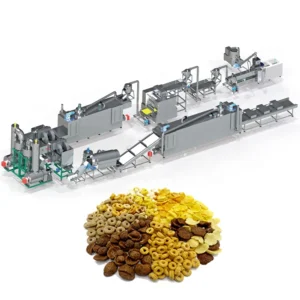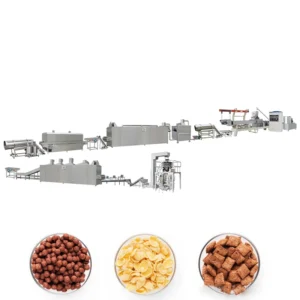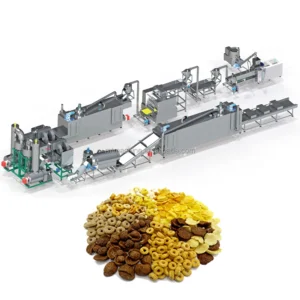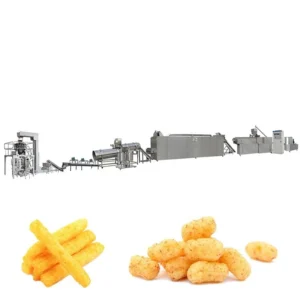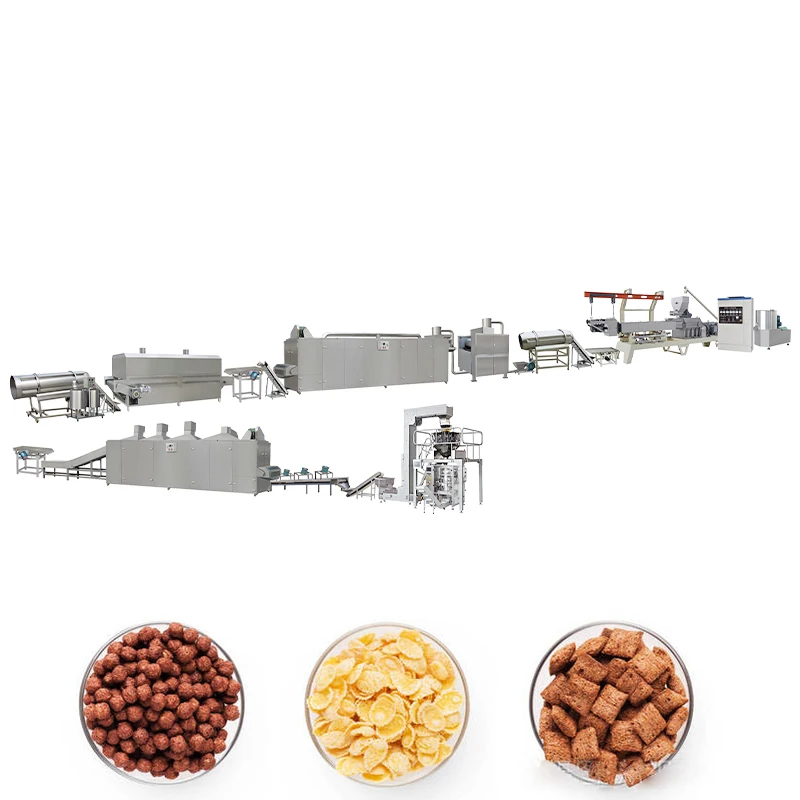
Throughput-Matched Stations — Every unit from the mixer to the packing conveyor is sized against the extruder’s actual output so no single station throttles the line.
Technical Specifications
| Parameter | Value |
|---|---|
| Model | MT70 / MT85 / MT75 |
| Product Type | Corn Flakes Production Line |
| Extruder Type | Twin Screw |
| Installed Power | MT70: 160 kW / MT85: 190 kW / MT75: 210 kW |
| Power Consumption | MT70: 120 kW / MT85: 140 kW / MT75: 150 kW |
| Capacity | MT70: 150–200 kg/h / MT85: 300–400 kg/h / MT75: 300–500 kg/h (basis not stated in source — confirm raw material, moisture and product format) |
| Overall Dimensions (L×W×H) | MT70: 41 × 1.5 × 2.2 m / MT85: 43 × 1.5 × 3.2 m / MT75: 45 × 1.5 × 3.5 m |
| Control System | PLC control for flaking machinery; MCC and PLC available for full line |
| Flaking Machinery | Hydraulic double-roller system; dual independent motors; infrared temperature monitoring |
| Dryer Heating Source | Gas or Electric (selectable) |
| Roasting Oven | Hot-air roasting with conciliation burner; dual circulating fans; cyclone dust removal; vibrating pan with high-temperature spraying tubes |
| Coating System | Double tumble melter, elevator, coating drum, spraying nozzle |
| Screw Material | Wear-resistant alloy (special treatment) |
| Lubrication | Automatic lubricating and cooling function |
| Assembly State | Complete turnkey production line |
| Standards | CE (since 2014), ISO |
Application Suitability
| Application | Material or Output |
|---|---|
| Natural corn flakes | Corn, rice, wheat, oat, and barley powder |
| Sugar-coated corn flakes | Corn grits with sugar coating via double tumble system |
| Shape-variant breakfast cereals | Ball, tube, stick, ring, fruit loop, star, wheel, flower, heart (by adjusting extruder die) |
| Puffed snacks (shared line) | Grain-based expanded snacks using same extrusion platform |
Why Matching Dryer Capacity to Extruder Output Matters More Than Peak Ratings
An undersized dryer silently caps your real output long before the extruder reaches its nameplate figure.
Buyers often compare extruders by installed power or hourly capacity, but when the dryer cannot evaporate moisture fast enough to keep pace, the entire corn flakes production line full equipment range slows to match the bottleneck. I have walked into plants where operators were deliberately starving the extruder because flakes were arriving at the dryer wetter than it could handle. The result is not just lost throughput — it is inconsistent flake texture, surface blistering that goes too far or not far enough, and shelf-life problems downstream. [NEED_CITE: moisture migration and shelf stability in toasted cereal products]
How Each Station Fits Into the Line Sequence
The mixing station feeds a batching system that controls ingredient ratios and moisture addition before material enters the twin-screw extruder. From there, extruded dough passes through the flaking machinery, where hydraulic pressure and infrared-monitored roller temperature determine flake thickness and surface quality. This corn flakes production line full equipment range continues through the dryer, where the choice between gas and electric heating depends on local utility costs and available infrastructure.
Where Throughput Matching Prevents Hidden Bottlenecks
The hot-air roasting oven uses dual circulating fans and a cyclone dust removal device to develop surface crispness without over-drying the interior. After roasting, the optional sugar coating station — with its double tumble melter, elevator, and spray-nozzle coating drum — must accept flakes at the same rate the roaster discharges them. If any station in this sequence runs slower than the one before it, material piles up, cools unevenly, and requires manual intervention. Throughput matching across every station is the reason a line rated at a given capacity can actually sustain it during continuous operation. [NEED_CITE: continuous line balancing principles in food extrusion]
Reading the Specs: What the Numbers Mean for Your Floor
The three extruder models — MT70, MT85, and MT75 — span distinct power and output bands. Installed power ranges from 160 kW to 210 kW, but power consumption during normal operation sits lower, between 120 kW and 150 kW, which matters for transformer sizing and running cost estimates. The twin-screw configuration allows the machine to handle a wider range of grain formulations and moisture levels than a single-screw alternative, giving producers flexibility when raw material supply varies. The hydraulic double-roller flaking system uses separate motors for each roller, so nip pressure and gap can be adjusted independently — this directly controls flake thickness, which in turn affects how the flake behaves in the roasting oven and ultimately how it feels in the bowl. The automatic lubricating and cooling function on the extruder gearbox reduces the chance of unplanned stops during long production runs, a factor that matters more as shift lengths increase.
What Happens When Voltage and Frequency Are Left Unspecified
When electrical parameters are not confirmed before production begins, the line arrives on site and cannot be powered. I spent years running installation projects across Latin America and later moved into technical support, and the most frustrating delays always came from this exact gap. One corn flakes line sat idle for weeks while the buyer arranged a transformer retrofit because the local grid frequency did not match the motor nameplate. That delay is not just lost production time — it is missed retail delivery windows, penalty clauses, and strained relationships with distributors. [NEED_CITE: voltage and frequency standards by export market] Every electrical schematic should carry confirmed voltage, phase, frequency, and control language before the machines leave the factory.
Why Source Every Station From One Supplier
When extruders, dryers, flakers, and roasters come from separate vendors, each one quotes capacity based on its own test conditions. The resulting mismatches are not visible until the line runs under real production loads. Sourcing the complete corn flakes production line full equipment range from a single supplier means the throughput calculation is performed once, against the same raw material assumptions, for every station. The screw configuration and die design are specified to the buyer’s grain formulation and target flake density rather than copied from a generic build. An in-house testing workshop allows trial runs on the buyer’s actual raw material before the machines ship, so product development starts from a known baseline rather than from the factory floor on day one. Pre-sales engineering covers line layout, utility planning, and phased installation scheduling, and that support continues through commissioning, operator training, and ongoing wear-parts supply.
Documentation & Verification
- Line layout with throughput calculation across every station from mixer to packer
- Machine specification sheet with screw and die configuration matched to your grain formulation
- Electrical schematic confirming voltage, frequency, phase, and control language for your market
- Factory test record and trial run report on your raw material before shipment
- CE declaration of conformity and ISO certificate
- Operation and maintenance manual with wear-parts list and replacement intervals
Installation, Commissioning & Support
- Foundation and floor plan based on the selected model’s footprint (up to 45 m line length)
- Dedicated power circuit sized to the extruder’s installed power (up to 210 kW) plus dryer and roaster loads
- Arrival condition: modular stations shipped separately, assembled and aligned on site
- First-run parameter setting: screw speed, barrel temperature profile, roller gap, and dryer dwell time
- Operator training covering PLC interface, flaking adjustment, and roasting oven fan balance
- Wear-parts kit including replacement screws, dies, and roller surfaces for initial operating period
What to Include With Your Inquiry
To configure a line that actually holds its rated output on your floor, share the grain type and particle size you plan to run, your target daily production volume, and the available workshop length and ceiling height. Confirm the local voltage, phase, and frequency, as well as the preferred control language for the PLC interface. If you already have upstream storage or downstream packing equipment, specify the connection points so the layout accounts for them.
Frequently Asked Questions
Q: How is the hourly capacity figure determined, and what conditions does it assume?
A: The published capacity values for each model assume specific raw material types, moisture content, and product format. Because grain variety and target flake thickness change the actual output, we calculate line capacity against your confirmed formulation during the proposal stage and validate it with a trial run on your material before the machines ship.
Q: What electrical parameters need to be confirmed before the line is built?
A: Voltage, phase, frequency, and control language must all be locked in before production begins. We issue an electrical schematic for your approval so that motor ratings, heating element specifications, and PLC interface language match your facility’s actual supply and operator requirements.
Q: How do I make sure the dryer and roaster keep up with the extruder I choose?
A: Each supporting station is sized against the extruder’s confirmed output during the line configuration stage. The throughput calculation accounts for moisture removal in the dryer and dwell time in the roasting oven, so no station becomes a bottleneck under continuous running conditions.
Q: Which extruder model fits my target output and available floor space?
A: The MT70 suits lower output targets and shorter workshops, while the MT85 and MT75 cover higher capacity bands with proportionally larger footprints. Selection depends on your confirmed daily volume, grain formulation, and available line length — all of which we evaluate together during the proposal phase.
Q: Can the same line produce both natural and sugar-coated corn flakes?
A: Yes. The sugar coating station — double tumble melter, elevator, coating drum, and spray nozzle — is an optional addition to the base line. When coating is not required, flakes bypass that section and proceed directly from the roasting oven to cooling and packing.