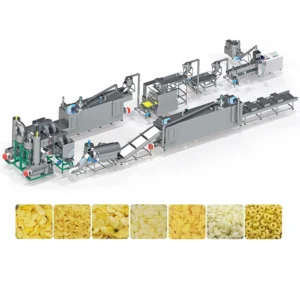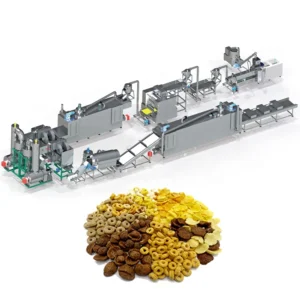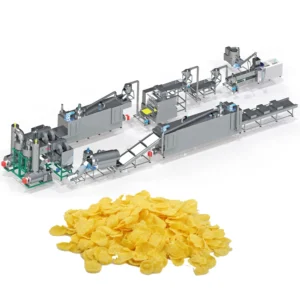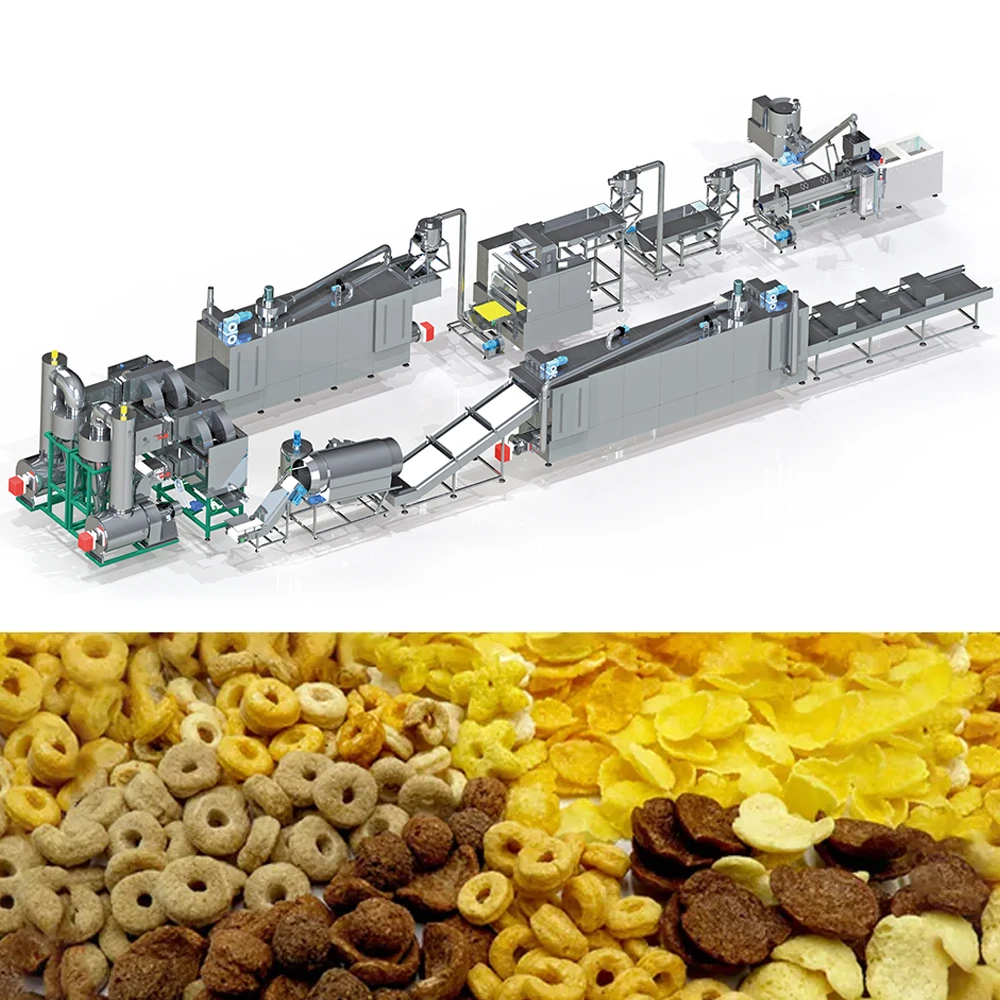
Matched Throughput Stations — every machine from the mixer to the packing scale is sized against the extruder’s real output, so one station never caps the rest of the corn flakes line.
Technical Specifications
| Parameter | Value |
|---|---|
| Product Type | Corn Flakes Production Line |
| Model | MT70 / MT85 / MT75 |
| Extruder Type | Twin-screw |
| Installed Power | 160 kW (MT70) / 190 kW (MT85) / 210 kW (MT75) |
| Power Consumption | 120 kW (MT70) / 140 kW (MT85) / 150 kW (MT75) |
| Output Capacity | 150–200 kg/h (MT70) / 300–400 kg/h (MT85) / 300–500 kg/h (MT75) (basis not stated in source — confirm raw material and moisture content) |
| Overall Dimensions (L×W×H) | 41 × 1.5 × 2.2 m (MT70) / 43 × 1.5 × 3.2 m (MT85) / 45 × 1.5 × 3.5 m (MT75) |
| Control System | PLC (flaking machinery) / MCC (line-level) |
| Heating Source (Dryer) | Gas or electric, configurable |
| Flaking Drive | Double motors with separate roller drive; hydraulic system |
| Flaking Temperature Control | Infrared sensor for even temperature pipe regulation |
| Roasting Oven Features | Hot air, vibrating pan, dual circulating fans, cyclone dust removal, conciliation burner |
| Coating System | Double tumble sugar melting, elevator, coating drum, spraying nozzle |
| Lubrication | Automatic lubricating and cooling |
| Voltage & Frequency | Customizable; common configurations include 415 V / 50–60 Hz, 440 V / 50–60 Hz, 220 V / 60 Hz |
| Final Product Shapes | Ball, tube, stick, ring, fruit loop, star, wheel, flower, heart (via die change) |
| Raw Materials | Corn, rice, wheat, oat, barley powder |
| Certification | CE, ISO |
Application Suitability
| Application | Material or Output |
|---|---|
| Natural corn flakes for breakfast cereal retail | Corn grits or corn flour, toasted without sugar coating |
| Sugar-coated corn flakes for mass-market packaging | Corn base with sugar tumble coating and drying |
| Multi-grain breakfast flakes | Blends of rice, wheat, oat and barley with corn |
| Extruded cereal shapes for snack or children’s cereal lines | Corn or rice flour formed into rings, fruit loops, stars, wheels via die swap |
| Fortified breakfast cereals for institutional nutrition programmes | Grain base with added vitamin-mineral premix in the batching stage |
Why Matching the Dryer to the Extruder Matters More Than the Extruder Itself
A corn flakes machine full equipment range that pairs a high-output extruder with an undersized dryer will never reach its quoted capacity.
Buyers often focus their evaluation on the extruder — screw diameter, motor power, barrel zones — and treat the downstream dryer and roaster as commodity add-ons. The problem surfaces on day one of production: the extruder pushes out a steady stream of half-formed flakes, but the dryer cannot remove moisture fast enough, and the line slows to match the dryer’s throughput. Operators then dial back the extruder feed rate, and the entire corn flakes machine full equipment range runs below what the buyer paid for [NEED_CITE: throughput bottleneck analysis in extruded cereal lines]. Sizing every station against the extruder’s real output on the buyer’s actual raw material is the only way to prevent this.
How Each Station Fits Into the Complete Line
A corn flakes production line moves through distinct stages — batching and mixing, twin-screw extrusion, flaking, drying, hot air roasting, cooling and packing — and each station has a different throughput characteristic. The mixer must prepare batches fast enough to keep the extruder hopper full without letting dough rest beyond its usable window. The extruder cooks and shapes the material, and its output sets the pace for everything downstream.
The flaking station uses a hydraulic double-roller system with separate motor drives to press extruded pellets into uniform flakes. Infrared-sensor temperature control keeps the roller surface within a narrow band so flake thickness stays consistent across the full production run. After flaking, the product moves into a dryer sized to handle the moisture load that the specific grain formulation releases at that throughput rate.
The Roasting and Coating Stages Where Quality Is Won or Lost
Natural corn flakes go from the dryer into a hot air roasting oven equipped with a vibrating pan, high-temperature spraying tubes and two separate circulating fans. The cyclone dust removal device captures fines before they can scorch or contaminate the batch. A conciliation burner maintains steady roasting temperature, which directly controls flake colour, crispness and bowl-life [NEED_CITE: roasting temperature profiles and corn flake texture outcomes].
For sugar-coated variants, the line adds a coating system with a double tumble for sugar melting, a bucket elevator, a rotating coating drum and precision spraying nozzles. The tumble melts sugar evenly before it reaches the drum, preventing clumping on the flake surface. Throughput through the coater must match the roaster output — if sugar-coated flakes pile up faster than the coater can process them, the product cools below the sugar adhesion temperature and coating coverage becomes patchy.
Reading the Specs: What the Numbers Mean on the Floor
The three extruder models — MT70, MT85 and MT75 — span different capacity bands, but installed power alone does not tell the full story. The MT70 draws 160 kW installed and runs at roughly 120 kW consumption, suited to smaller operations or pilot-scale breakfast cereal runs. The MT75 at 210 kW installed handles higher volume but also requires more floor space at 45 m in total line length, meaning a longer building envelope and more material handling between stations.
The twin-screw design across all models matters for grain formulations with varying starch and fibre content. A single screw struggles with high-fibre blends such as oat or barley mixes because the material does not feed evenly; the intermeshing screws of a twin-screw configuration force-feed the dough through the barrel regardless of stickiness or fibre load. Automatic lubricating and cooling on the gearbox allows the extruder to run extended shifts without manual lubrication stops, which protects both screw life and batch consistency. The flaking machinery’s hydraulic roller system lets operators adjust gap pressure from the control panel rather than shimming rollers manually — a detail that cuts flake thickness variation across a long production day.
The Hidden Cost of Buying Stations From Separate Vendors
When a buyer sources the extruder from one supplier and the dryer, roaster and coater from others, no single party is responsible for line throughput. The extruder vendor quotes capacity based on their machine alone, and the dryer vendor does the same. When the assembled line underperforms, each vendor points to the other’s equipment as the constraint [NEED_CITE: multi-vendor line integration disputes in food processing]. The buyer absorbs the cost of rework — resizing ductwork, adding conveyor sections, replacing a dryer that cannot keep up — and the line sits idle through weeks of troubleshooting that one integrated supplier would have resolved at the layout stage.
What Sourcing From One Supplier Actually Changes
Every station in this corn flakes line is specified against the others before it is built. The dryer’s evaporation rate is calculated from the extruder’s output on the buyer’s stated raw material, not from a generic moisture figure. The flaking mill’s roller width is matched to the extruder die plate so that flake throughput does not bottleneck at the press.
The in-house testing workshop runs trial batches on the buyer’s actual grain formulation before the line ships, verifying that screw configuration, barrel temperature profile and die geometry produce the target flake density. PLC control on the flaking machinery integrates with MCC line-level control so that one operator can monitor the entire sequence. CE and ISO certification applies across the line, not just the extruder, which simplifies compliance documentation for import markets [NEED_CITE: CE machinery directive requirements for food processing equipment]. Engineering support covers layout design, installation supervision, commissioning and operator training under one scope of work.
Documentation & Verification
- Line layout and capacity calculation showing throughput matched across every station
- Machine specification sheet with screw and die configuration matched to your grain formulation
- Electrical schematic with voltage and frequency confirmed for your local grid standard
- Trial run report on your raw material from the in-house testing workshop before dispatch
- Factory test record covering all stations running together at target throughput
- Wear parts list identifying screws, dies and flaking rollers with first-replacement intervals
Installation, Commissioning & Support
- Foundation must support line footprint up to 45 m length with level concrete pad and drainage channels near the roasting oven
- Dedicated electrical supply sized to the selected model’s installed power — up to 210 kW for the MT75 — with confirmed voltage and frequency before wiring
- Extruder barrel and screw assemblies shipped in protective crating and aligned on-site during commissioning
- First-run parameter setting includes barrel zone temperatures, screw speed and flaking roller gap tuned to your raw material
- Operator training covers PLC interface navigation, hydraulic roller adjustment and emergency stop sequences across all stations
- Spare screws, dies and flaking rollers identified in the wear parts list with stocking guidance for the first replacement cycle
What to Include in Your Inquiry
To configure a corn flakes line that holds its rated throughput, share your raw material specification including grain type, particle size and moisture content, your target daily output in finished product weight, and your workshop length and ceiling height. Confirm the local voltage and frequency at your facility so that motors and control panels ship pre-configured. If you plan to run both natural and sugar-coated flakes, note that upfront so the coating stations are included in the initial layout rather than retrofitted later.
Frequently Asked Questions
Q: How is line capacity verified against my specific raw material and moisture content?
A: Capacity figures for each extruder model are based on test conditions that may differ from your formulation. Before the line ships, a trial run is conducted in the testing workshop using your actual grain mix to verify extrusion behaviour, flake density and dryer throughput. The results are documented in a trial run report that confirms real output under your conditions.
Q: Which voltage and frequency configurations are available for my target market?
A: The line is configurable to common industrial standards including 415 V / 50–60 Hz, 440 V / 50–60 Hz and 220 V / 60 Hz. Motors, heaters and control panels are all wound or set to the confirmed specification before assembly. Voltage and frequency must be locked in before the electrical schematic is finalized.
Q: How do I choose between natural and coated corn flakes line configurations?
A: Natural flakes require the dryer and roasting oven stages only. Coated flakes add a sugar melting tumble, coating drum and spraying system downstream of the roaster. If you plan to produce both types, the line can be configured with a bypass conveyor so natural flakes skip the coating stations without stopping the roaster.
Q: What supporting equipment is included and how is throughput matched between stations?
A: The line covers mixing, extruding, flaking, drying, roasting, cooling and packing stations, plus sugar coating when specified. Each station is sized during the layout phase so that its throughput capacity equals or slightly exceeds the extruder’s verified output on your raw material, preventing any single station from capping the line.
Q: What spare wear parts are supplied and when is the first replacement due?
A: The wear parts list covers extruder screws and die plates, flaking rollers and spray nozzles. First replacement timing depends on the abrasiveness of your grain mix and the number of production hours per shift. The list includes estimated intervals from the trial run so you can stock spares before the first changeover is needed.