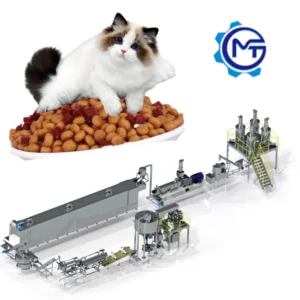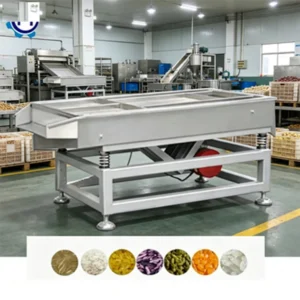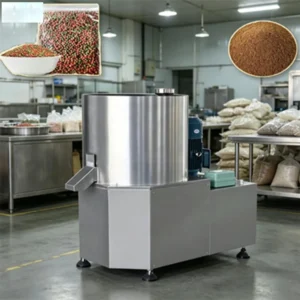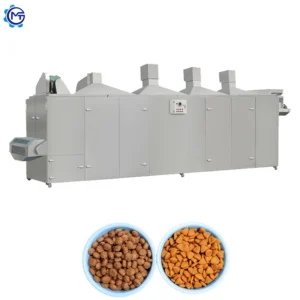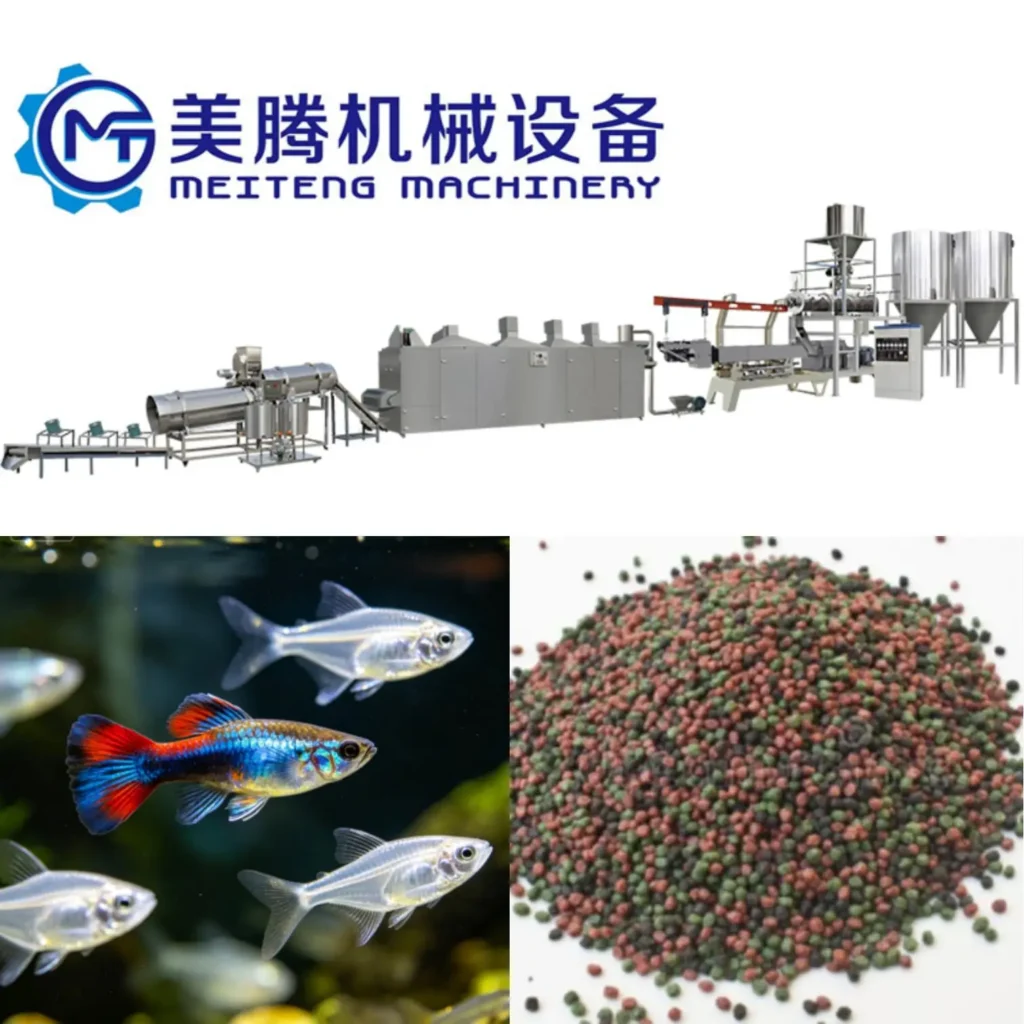
Throughput-Matched Stations — Every unit from the batching hopper to the packing scale is sized against the extruder’s actual output, so no single station chokes the line.
Technical Specifications
| Parameter | Value |
|---|---|
| Product Type | Twin Screw Fish Feed Extrusion Line |
| Output Capacity | 200–300 kg/h (basis not stated in source — confirm raw material formulation, moisture content and pellet diameter before quoting) |
| Screw Type | Twin-screw |
| Construction Material | 304 stainless steel (food-contact parts) |
| Control System | PLC and MCC control |
| Line Stations | Batching, mixing, extrusion, drying, flavouring/coating, cooling, packing |
| Die Configuration | Matched to target pellet size and density (floating or sinking) |
| Screw Configuration | Specified to buyer’s raw material and target product |
| Assembly State | Complete line with supporting equipment |
| Voltage & Frequency | Configurable per buyer’s site requirement (source value — verify against manufacturer catalog) |
| Trial Run | In-house testing on customer raw material before shipment |
| Standards | CE, ISO |
Application Suitability
| Application | Material or Output |
|---|---|
| Floating pellets for tilapia and catfish | High-starch formulations with controlled expansion for buoyancy |
| Sinking pellets for trout and salmon | High-protein, high-fat formulations with dense pellet structure |
| Shrimp feed pellets | Fine-grind raw materials requiring uniform diameter and water stability |
| Species-specific aquaculture diets | Custom formulations with vitamin and mineral premixes |
Why "200–300 kg/h" Means Nothing Without the Raw Material Story
Capacity is only real when it is tied to a specific formulation, moisture level, and pellet diameter.
I have walked through workshops where a twin screw fish feed extruder for sale was purchased on a headline number alone. The buyer’s recipe carried a protein load the generic screw profile could not push through, and actual output fell to roughly half the quoted figure. The dryer downstream was sized for the nameplate rate, so it ran half-empty while the extruder bottlenecked the entire shift [NEED_CITE: mismatch between extruder nameplate capacity and real-world high-protein aquatic feed formulations].
How Screw Geometry Dictates What You Can Actually Run
The twin-screw configuration gives operators a wide window to adjust shear, residence time and pressure along the barrel. For a fish feed extrusion machine manufacturer, the job starts with the buyer’s recipe: the protein-to-starch ratio, fat content and target moisture all decide which screw elements go where. Conveying segments, kneading blocks and reverse-flight sections are arranged in a sequence that matches the formulation, not copied from a catalogue default.
Die Design and the Floating-versus-Sinking Question
Whether a pellet floats or sinks is settled at the die face. The number of die holes, their diameter and the land length control the pressure drop and expansion rate as dough exits the barrel. A high-expansion die produces low-density floating pellets for surface-feeding species, while a restricted die holds pressure in and yields the dense, slow-sinking pellets that bottom-feeders require. Getting this wrong means reformulating the recipe to compensate — an expensive workaround that still leaves texture outside specification [NEED_CITE: relationship between die land length and pellet density in aquatic feed extrusion].
Reading the Specs That Actually Matter on the Floor
Twin-screw extrusion relies on intermeshing screw flights to create positive conveying and self-wiping action, which keeps high-fat and high-protein doughs moving without dead zones. The 304 stainless steel contact surfaces resist corrosion from fish meal, shrimp meal and marine oils that would pit carbon steel within a season. PLC and MCC control allows operators to store barrel temperature profiles and screw-speed recipes per formulation, reducing changeover variance between floating and sinking runs. Voltage and frequency must be confirmed before the motor windings are wound; a 50 Hz motor shipped to a 60 Hz site will run at the wrong base speed and throw off every downstream timing calculation.
What Happens When the Dryer Is Sized to the Wrong Number
If the extruder delivers less than the dryer expects, the belt runs with a thin product bed and over-dries the pellets, cracking them and generating fines that the coating drum cannot pick up evenly. If the extruder somehow exceeds the dryer’s evaporation capacity, pellets exit with excess moisture, inviting mould growth inside the bag within weeks. Either mismatch traces back to a capacity figure that was never validated against the buyer’s actual raw material [NEED_CITE: consequences of throughput mismatch between extruder and dryer in feed pellet lines].
Why Procurement Stops Here Instead of Spreading Across Vendors
Sourcing a fish feed extrusion machine manufacturer that supplies the full line — batching through packing — means every conveyor width, dryer belt length and coating drum volume is calculated against the same verified throughput. Screw and die configurations are documented against the buyer’s specific formulation, not left as a generic build. An in-house testing workshop runs the buyer’s raw material through the assembled extruder before shipment, producing a trial report that confirms actual output and pellet quality. CE and ISO documentation ships with the line, and electrical schematics reflect the confirmed voltage and frequency rather than a factory default.
Documentation & Verification
- Line layout drawing showing station-by-station throughput calculations for your target pellet diameter
- Screw element arrangement and die specification record matched to your raw material formulation
- Trial run report produced on your raw material in the testing workshop before dispatch
- Electrical schematic confirming voltage, frequency and control language for your site
- Factory acceptance test record covering PLC program logic and safety interlocks
- CE declaration of conformity and ISO certificate covering manufacturing processes
Installation, Commissioning & Support
- Foundation plan accounts for extruder vibration isolation and dryer exhaust ducting requirements
- Dedicated power circuit sized for the combined motor load of extruder, dryer and cooling fans
- Modular frame sections arrive bolted for on-site alignment of the full batching-to-packing line
- PLC program uploaded and tuned against your first production batch of floating or sinking pellets
- Operator training covers screw-speed and barrel-temperature recipe storage for each formulation
- Wear parts list identifies screw flights, die inserts and dryer belt sections for first reorder
Before You Send the Inquiry
To size the line correctly, we need your target species and whether you run floating, sinking or both pellet types. Share your raw material formulation — protein source, starch base, fat level and any premixes — along with the pellet diameter range you sell into. Confirm your site voltage, frequency and preferred control language, and let us know if you can send a sample batch for a pre-shipment trial run.
Frequently Asked Questions
Q: How is the 200–300 kg/h capacity verified, and on which raw material formulation?
A: That range is a starting reference. We confirm real throughput by running your specific formulation — including protein level, starch source and moisture content — through the extruder in our testing workshop. The trial report documents actual output at your target pellet diameter, so the number you see on paper matches what the line delivers on your floor.
Q: Which line stations are included, and how is throughput matched across them?
A: The line covers batching, mixing, extrusion, drying, flavouring or coating, cooling and packing. Each station is sized so the dryer belt, coating drum volume and cooler capacity all handle the verified extruder output without over- or under-loading, preventing the bottlenecks that appear when equipment comes from separate vendors.
Q: What screw and die configuration will be specified for my raw material?
A: We build the screw profile — conveying segments, kneading blocks and reverse elements — around your recipe’s protein-to-starch ratio and fat content. The die plate is selected for your target pellet diameter and density, whether you need high-expansion floating feed or slow-sinking pellets for bottom-feeding species.
Q: Can a trial run be done on my raw material before shipment?
A: Yes. Send a batch of your actual formulation to our testing workshop. We run it through the configured extruder, record output rate, pellet density, expansion ratio and surface quality, and provide a full trial report before the line is crated for dispatch.
Q: What voltage, frequency and control language will be confirmed before production?
A: We verify your site’s electrical supply — voltage and frequency — before the motor and transformer are ordered, and we set the PLC interface language to your operators’ preference. The electrical schematic in your documentation package reflects these confirmed values, not a generic factory default.