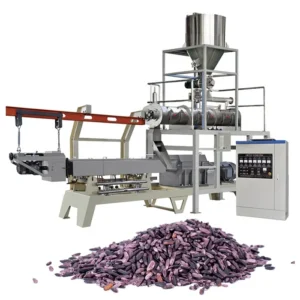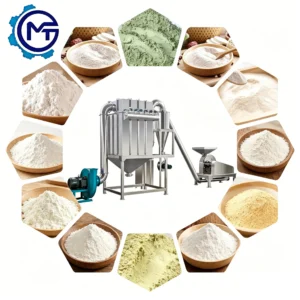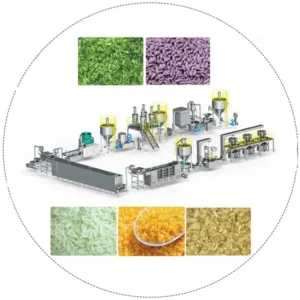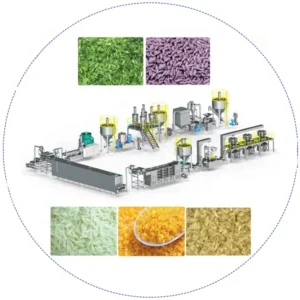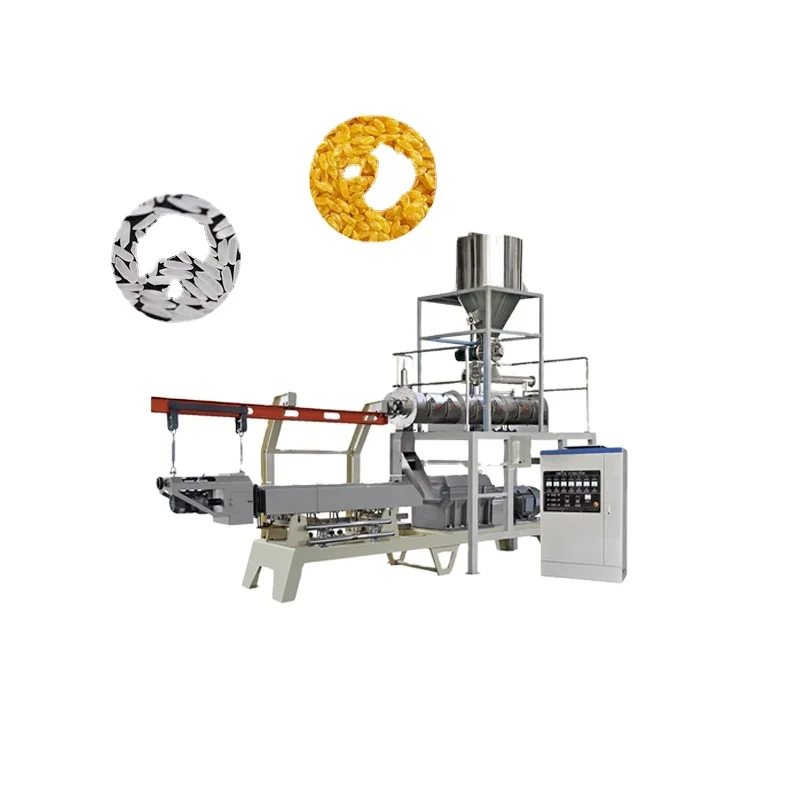
Matched Throughput Across Every Station — each machine from the batching system to the packing line is sized so the extruder never waits on a dryer or cooler, preventing the kind of bottleneck that stalls commissioning.
Technical Specifications
| Parameter | Value |
|---|---|
| Model | MT65 / MT70 / MT85 / MT75 / MT95 |
| Product Type | Fortified Rice Kernel Extrusion Line |
| Screw Type | Twin-screw |
| Installed Power | 85 kW (MT65) / 120 kW (MT70) / 235 kW (MT85) / 180 kW (MT75) / 260 kW (MT95) |
| Power Consumption | 60 kW (MT65) / 85 kW (MT70) / 165 kW (MT85) / 135 kW (MT75) / 195 kW (MT95) |
| Output Capacity | 80–100 kg/h (MT65) / 100–120 kg/h (MT70) / 200–300 kg/h (MT85) / 300–500 kg/h (MT75) / 800–1000 kg/h (MT95) (basis not stated in source — confirm raw material formulation / moisture content / pellet size) |
| Overall Dimensions (L×W×H) | 28×1.2×2.2 m (MT65) / 30×1.5×2.2 m (MT70) / 34×3.5×4.3 m (MT85) / 32×3.5×4.3 m (MT75) / 36×3.5×4.3 m (MT95) |
| Control System | Frequency speed control with high automation; PLC and MCC available per configuration |
| Feeding System | Single or double screw feeding system selected according to material characteristics |
| Screw Material | Special wear-resistant alloy |
| Lubrication & Cooling | Automatic lubricating and cooling system |
| Line Stations | Mixing → Extruding → Vibrating → Low-temperature Drying → Cooling → High-temperature Roasting → Cooling → Packing |
| Dryer Heating Source | Electric or gas |
| Dryer Feature | Circulation drying process with frequency motor-controlled mesh belt speed |
| Assembly State | Complete turnkey line |
| Certification | CE, ISO |
Application Suitability
| Application | Material or Output |
|---|---|
| Fortified rice kernel (FRK) production | Broken rice blended with vitamin and mineral premix |
| Artificial rice from alternative grains | Corn, millet, wheat, oats, buckwheat with starch binder |
| Nutritional rice for feeding programmes | Bean and cereal base with micronutrient fortification |
| Instant rice and quick-cook formats | Starch-rich formulations requiring controlled gelatinisation |
What "Rated Capacity" Leaves Out About Your Fortified Rice Line
A line quoted on nominal output that cannot sustain it on your actual grain blend is not a production line — it is a commissioning problem.
I have watched a Southeast Asian plant lose two full days clearing a stalled extruder barrel because the batching scale was feeding faster than the twin-screw could process the mix. The motor tripped, the chamber packed solid, and the entire Fortified Rice Kernel Extrusion Line sat idle while operators dug out hardened starch. The rated capacity number on the quotation meant nothing once the real formulation hit the screws [NEED_CITE: throughput matching between batching and extrusion stations]. That is the reason every station on this line is catalogued with its own throughput envelope, so the dryer, the cooler, and the roaster each match the extruder rather than choke it.
Every Station in the Catalogue and Where It Sits
The Fortified Rice Kernel Extrusion Line follows a fixed sequence: mixing, extruding, vibrating, low-temperature drying, cooling, high-temperature roasting, a second cooling pass, and packing. Each station appears here with its role so buyers can see the complete machine list before specifying a project. The vibrating screen after extrusion removes fines and oversized pieces before they enter the dryer, protecting belt loading consistency.
How the Dryer and Roaster Are Sized to the Extruder
Drying and roasting together account for the longest residence time on the line. The circulation dryer uses a frequency-controlled mesh belt, so belt speed adjusts to the moisture drop required by your specific formulation. Electric or gas heating is available depending on local utility cost. If the dryer cannot remove moisture as fast as the extruder produces it, kernels pile up on the belt and deform under their own weight — a problem that only shows up once the line is running at full feed rate [NEED_CITE: drying capacity calculation for extruded rice kernels].
Reading the Screw and Power Figures for Real Output
The twin-screw design handles high-starch blends that would stall a single-screw barrel. Installed power ranges from 85 kW on the MT65 to 260 kW on the MT95, with running consumption roughly 70–75 % of installed figures across the range. The wear-resistant alloy screws resist the abrasive effect of mineral premix particles, which accelerates wear on standard steel flights. Automatic lubrication and cooling keeps barrel temperature stable during long production runs, reducing the risk of premature gelatinisation inside the chamber. The single or double screw feeder is chosen based on whether your premix is free-flowing or tends to bridge in the hopper.
The Hidden Cost of Mismatched Station Capacity
When a line is assembled from separate vendors, the extruder supplier quotes one capacity and the dryer supplier quotes another, and nobody owns the gap between them. The result is a plant that runs at a fraction of the paid-for output while operators constantly adjust belt speeds and oven temperatures to keep up. Kernels exit the dryer with uneven moisture, cracking during roasting or turning brittle in storage [NEED_CITE: moisture uniformity requirements for shelf-stable rice kernels]. These losses accumulate quietly and are rarely traced back to the original equipment mismatch.
Why Buyers Specify This Line From a Single Catalogue
Every station is engineered under one supplier, so throughput calculations cover the full sequence rather than individual machines. Screw configuration and die design are matched to the buyer’s grain blend and kernel shape before production starts. The in-house testing workshop runs trial batches on customer-supplied raw material, confirming texture and density before the line ships. Voltage, frequency, and control language are confirmed at the quotation stage, so the MCC and PLC panels arrive ready for the local electrical grid. Documentation covers the complete line, not individual machines from different sources.
Documentation & Verification
- Line layout and capacity calculation showing matched throughput across all eight stations
- Screw and die configuration record written for your grain and premix formulation
- Electrical schematic with voltage and frequency confirmed against your local utility
- Factory test record from trial runs on customer-supplied raw material before dispatch
- CE declaration of conformity and ISO certificate for the complete line
- Wear parts list identifying screws, dies, and mesh belt sections with replacement intervals
Installation, Commissioning & Support
- Overall footprint up to 36 m in length requires a clear bay with level concrete floor and anchor points
- Total installed power up to 260 kW on the MT95 demands a dedicated transformer circuit with soft-start capability
- Line ships in sectional modules for container loading, with reassembly supervised on site
- First-run commissioning includes screw speed, barrel temperature, and dryer belt speed calibration
- Operator training covers feeder adjustment for different premix flow characteristics
- Wear parts stock covers replacement screws, die plates, and dryer belt sections for initial service interval
What to Share With Your Inquiry
Send the grain or starch base you plan to use, the vitamin and mineral premix ratio, and the kernel size you need the market to accept. Include your local voltage and frequency so the MCC and PLC panels can be built to match. If you have an existing packing system upstream or downstream, share its speed and interface so the line throughput can be aligned before the layout is drawn.
Frequently Asked Questions
Q: Which extruder model fits my target output and raw material formulation?
A: The range covers five models from the MT65 to the MT95, with output spanning small pilot batches to continuous high-volume production. The correct model depends on your grain blend, premix loading, and kernel size, all of which affect actual throughput. A trial run in the testing workshop confirms which model holds your target rate on your specific formulation before the order is finalised.
Q: How are the supporting stations sized to avoid bottlenecking the extruder?
A: Dryer belt length, roaster chamber volume, and cooler airflow are each calculated against the extruder’s maximum feed rate for your product. The circulation dryer uses a variable-speed mesh belt so residence time can be tuned during commissioning. This matching is documented in the line layout and capacity calculation provided with the quotation.
Q: What utility requirements should I confirm before ordering?
A: Voltage, frequency, and available gas supply for the dryer all need confirmation so the electrical panels and heating system are built correctly. The MT95 at 260 kW installed power may require a dedicated transformer. Control language for the PLC and HMI is also set at this stage to avoid delays when the line arrives on site.
Q: Can individual stations be purchased separately or only as a complete line?
A: Individual machines such as the dryer or roaster can be supplied to integrate with existing equipment, provided throughput and interface dimensions are confirmed first. Most buyers choose the full sequence to ensure matched capacity across every station and a single source for documentation and commissioning support.
Q: What test records are provided before the line ships?
A: The testing workshop runs your raw material through the configured extruder and dryer, producing a trial run report that documents kernel density, moisture content after drying, and throughput achieved. This report, along with the factory test record, ships with the line so you have a verified baseline for commissioning.