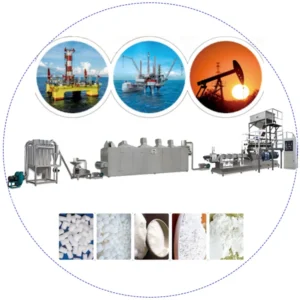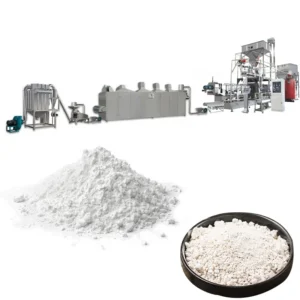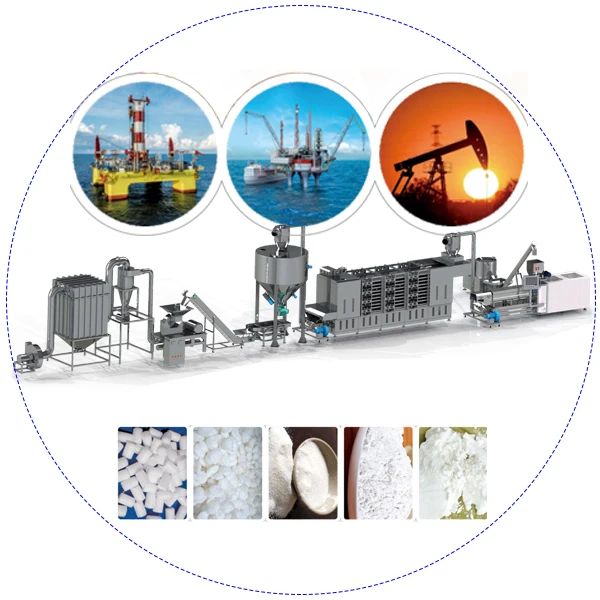
Throughput Matching Across Every Station — a modified starch line where mixing, extrusion, drying, and grinding capacities are calculated together so wet product never backs up at the die.
Technical Specifications
| Parameter | Value |
|---|---|
| Product Type | Modified Starch Processing Line |
| Screw Type | Twin screw |
| Raw Materials | Wheat flour, corn starch, potato starch |
| Output Capacity | 80–500 kg/h (basis not stated in source — confirm raw material type, moisture content and target starch specification) |
| Mixer Motor Power | 4.0 kW |
| Mixer Batch Output | 3.0–4.0 kg per batch |
| Screw Conveyor Motor Power | 1.1 kW |
| Screw Conveyor Output | 0–150 kg/h |
| Frame Material | Stainless steel 201 |
| Contact Parts Material | Food grade stainless steel 304 |
| Voltage & Frequency | Three phase 380V/50Hz or single phase 220V/50Hz (configurable) |
| Energy Source Options | Electricity, gas, diesel, or steam |
| Motor Brand | Siemens (China) or equivalent; Delixi or Delta inverter |
| Control System | PLC and MCC |
| Process Flow | Mixer → Screw Conveyor → Twin Screw Extruder → Air Conveyor → Dryer → Air Conveyor → Conditioning → Conveyor → Grinder |
| Die Configuration | Interchangeable dies for different product forms |
| Standards | CE |
Application Suitability
| Application | Material or Output |
|---|---|
| Pregelatinized starch for instant food blending | Corn starch or wheat flour at controlled gelatinization degree |
| Modified starch for paper and textile sizing | Potato starch or corn starch with targeted viscosity profile |
| Industrial adhesive starch raw material | Wheat flour processed for specific functional properties |
| Nutritional powder and infant formula ingredient | Food-grade pregelatinized starch from corn or potato base |
Why "80 to 500 kg/h" Means Nothing Without the Raw Material
Capacity numbers on a modified starch processing line only hold when tied to a specific starch type, moisture content, and target gelatinization degree.
I once watched a buyer pair a twin-screw extruder with an undersized belt dryer sourced separately. The wet gelatinized starch backed up at the die within hours. Three days of on-site rework followed just to rebalance throughput across the line. When a modified starch processing line manufacturer quotes output without stating the raw material basis, that number is a ceiling the line will rarely reach on your actual formulation [NEED_CITE: starch gelatinization energy requirements by raw material type]. Different starches demand different shear profiles, barrel temperature zones, and drying residence times — a line tuned for corn starch may underperform on potato starch at the same screw speed.
Screw Configuration Determines Gelatinization, Not Just Output
The twin-screw extruder in this modified starch processing line uses screw elements and die geometry specified to the buyer’s starch type. Corn starch, wheat flour, and potato starch each have distinct gelatinization temperatures and shear sensitivities. A configuration optimized for one material may leave another partially ungelatinized or thermally degraded. The screw profile and barrel temperature zones are set after reviewing the buyer’s raw material sample and target functional property, rather than copied from a generic build.
Energy Source Selection Affects Drying Uniformity
The dryer stage supports electricity, gas, diesel, or steam as the heat source. This choice directly influences how evenly moisture is removed from the gelatinized starch before grinding. Steam-heated dryers integrate well into facilities that already operate boilers, while electric or gas options suit smaller plants without existing steam infrastructure [NEED_CITE: industrial drying energy source comparison for starch processing]. The dryer capacity is matched to the extruder output so material flows continuously without accumulating at the discharge end.
Reading the Specs That Actually Matter
The twin-screw design provides the shear control needed for consistent starch modification across different raw materials. Food-grade stainless steel 304 contact parts ensure product safety from the mixer through the grinder. The PLC and MCC control system manages barrel temperature zones, screw speed, and feeder rates as an integrated process rather than isolated machine functions. Voltage and frequency are confirmed before production to match the buyer’s local electrical standard — a step that prevents the commissioning delays I have seen when a 380V/50Hz line arrives at a facility wired for a different supply. Energy source flexibility at the dryer and conditioning stages means the line adapts to existing plant utilities rather than forcing infrastructure changes.
The Cost of Mismatched Stations Downstream
When the grinder is undersized relative to the dryer output, dried starch accumulates in intermediate conveyors and absorbs ambient moisture before reaching the mill. The resulting powder falls outside the target mesh specification, requiring reprocessing. When the mixer batch output cannot keep pace with the extruder feeder, the line runs intermittently — starting and stopping disrupts barrel temperature stability and produces inconsistent gelatinization across batches [NEED_CITE: impact of intermittent feeding on extrusion consistency]. These are not problems that show up in a catalog, but they dominate the first month of production on a poorly balanced line.
Why Source This Line From MT Machinery
Throughput matching is calculated station by station, from the 3.0–4.0 kg mixer batch through the screw conveyor, extruder, dryer, and grinder, so no unit bottlenecks the next. Screw configuration and die design are specified to the buyer’s raw material and target starch viscosity, not pulled from a standard template. An in-house testing workshop runs trial production on customer-supplied starch before shipment, generating a test report that confirms the line produces the expected gelatinization degree. PLC and MCC controls are wired and programmed with the buyer’s voltage, frequency, and preferred operating language confirmed in advance. The complete line — batching through grinding — comes from a single supplier, eliminating the integration gaps that occur when machines are assembled from separate vendors.
Documentation & Verification
- Line layout drawing with station-by-station throughput calculation for your starch type
- Screw and die configuration record matched to your raw material and target viscosity
- Trial run report on your supplied starch sample from the in-house testing workshop
- Electrical schematic with confirmed voltage, frequency, and control panel language
- CE declaration of conformity covering the complete processing line
- Wear parts list specifying screws, dies, and barrel segments for first-year operation
Installation, Commissioning & Support
- Foundation planning based on the full line footprint from mixer through grinder
- Dedicated electrical circuit sized for approximately 100 kW total installed power on electric heating
- PLC and MCC commissioning with parameter sets loaded for your confirmed starch formulation
- Operator training covering screw speed, barrel temperature zones, and feeder rate adjustments
- First-year spare parts package including replacement screw elements and interchangeable dies
- Maintenance schedule aligned with stainless steel 304 contact part inspection intervals
What to Share Before Quoting
To configure a modified starch processing line that holds its rated output on your material, we need to know your starch source — corn, wheat, or potato — along with the target gelatinization degree or functional property. Your local voltage and frequency, available energy source for drying, and workshop dimensions help us finalize the layout. If you have existing upstream or downstream equipment, share the model and capacity so the new line integrates without bottlenecks.
Frequently Asked Questions
Q: How is line capacity verified against my specific starch raw material?
A: Capacity is confirmed through a trial run on your supplied raw material in the in-house testing workshop before shipment. The resulting report documents actual throughput, gelatinization degree, and product quality against your target specification, rather than relying on generic catalog figures.
Q: How are screw and die configurations selected for different starch types?
A: Corn starch, wheat flour, and potato starch have different gelatinization temperatures and shear requirements. Screw element arrangement, compression ratio, and die geometry are specified based on your raw material analysis and target product viscosity to ensure consistent modification across production runs.
Q: What electrical parameters are confirmed before production begins?
A: Voltage, frequency, control panel language, and MCC layout are confirmed during the specification stage. An electrical schematic is provided for your review so the line matches your facility’s power supply and operator requirements, preventing delays during on-site commissioning.
Q: How is throughput balanced between the extruder, dryer, and grinder?
A: Each station’s capacity is calculated against the extruder output on your specific raw material. The dryer residence time and grinder throughput are sized so material flows continuously without accumulation, avoiding the wet-product backup that occurs when stations are sourced from separate vendors.
Q: What spare wear parts should I plan for in the first year?
A: Screw elements, barrel segments, and interchangeable dies experience normal wear during starch extrusion. A recommended first-year spare parts list is provided with your quotation, based on your raw material abrasiveness and projected annual operating hours.