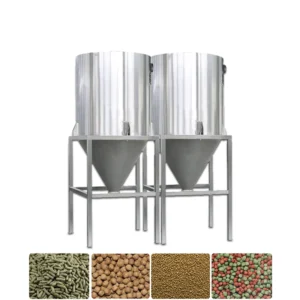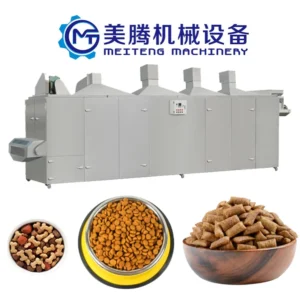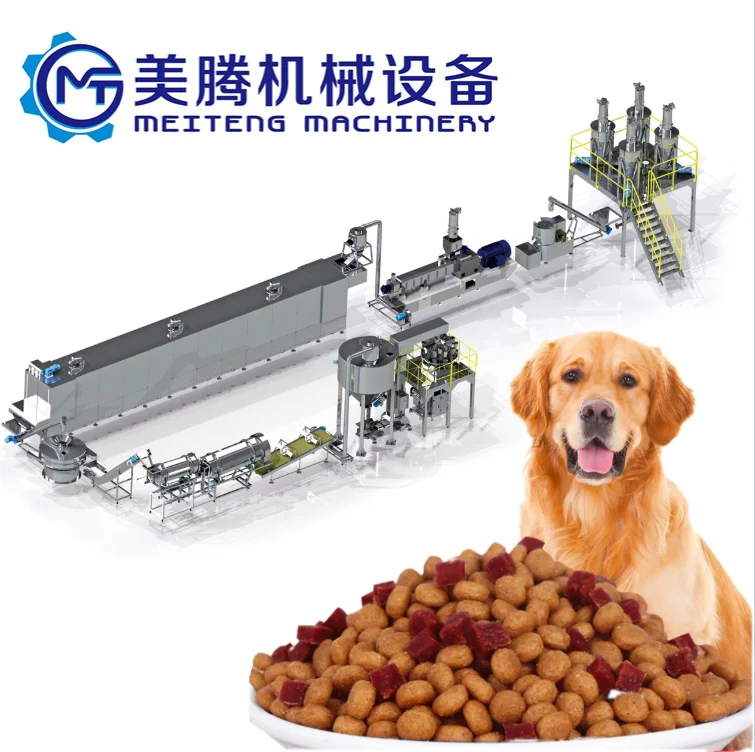
Throughput-Balanced Line Design — Every station from mixer to packaging is matched to your target output, so the extruder never waits on the dryer and the dryer never floods the cooler.
Technical Specifications
| Parameter | Value |
|---|---|
| Product Type | Pet Food Extrusion Production Line |
| Automation Level | Full Automation (raw material mixing to packaging) |
| Control System | PLC and MCC control (model to be confirmed per project) |
| Construction Standard | Food-grade contact materials throughout |
| Compliance | CE, FDA |
| Recipe Adaptability | Dry kibble, semi-moist, and pet treats |
| Configuration | Modular station design for cleaning, maintenance, and expansion |
| Output Capacity | Configurable to project target (basis to be confirmed on raw material) |
| Line Composition | Mixing, extrusion, drying, flavouring, coating, cooling, packaging |
| Sensor Integration | Advanced sensors for batch-to-batch consistency |
Application Suitability
| Application | Material or Output |
|---|---|
| Dry kibble for dogs and cats | Corn, wheat, rice, meat meal, and fat blends at varying protein ratios |
| Bird feed pellets | Millet, sorghum, and seed-based formulations |
| Aquatic feed (floating and sinking) | Fish meal, soy protein, and starch binders for catfish, tilapia, and shrimp |
| Cattle and livestock extruded feed | Grain, bran, and protein concentrate blends |
| Semi-moist pet treats | High-moisture formulations with humectants and meat slurry |
| Pet dental and functional treats | Fibre-enriched and supplement-loaded dough bases |
Why Matching Dryer Capacity to the Extruder Changes Everything
A 500 kg/h extruder feeding a 300 kg/h dryer is not a 500 kg/h line.
I learned this the hard way on a Middle East project where the signed contract quoted a pet food extrusion production line full equipment range at a nominal capacity, but the raw material the buyer actually ran was high in protein and fat. The screws could not feed cleanly, actual throughput dropped, and the dryer sat half-empty while the extruder choked. Downstream, the coating drum was sized for the original number, so residence time was wrong and flavour pickup was uneven. The entire pet food extrusion production line full equipment range stalled at the extrusion station, and the buyer’s market window narrowed while we reconfigured screws and rebalanced auxiliary equipment. That project reshaped how I approach every line quote: match every station to the buyer’s actual material and confirmed output, not a catalogue number. [NEED_CITE: throughput balancing across extrusion line stations]
Station-by-Station Throughput Matching
Each module in this pet food extrusion production line full equipment range is calculated against the others. The mixer batch cycle feeds the extruder hopper at a rate that prevents starvation or surge. The extruder output, measured in actual kg/h on your specific recipe, sets the dryer belt loading, which in turn dictates the cooling conveyor length and the packaging head speed. No station is selected from a standalone catalogue page.
Control Architecture Across the Line
The PLC and MCC control system coordinates every station so that a speed change at the extruder cascades to the dryer belt, the flavouring drum RPM, and the packaging weigh-head. Advanced sensors at each transfer point detect material flow interruptions and pause upstream feed before a blockage propagates. This architecture keeps the pet food extrusion production line full equipment range running as a single coordinated system rather than a chain of independent machines.
How Screw and Die Selection Shapes the Final Kibble
Screw configuration determines shear, residence time, and gelatinisation degree inside the barrel. A high-fat recipe requires a different screw profile and compression ratio than a lean grain-based dough. Die geometry then controls expansion, density, and kibble shape. When the screw and die are specified against the buyer’s actual raw material blend, the extruder holds its rated output and produces kibble that floats or sinks, expands or stays dense, exactly as the market expects. Food-grade contact materials throughout the barrel and die assembly ensure compliance with FDA and CE standards regardless of the recipe. [NEED_CITE: twin-screw extrusion screw configuration for pet food]
What Happens When Stations Are Sourced Separately
I have visited factories where the extruder came from one supplier, the dryer from another, and the packaging machine from a third. Each unit met its own nameplate spec, yet the line as a whole could never hold a steady run. The dryer was too short for the extruder’s moisture load, so kibble left the belt with residual humidity that caused mould in the bag. The coating drum was too small, so tumbling time was insufficient and flavour adhesion failed shelf-life testing. Retrofitting mismatched stations costs more in downtime and re-engineering than specifying a balanced pet food extrusion production line full equipment range from a single source at the outset. [NEED_CITE: line integration challenges with multi-vendor extrusion equipment]
Why Procurement Stops Here
Complete line design under one supplier means throughput calculations span every station, not just the extruder nameplate. Screw configuration and die design are documented against the buyer’s raw material sample before production begins. An in-house testing workshop runs the buyer’s actual recipe, generating a trial report that confirms output and product texture before the line ships. Twin-screw expertise covers kibble, aquatic feed, semi-moist treats, and functional pet food formats across a single platform. Pre-sales engineering, on-site installation, commissioning, and operator training are delivered by the same team that built and tested the line.
Documentation & Verification
- Line layout and capacity calculation showing throughput match at each station for your recipe
- Screw and die configuration record tied to your raw material sample and target kibble density
- Trial run report from the in-house testing workshop using your actual formulation before dispatch
- Electrical schematic with voltage and frequency confirmation matched to your facility supply
- CE declaration of conformity and FDA-compliant material certificates for all food-contact surfaces
Installation, Commissioning & Support
- Foundation and floor-load plan provided for the full modular station footprint and drying conveyor length
- Dedicated electrical circuit specification covering total connected load of the PLC-controlled line
- Stations shipped in assembly-ready modules with food-grade contact surfaces pre-installed and protected
- First-run parameter setting on your raw material by the same engineers who configured the screw profile
- Operator training covering recipe changeover, sensor calibration, and control language selection
- Wear parts list for screws, dies, and dryer belts with replacement sourcing procedure documented
What We Need to Configure Your Line
To size every station correctly, share your target kibble or treat format, the raw material formulation you intend to run including protein and fat ratios, and the daily output you need to meet market commitments. Provide your facility voltage, frequency, and available floor area so the layout can be drafted to your actual building. Let us know whether you need a trial run on your material before shipment.
Frequently Asked Questions
Q: How is output capacity verified and on what raw material basis is it quoted?
A: Capacity is quoted only after a trial run on your actual raw material in our testing workshop. The trial report documents the confirmed kg/h at your specific protein, fat, and moisture levels, so the number on the contract reflects your recipe rather than a generic test grain.
Q: How do you ensure dryer and coating capacity matches the extruder throughput?
A: Each station is calculated from the extruder’s confirmed output on your material. Dryer belt length, air flow, and coating drum diameter are all derived from that number, so no station becomes a bottleneck during continuous production.
Q: Can the line layout be customised to my existing factory footprint and utility points?
A: Yes. The modular station design allows the line to be arranged around existing columns, doorways, and utility drops. We draft the layout to your floor plan and confirm electrical connection points before manufacturing begins.
Q: What station-by-station specifications are documented before shipment?
A: You receive a complete documentation package including the line layout, capacity calculation, screw and die configuration record, electrical schematic, trial run report, and compliance certificates for every station before the line leaves the factory.
Q: Which spare wear parts are included and how are replacements sourced after installation?
A: A wear parts list covering screws, dies, and dryer belt sections is provided with the shipment. Replacement components are manufactured to the same configuration record, and sourcing procedures are documented in the operation manual.