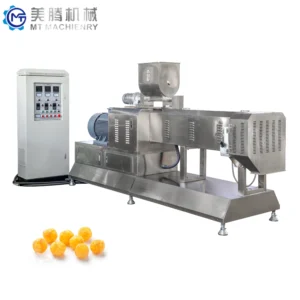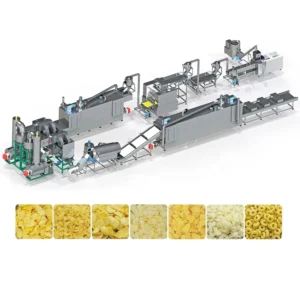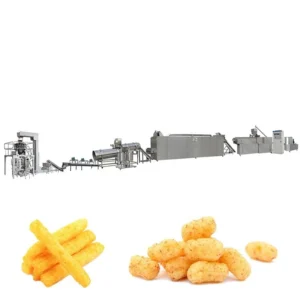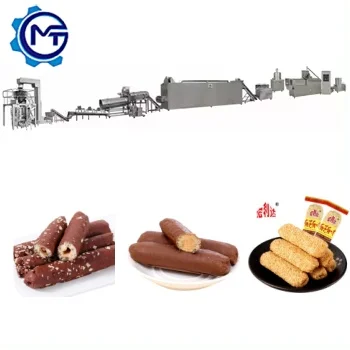
Complete Line Integration — Every station from batching to packing is throughput-matched under a single equipment schedule, eliminating the bottlenecks that arise when extruders, dryers, and coating drums are sourced from separate vendors with incompatible capacities.
Technical Specifications
| Parameter | Value |
|---|---|
| Model | MT65 / MT70 / MT85 / MT100 |
| Product Type | Twin Screw Puffed Corn Snack Extruder Production Line |
| Screw Type | Twin-screw |
| Installed Power | MT65: 130 kW; MT70: 180 kW; MT85: 220 kW; MT100: 240 kW |
| Real Consumption | MT65: 95 kW; MT70: 120 kW; MT85: 130 kW; MT100: 160 kW |
| Output Capacity | MT65: 120–150 kg/h (basis to be confirmed); MT70: 200–300 kg/h (basis to be confirmed); MT85: 300–500 kg/h (basis to be confirmed); MT100: 600–800 kg/h (basis to be confirmed) |
| Control System | Frequency speed controlling system |
| Barrel Lubrication | Automatic lubricating and cooling |
| Die Configuration | Interchangeable dies for multiple shapes (ball, tube, stick, ring, fruit loop, star, wheel, flower, heart) |
| Core Filling Option | Available with add-on core filling and cutting machine |
| Line Stations | Mixing → Batching → Extruding → Drying → Coating / Flavouring → Cooling → Packing → Stacking |
| Dryer Heating Source | Electric / steam / gas (configurable to site utility) |
| Flavouring System | Double drum with sugar melting and spraying nozzle |
| Packing Machine | Automatic weighing, sealing, marking, coding; vibration feeding with electronic pad weighing |
| Warranty | 1 year |
| Standards | CE, ISO |
Application Suitability
| Application | Material or Output |
|---|---|
| Puffed snack production | Corn, rice, wheat, oat, and barley flour formulations |
| Core-filled snacks | Chocolate, cream, or fruit paste injected into extruded shells |
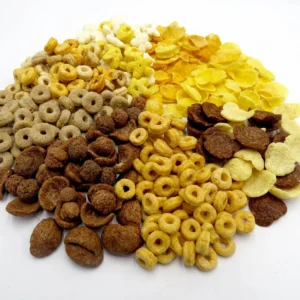
| Breakfast cereal variants | Cereal rings, fruit loops, and ball formats from grain blends |
| Custom shape extrusion | Star, wheel, heart, stick, and tube cross-sections via interchangeable dies |
What a Capacity Number Actually Means on Your Raw Material
A twin screw extruder snack production line manufacturer must tie every throughput figure to a specific formulation and moisture level.
I spent years doing after-sales service on puffed food lines across the Yangtze Delta region, and the most common commissioning failure was not mechanical — it was a mismatch between the capacity quoted on standard corn grits and what the buyer was actually running. A customer switching to a high-fibre multigrain recipe would see expansion collapse and density spike, because the screw configuration had been set for a completely different starch profile. The extruder was not undersized; it was configured for the wrong material. [NEED_CITE: raw material moisture and fibre content effect on extrusion expansion rate]
When evaluating any twin screw extruder snack production line manufacturer, the first question should never be "what is your maximum output" — it should be "what is your output on my exact formulation at my target moisture content."
Die Geometry and Product Consistency Across SKUs
The interchangeable die system on these models supports ball, tube, stick, ring, fruit loop, star, wheel, flower, and heart profiles, allowing a single extruder barrel to serve multiple product SKUs without a full screw rebuild. Each die cross-section alters back-pressure inside the barrel, which in turn affects starch gelatinisation and the expansion ratio at the die face.
Switching from a tube die to a filled-ring die changes the shear profile enough that barrel temperature zones typically need adjustment. A twin screw extruder snack production line manufacturer that documents the screw configuration and die pairing for each shape helps buyers plan changeover procedures before the first production run.
Matching Dryer Capacity to Extruder Throughput
The dryer station is configurable for electric, steam, or gas heating to match whatever utility infrastructure exists at the installation site. This matters because an extruder producing at its rated output will overwhelm a dryer that was spec’d independently, leaving product with residual moisture that causes sogginess or microbial instability downstream.
The double-drum flavouring system with integrated sugar melting and spray nozzles must also be sized to handle the extruder’s peak discharge rate. When these three stations — extruder, dryer, flavouring — are quoted as separate packages from different suppliers, the integration gaps are where bottlenecks appear. [NEED_CITE: industrial food line throughput matching between extrusion and drying stages]
Reading the Power and Throughput Table Correctly
The installed power figures (ranging from 130 kW on the MT65 to 240 kW on the MT100) represent peak motor and heating draw, while the real consumption values (95 kW to 160 kW) reflect typical running load under continuous operation. This distinction matters for sizing the factory’s electrical supply and calculating operating cost.
The twin-screw configuration provides higher shear and better mixing than single-screw designs, which is necessary when working with composite flour blends containing fibre, protein isolate, or fortification additives. The automatic barrel lubrication and cooling system maintains stable barrel temperature across long production runs, preventing the thermal drift that causes batch-to-batch variation in puff density. Output capacity figures are listed per model but carry a basis-to-be-confirmed note because actual throughput depends entirely on the raw material composition, moisture percentage, and target expansion ratio.
The Hidden Cost of an Unverified Screw Configuration
A generic screw build copied from a standard template will extrude corn grits adequately but fail on anything with higher fibre or fat content. When the configuration is not matched to the buyer’s recipe, the result is inconsistent puffing, surface cracking, or product that does not meet the density specification the retail market expects.
Correcting this after installation means sourcing replacement screw elements, re-running trials, and absorbing the downtime — costs that far exceed the effort of specifying the configuration correctly before the machine leaves the factory. [NEED_CITE: twin-screw element configuration impact on extrusion texture and density]
Why Equipment Buyers Source This Line Here
The line covers every station from batching through stacking under one supplier, so throughput is matched across the extruder, dryer, and flavouring drum rather than assembled from separate vendors with incompatible capacities. Screw configuration and die selection are specified to the buyer’s actual raw material and target product shape, not pulled from a generic template.
An in-house testing workshop runs trial production on customer-supplied raw material before shipment, generating a trial run report that documents expansion ratio, density, and screw settings. Electrical schematics and voltage specifications are confirmed in writing before production begins, preventing the commissioning delays caused by wrong frequency or control language. CE and ISO declarations accompany every shipment, and wear parts lists ensure replacement screws and dies are available from day one.
Documentation & Verification
- Line layout and capacity calculation matched to your specific flour blend and target output
- Screw and die configuration record documenting element arrangement for each product shape
- Trial run report on customer-supplied raw material generated before dispatch
- Electrical schematic with voltage and frequency confirmed to your site specification
- Operation and maintenance manual covering barrel lubrication intervals and die changeover
Installation, Commissioning & Support
- Power supply must match confirmed voltage and frequency; dedicated circuit sized for up to 240 kW installed load
- Automatic barrel lubrication system requires first-fill and pressure check during commissioning
- Die changeover training covers all standard shapes plus any custom profiles included in the order
- Dryer heating source configured to site utility (electric, steam, or gas) during installation
- Frequency speed controlling system parameters set per product recipe during first production run
- Wear parts list with screw element and die specifications provided for future reorder reference
What to Include in Your Inquiry
Provide the specific grain flours or composite formulations you plan to run, along with typical moisture content and any fat or fibre additions. Include your local voltage and frequency standard so electrical components are specified correctly before production starts. If you have existing upstream mixing or downstream packing equipment, share the interface details so the line can be configured around them.
Frequently Asked Questions
Q: How do I choose between MT65, MT70, MT85 and MT100 for my target capacity?
A: Model selection depends on your raw material formulation and moisture content, not just a target kilogram figure. The capacity ranges listed for each model carry a basis-to-be-confirmed note because actual throughput varies with starch composition. Submit your recipe details so the correct model is matched to your realistic output requirement.
Q: What supporting stations are included and where does each fit in the line?
A: The line sequence runs mixing, batching, extruding, drying, coating or flavouring, cooling, packing, and stacking. Each station is sized to match the extruder model selected, preventing bottlenecks where a downstream dryer or flavouring drum cannot keep pace with the extruder discharge rate.
Q: Can the dryer heating source be changed to match my factory’s steam or gas supply?
A: Yes. The dryer is configurable for electric, steam, or gas heating to align with whatever utility infrastructure exists at your site. Confirming your available heating source during the inquiry stage ensures the dryer is built to the correct specification before shipment.
Q: Which die shapes are included as standard and how are custom profiles quoted?
A: Standard interchangeable dies cover ball, tube, stick, ring, fruit loop, star, wheel, flower, and heart shapes. Custom cross-section profiles are quoted separately based on die complexity. Request the die configuration record to confirm which shapes are included in your line package before order confirmation.
Q: How is throughput matched between extruder, dryer and flavouring drum to avoid bottlenecks?
A: Each supporting station is specified relative to the extruder model chosen, so the dryer residence time and flavouring drum capacity align with the extruder’s real discharge rate. This integration is documented in the line layout and capacity calculation provided during the proposal stage.