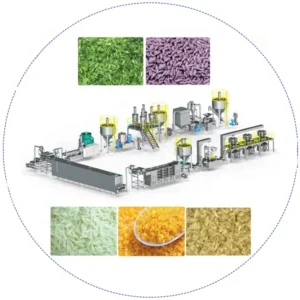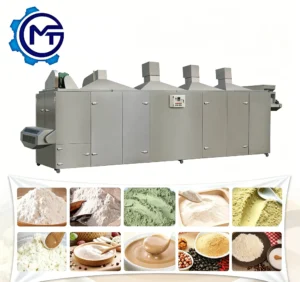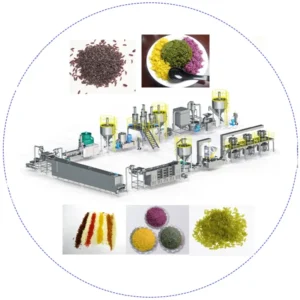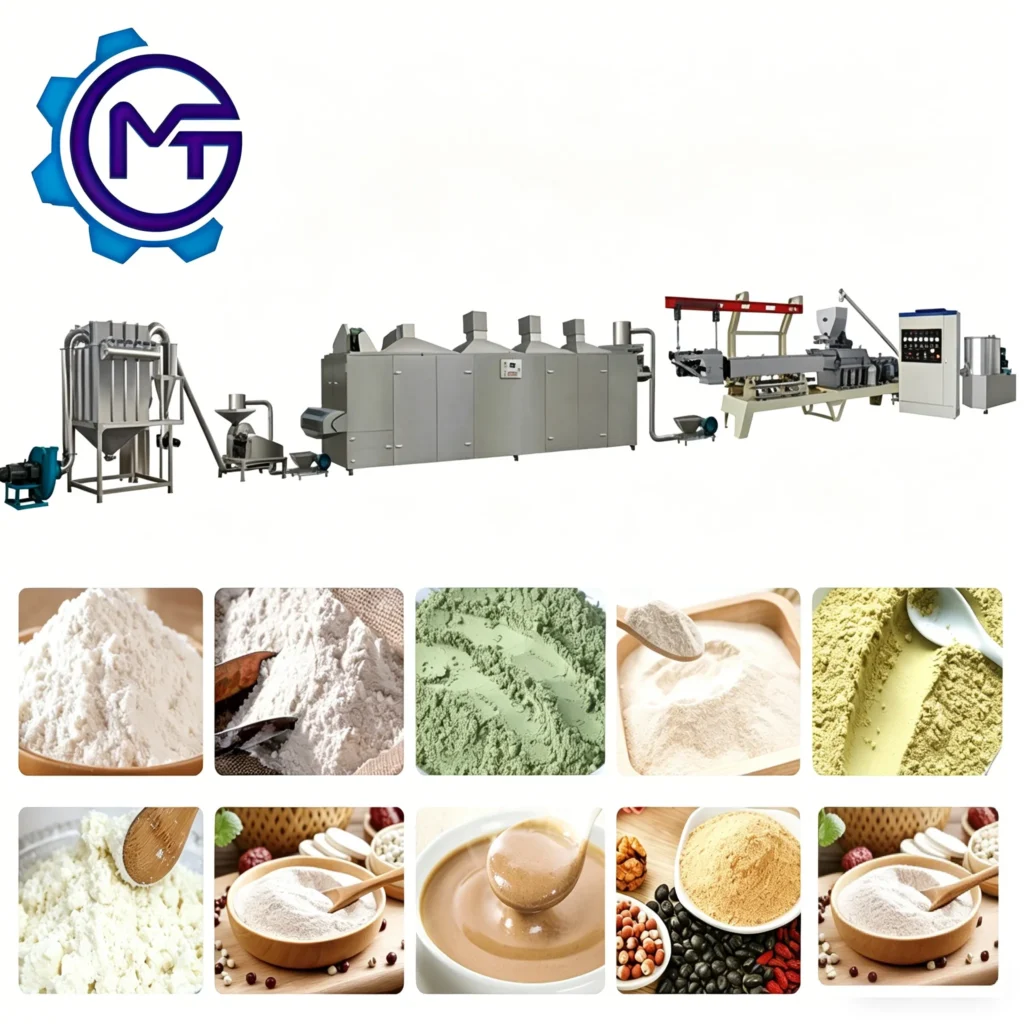
Throughput-Matched Stations — Every mixer, extruder, and dryer in the nutrition powder processing line full equipment range is sized so no single unit bottlenecks the next.
Technical Specifications
| Parameter | Value |
|---|---|
| Product Type | Nutrition Powder Processing Line |
| Output Capacity | 200–500 kg/h (basis not stated in source — confirm raw material type, moisture content, and formulation) |
| Control System | PLC with touch control panel and digital system |
| Construction Material | Food-grade 304 stainless steel |
| Heat Source Options | Electric, gas, or steam |
| Line Stations | Mixers, extruders, baking ovens, drying, cooling, packing |
| Assembly State | Complete line from batching to packing |
| Warranty | 1 year |
| After-Sales Support | Overseas engineer service available |
| Certification | CE, ISO |
Application Suitability
| Application | Material or Output |
|---|---|
| Infant cereal production | Rice flour, corn flour, oat flour blended into fine porridge powder |
| Fortified nutrition powder | Grain base with added vitamin premix, minerals, and protein isolates |
| Baby food powder blending | Multi-grain formulations including wheat, barley, and legume flours |
| Cereal-based dietary supplement | Extruded and dried grain matrix milled to target particle size |
Why Unmatched Station Capacity Derails a Nutrition Powder Line
A line rated on paper collapses the moment the dryer cannot keep pace with the extruder.
I once watched a buyer receive an extrusion unit that produced powder precursor faster than the downstream dryer could handle. Moisture stayed trapped inside the granules, shelf life dropped, and the entire batch had to be re-processed. That situation repeats whenever equipment is sourced station by station instead of as a matched set. When buyers survey a nutrition powder processing line full equipment range, the priority is confirming that each station’s throughput rating aligns with the others under the buyer’s actual formulation [NEED_CITE: throughput matching methodology for multi-station food lines].
Station-by-Station Equipment Survey
Reviewing a nutrition powder processing line full equipment range starts at the batching and mixing stage. Mixers must disperse micro-ingredients such as vitamin premix and mineral salts evenly through the grain base before extrusion. Any dead zone in the mixing vessel creates hot spots of nutrient concentration that lab testing will flag later.
The extruder is the next critical station. Screw profile and barrel temperature zones determine starch gelatinisation degree, which directly controls powder solubility and mouthfeel in the final reconstituted product. Buyers comparing machines on this site can cross-reference motor power, screw diameter, and barrel segment count against their target output.
Heat Source Selection for Drying and Baking
Drying and baking stations follow extrusion, and their heat source must match the factory’s existing utility infrastructure. Facilities with abundant steam from a central boiler will find steam-heated dryers more economical to run, while plants without gas lines may rely entirely on electric heating elements. Selecting the wrong heat source after installation forces expensive retrofit work and delays commissioning [NEED_CITE: industrial heat source selection for food drying equipment].
Food-grade 304 stainless steel construction across contact surfaces keeps the line compliant with hygiene standards required for infant and clinical nutrition products. The PLC touch control panel centralises temperature, screw speed, and feed rate parameters so operators adjust one station without losing synchronisation with the rest.
Reading the Specs That Matter for Powder Quality
Output capacity figures assume a specific raw material and moisture content. A line rated at 200–500 kg/h may shift considerably when the formulation changes from pure corn flour to a blend loaded with whey protein isolate, because protein alters dough viscosity inside the barrel. Buyers should request a capacity calculation based on their own recipe before committing.
The PLC digital control system stores recipes as parameter sets, allowing repeat runs without manual recalibration. This matters for nutrition powder because even small drifts in barrel temperature or screw speed change the degree of starch modification and, consequently, how the powder behaves when mixed with water or milk.
Heat source flexibility across baking and drying stations lets the buyer match local energy costs. Electric heating gives precise zone control; gas firing lowers operating cost at high volume; steam integration reduces redundancy if the plant already runs a boiler for other processes.
The Cost of Skipping a Pre-Shipment Trial Run
When an extruder ships without a trial on the buyer’s actual raw material, the first weeks of production become an expensive experiment. I have seen lines sit idle while technicians adjusted screw speed, barrel temperature, and die geometry to accommodate a high-protein formulation that behaved nothing like the standard test flour. Downtime, wasted ingredients, and delayed market launch add up quickly, and the buyer absorbs every cost [NEED_CITE: commissioning delays in food extrusion projects].
Sourcing Advantages Rooted in Line Integration
Matching throughput across every station from one supplier eliminates the finger-pointing that occurs when a mixer vendor blames the extruder vendor for inconsistent feed. Each unit in this nutrition powder processing line full equipment range is specified together, so capacity calculations reflect real interaction between stations.
Screw configuration and die design are documented against the buyer’s raw material and target particle size, not copied from a generic template. An in-house testing workshop runs the buyer’s formulation before shipment, producing a trial report that becomes the baseline for commissioning.
Pre-sales engineering covers line layout and utility planning, so floor space, electrical load, and ventilation are confirmed before production begins. On-site installation, operator training, and ongoing maintenance support continue after the line is running.
Documentation & Verification
- Machine specification sheet per station listing power, dimensions, and throughput rating
- Line layout drawing with throughput matching confirmed between adjacent stations
- Electrical schematic with voltage and frequency locked to the buyer’s market standard
- Trial run report generated on the buyer’s actual raw material before dispatch
- CE declaration of conformity and ISO certificate for export clearance
Installation, Commissioning & Support
- Foundation plan accounts for mixer and extruder weight distribution and vibration isolation
- Dedicated electrical circuit sized for combined extruder motor and dryer heating load
- Modular station delivery allows phased installation where ceiling height restricts full assembly
- PLC parameter upload from trial run data sets the starting point for on-site commissioning
- Operator training covers recipe storage, temperature zone adjustment, and emergency stop procedures
- Wear parts list identifies screw segments and die plates with reorder part numbers
Preparing Your Inquiry
Share your raw material formulation, including protein and fat percentages, so screw and die configuration can be matched before quotation. Confirm your local voltage, frequency, and preferred control language to avoid rewiring or reprogramming on arrival. If you already operate upstream milling or downstream packing equipment, provide interface dimensions so the line integrates without custom adapters.
Frequently Asked Questions
Q: What supporting stations are included in the nutrition powder line and how is throughput matched?
A: The line covers mixers, extruders, baking ovens, dryers, cooling conveyors, and packing stations. Each unit is selected so its capacity aligns with the adjacent station under your specific formulation, preventing bottlenecks that occur when machines are sourced separately.
Q: Which heat source options are available for the drying and baking stations?
A: Electric, gas, and steam heating are all available. The choice depends on your factory’s existing utility setup and local energy costs. Steam integration is common where a central boiler already serves other production areas.
Q: How is the control system configured across different machines in the line?
A: A PLC with a touch control panel manages extruder speed, barrel temperature, and dryer settings from one interface. Recipe parameters are stored digitally, so operators recall them for repeat batches without manual recalibration.
Q: What raw materials and formulations can the extruder handle?
A: Rice, corn, beans, oats, and multi-grain blends are standard. High-protein or high-fat formulations change dough viscosity, so screw profile and barrel zones must be adjusted. A trial run on your actual recipe confirms the configuration before shipment.