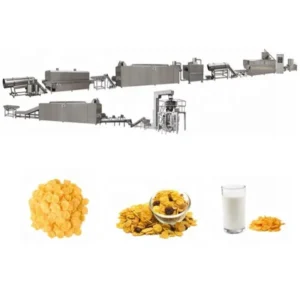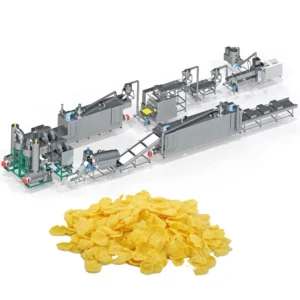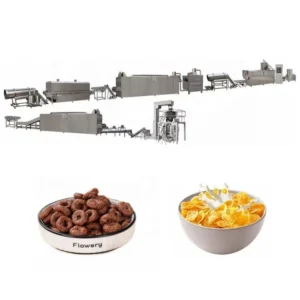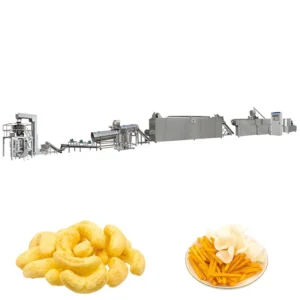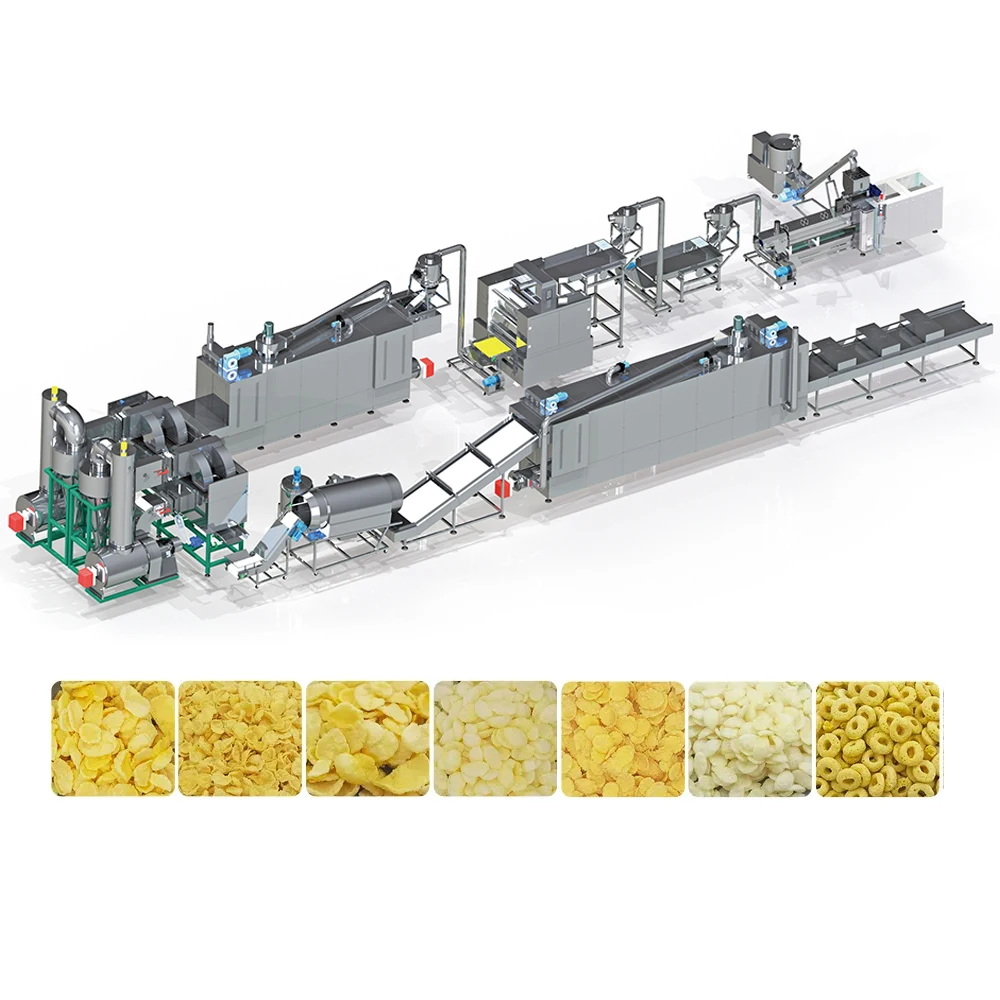
Matched throughput across every station — extruder, flaker, dryer, roaster, and coater sized together so the corn flakes production line equipment runs at the pace the slowest unit can sustain.
Technical Specifications
| Parameter | Value |
|---|---|
| Product Type | Corn Flakes Production Line / Twin Screw Extrusion Line |
| Extruder Models Available | MT70 / MT85 / MT75 |
| Screw Configuration | Twin-screw with automatic lubricating and cooling function |
| Installed Power (MT70) | 160 kW |
| Installed Power (MT85) | 190 kW |
| Installed Power (MT75) | 210 kW |
| Power Consumption (MT70) | 120 kW |
| Power Consumption (MT85) | 140 kW |
| Power Consumption (MT75) | 150 kW |
| Output Capacity (MT70) | 150–200 kg/h (basis not stated in source — confirm raw material type / moisture content) |
| Output Capacity (MT85) | 300–400 kg/h (basis not stated in source — confirm raw material type / moisture content) |
| Output Capacity (MT75) | 300–500 kg/h (basis not stated in source — confirm raw material type / moisture content) |
| Overall Dimensions (MT70) | 41 × 1.5 × 2.2 m |
| Overall Dimensions (MT85) | 43 × 1.5 × 3.2 m |
| Overall Dimensions (MT75) | 45 × 1.5 × 3.5 m |
| Control System | PLC control system |
| Flaking Machinery | Hydraulic double-roller system with separate motors and infrared temperature sensing |
| Dryer Heating Source | Gas or Electric |
| Roasting Oven | Hot air oven with vibrating pan, two circulating fans, cyclone dust removal, conciliation burner |
| Coating System | Double tumble sugar melter, elevator, coating drum, spraying nozzle |
| Certifications | CE, ISO |
Application Suitability
| Application | Material or Output |
|---|---|
| Natural corn flakes | Corn powder, processed through mixing, extrusion, flaking, drying, roasting, and cooling |
| Sugar-coated corn flakes | Sugar sprayed and tumble-coated after roasting, then dried again before packing |
| Shaped breakfast cereals | Rice, wheat, oat, or barley powder extruded through interchangeable moulds into balls, tubes, sticks, rings, fruit loops, stars, wheels, flowers, or hearts |
| Fortified cereal production | Vitamin and mineral blends integrated at the mixing stage before extrusion |
What Buyers Miss When They Price a Corn Flakes Line by the Extruder Alone
The extruder is the loudest machine on the floor, but the line speed is set by whichever station can’t keep up.
I’ve walked into plants where the twin-screw was running at full capacity and the flaking rolls were still processing the previous batch. Corn piles on the transfer belt, moisture drops unevenly, and half the sheet comes out too thick to roast through. Downstream, the hot air oven has empty pan space because the coater can’t feed it fast enough. When buyers compare quotations for corn flakes production line equipment, they often anchor on the extruder model and treat everything else as accessories. The dryer capacity, flaker roll speed, and roaster pan area each need to be calculated against the extruder’s actual throughput on the buyer’s specific flour blend [NEED_CITE: throughput matching between extruder and downstream stations in cereal processing].
Every Station from the Mixer to the Packing Conveyor
The MT70, MT85, and MT75 extruders anchor the line, but the corn flakes production line equipment extends well beyond the barrel. Upstream, the batching and mixing system meters corn, rice, wheat, oat, or barley powder with water and any fortification additives before the extruder’s feeding system takes over. Downstream of extrusion and cutting, the flaking machinery uses a hydraulic double-roller system with separate motors for each roll and infrared sensors to hold temperature evenly across the roll face. Uniform flake thickness at this stage determines whether the hot air roaster can achieve consistent surface bubbling without scorching the edges.
How the Dryer and Roaster Protect Flake Texture
After flaking, the dryer performs a pre-drying pass that reduces surface moisture just enough to prevent sticking in the roaster. The heating source is configurable between gas and electric depending on the buyer’s utility infrastructure. The hot air roasting oven that follows uses a vibrating pan and two separate circulating fans to move air across the flakes, while a cyclone dust removal device captures fine particulate before it can settle back onto the product. A conciliation burner modulates flame output to hold the target roasting temperature. Getting this stage right is what gives corn flakes their characteristic crispness and light brown colour rather than a hard, undercooked centre [NEED_CITE: roasting temperature profiles for flaked cereal products].
Reading the Power and Dimension Figures
Installed power across the three extruder models ranges from 160 kW to 210 kW, with running power consumption between 120 kW and 150 kW. These figures cover the complete extruder assembly — feeding system, extruding system, cutting system, heating system, and gearing system. The overall line footprint stretches from 41 m to 45 m in length depending on model selection, with widths around 1.5 m and heights between 2.2 m and 3.5 m. Twin-screw operation provides the shear and residence time control needed for consistent starch gelatinisation across corn, rice, and multi-grain blends, which is essential before the dough reaches the flaking rolls. The PLC control system manages barrel temperature zones and screw speed to hold batch-to-batch consistency, something operators rely on when switching between natural and sugar-coated production runs.
When the Flaker and Roaster Are Undersized
A flaking mill rated for a lower throughput than the extruder creates a bottleneck that forces the extruder to run in intermittent cycles. Each restart disrupts barrel temperature stabilisation and produces off-spec dough that operators must discard. An undersized roaster means flakes spend less time under hot air, leaving the centre chewy and prone to staling on the shelf. I’ve seen sugar-coating drums that couldn’t handle the volume from the roaster, so operators had to let trays of roasted flakes sit uncovered while waiting their turn — by the time they entered the drum, moisture had already shifted the texture. These mismatches are invisible in a line drawing but show up on the first production day [NEED_CITE: impact of line station mismatch on cereal flake quality].
Why Sourcing the Complete Line from One Supplier Matters
Throughput calculations for every station are completed before the quotation is issued, so the dryer, flaker, roaster, and coater are each sized against the selected extruder model’s actual output on the buyer’s raw material.
Screw configuration and die design are specified to the buyer’s flour blend and target flake thickness rather than copied from a generic build.
An in-house testing workshop runs the buyer’s raw material through the extruder and flaker before shipment, confirming starch gelatinisation behaviour and flake integrity.
Pre-sales documentation includes line layout and capacity calculation so the buyer can verify station spacing against their factory footprint before production begins.
CE and ISO certifications cover the complete line, meaning electrical safety and quality management standards apply to every station rather than only the extruder.
Documentation & Verification
- Line layout drawing showing station spacing matched to your factory floor dimensions
- Screw and die configuration record specific to your flour blend and target flake thickness
- Electrical schematic with voltage and frequency confirmed before production starts
- Trial run report on your raw material from the in-house testing workshop
- Factory test record documenting throughput and flake quality at each station
- Operation and maintenance manual covering all stations from mixer to packing conveyor
Installation, Commissioning & Support
- Foundation and floor space planning based on the 41–45 m line length and 1.5 m width envelope
- Dedicated power circuit sized for the 160–210 kW installed load of the selected extruder model
- Gas or electric dryer heating source configured to match on-site utility availability
- PLC control system programmed and language set before the commissioning team arrives
- First-run parameter tuning on the buyer’s raw material with operators present for hands-on training
- Wear parts list for screws, dies, and flaker rolls provided with recommended replacement intervals
What We Need to Configure Your Line
To prepare a layout and quotation, share the raw material type or blend you plan to run, your target hourly output, and the dimensions and ceiling height of the production hall. Let us know the local voltage and frequency, and whether gas or electric heating is preferred for the dryer and roaster. If you have existing upstream or downstream equipment you want to integrate, provide the model and throughput rating so we can check compatibility.
Frequently Asked Questions
Q: How is throughput matched between the extruder and each downstream station?
A: Each station’s capacity — flaker, dryer, roaster, and coater — is calculated against the extruder model’s output on the buyer’s specific raw material before the line is quoted. This prevents the common problem where the extruder runs ahead of downstream equipment, causing material pile-up and inconsistent drying.
Q: What is included in the complete line versus what must be sourced separately?
A: The line covers mixing, extruding, flaking, drying, roasting, cooling, and packing stations, plus the sugar coating system for coated variants. Raw material silos, finished product storage, and factory-level utilities such as compressed air and gas supply connections are typically buyer-provided.
Q: How do the three extruder models differ in capacity range and footprint?
A: The MT70 is the most compact at 41 m with a lower installed power and output range. The MT85 and MT75 extend to 43 m and 45 m respectively, with higher motor ratings and broader output ranges. Selection depends on the buyer’s target throughput and available floor length.
Q: Can the line produce both natural and sugar-coated corn flakes?
A: Yes. Natural flakes follow the mixing–extrusion–flaking–drying–roasting–cooling–packing sequence. Sugar-coated variants add sugar spraying, tumble coating, and a second drying stage after roasting. The coating system includes a double tumble sugar melter, elevator, coating drum, and spraying nozzle.