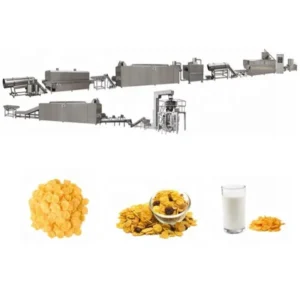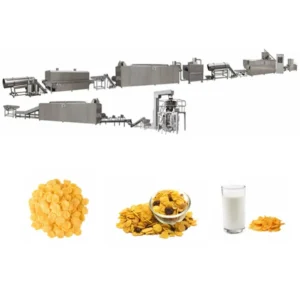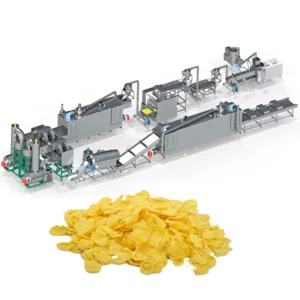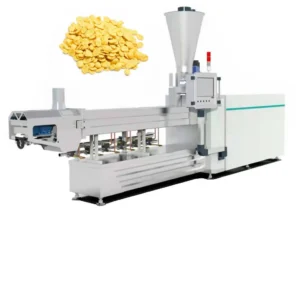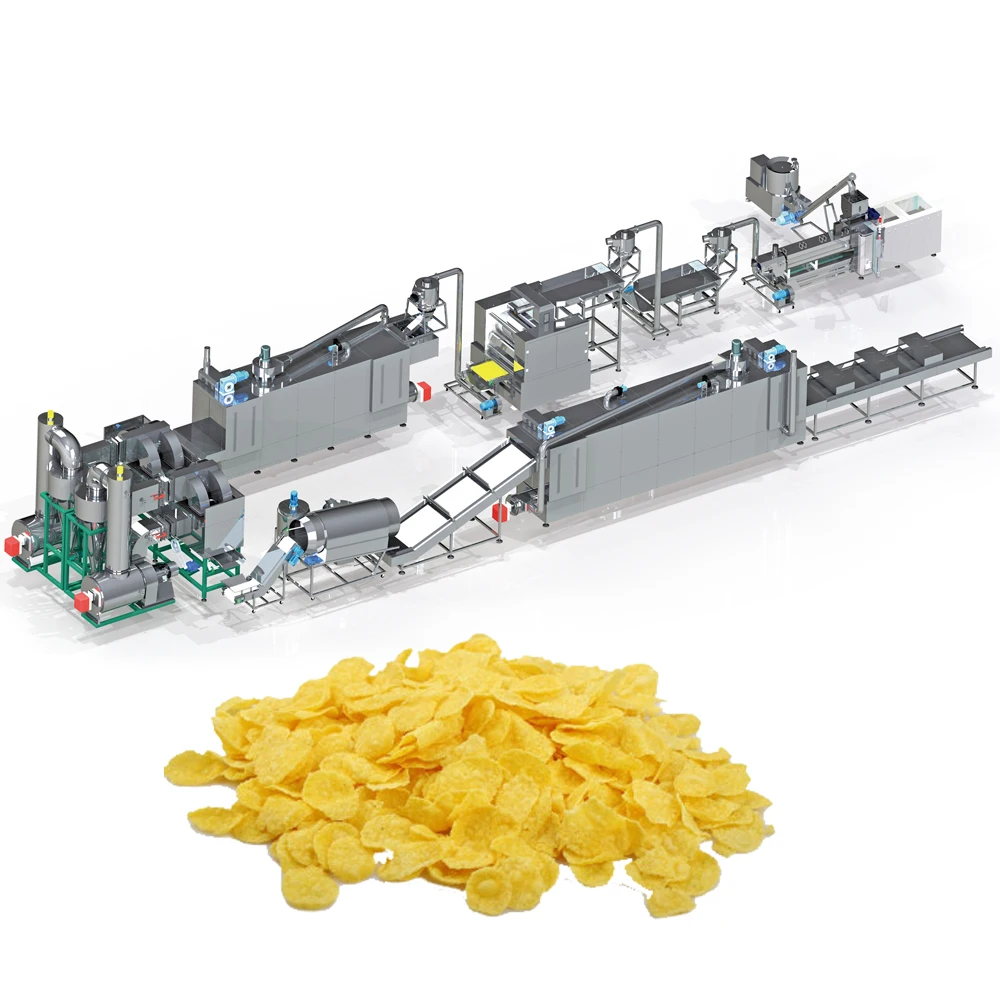
Matched throughput across every station — this corn flakes line sources extruder, flaker, dryer and roaster from one build, so no station bottlenecks the next.
Technical Specifications
| Parameter | Value |
|---|---|
| Model | MT70 / MT85 / MT75 |
| Product Type | Corn Flakes Production Line with Twin Screw Extruder |
| Screw Type | Twin-screw |
| Installed Power | MT70 — 160 kW; MT85 — 190 kW; MT75 — 210 kW |
| Power Consumption | MT70 — 120 kW; MT85 — 140 kW; MT75 — 150 kW |
| Output Capacity | MT70 — 150–200 kg/h (basis not stated in source); MT85 — 300–400 kg/h (basis not stated in source); MT75 — 300–500 kg/h (basis not stated in source) |
| Overall Dimensions (L×W×H) | MT70 — 41 × 1.5 × 2.2 m; MT85 — 43 × 1.5 × 3.2 m; MT75 — 45 × 1.5 × 3.5 m |
| Control System | PLC control system on flaking machinery; MCC and PLC available for extruder line |
| Extruder Lubrication | Automatic lubricating with cooling function |
| Dryer Heating Source | Gas or electric, configurable |
| Flaking Machinery Drive | Hydraulic double-roller system; dual-motor separate drive; infrared-sensor temperature control |
| Hot Air Roasting Oven | Vibrating pan, two circulating fans, cyclone dust removal |
| Coating System | Double tumble sugar melting, elevator, coating drum, spraying nozzle |
| Assembly State | Complete production line from mixing to packing |
| Standards | CE; ISO |
Application Suitability
| Application | Material or Output |
|---|---|
| Natural corn flakes | Corn, rice, wheat, oat, barley powder through extrusion, flaking, drying and roasting |
| Sugar-coated corn flakes | Base flakes processed through additional sugar spraying, coating and secondary drying stations |
| Shaped breakfast cereals | Ball, tube, stick, ring, fruit loop, star, wheel, flower and heart forms via die change on the same extruder |
| Puffed snack variations | Same base stations repurposed for expanded snack formats without flaking or roasting |
Why Capacity Claims Fall Short Without Raw Material Context
Output numbers mean nothing if the extruder cannot hold them on your actual flour blend.
When buyers compare corn flakes production line equipment for sale, the first figure they check is kilograms per hour. Yet that figure is often measured on a standard corn grit recipe under controlled moisture. Switch to a locally sourced coarse grain or a higher-fiber blend and the same screw configuration may produce blistered sheets that shatter after drying. I have watched lines stall for days because the trial material never matched the production flour [NEED_CITE: raw material variability in extrusion processing]. The fix is never a bigger motor — it is a different screw profile and die geometry matched to the buyer’s recipe before the machine ships.
Station Matching Across the Full Catalogue
A corn flakes production line equipment for sale from a single catalogue means the extruder output, flaker width, dryer belt length and roaster residence time are calculated together. The MT70, MT85 and MT75 models differ in installed power and footprint, but every supporting station — mixing, conveying, flaking, drying, roasting, coating and packing — is selected so that its throughput envelope covers the extruder’s actual output range. When stations are sourced separately, a common failure is a dryer that cannot keep pace, forcing the extruder to idle and lose temperature stability.
From Natural to Sugar-Coated on One Base Layout
The base line runs mixing through cooling for natural flakes. Adding sugar-coated variants inserts a sugar spraying and coating drum stage between roasting and final drying. Because both tumble drums, spray nozzles and the secondary dryer are listed in the same equipment catalogue, the line layout can reserve space and utility connections for the coating stage from day one. Buyers who plan to offer both SKU types avoid costly retrofitting later [NEED_CITE: line layout planning for multi-SKU cereal production].
Reading the Specs That Actually Matter
Twin-screw extrusion gives corn flakes lines a wider operating window than single-screw designs. The co-rotating screws handle varying moisture and particle size, which matters when local grain supply shifts between seasons. The automatic lubricating system with cooling on the gearbox prevents thermal shutdown during continuous runs — a detail that only shows up once the line has been running past the first shift. On the flaking stage, the hydraulic double-roller system with separate dual-motor drive lets each roller maintain independent pressure, producing uniform flake thickness even as roller surfaces wear. Infrared-sensor temperature control on the roller temperature pipe keeps the dough sheet pliable enough to flatten without tearing. The hot air roasting oven uses two separate circulating fans and a cyclone dust removal device, which keeps fine corn dust from settling back onto the flakes and causing scorch spots.
The Hidden Cost of Mismatched Stations
When a dryer is undersized relative to the extruder, operators compensate by slowing the feed, which changes residence time inside the barrel and shifts the gelatinisation point. Flakes leave the die at inconsistent moisture, and the roaster cannot correct what the dryer failed to remove. I have seen entire batches rejected for uneven blistering because the roaster cycling time was set for a dryer output that never arrived [NEED_CITE: thermal balance between drying and roasting stages]. The result is not a minor quality dip — it is a production halt while the bottleneck station is replaced or supplemented.
Why This Equipment Range Fits the Project
Every station from batching to packing comes from the same supplier, so throughput calculations are cross-checked before the line layout is finalized. Screw configuration and die design are specified to the buyer’s raw material and target flake thickness, not copied from a generic build. The in-house testing workshop runs trial production on the buyer’s actual flour blend before shipment, so screw adjustments happen at the factory, not on the buyer’s floor. The PLC control system on the flaking machinery and the MCC and PLC options on the extruder line allow centralized monitoring of motor loads, temperatures and feed rates across every station. Pre-sales line layout and capacity calculation documents show the buyer exactly how each station’s throughput was matched.
Documentation & Verification
- Line layout and capacity calculation showing throughput at each station from mixer to packer
- Screw and die configuration record matched to buyer’s raw material and target flake geometry
- Factory test record from trial run on buyer’s flour blend before shipment
- Electrical schematic with voltage, frequency and control language confirmed pre-production
- Wear parts list covering screws, dies, flaking rollers and spray nozzles with lead times
Installation, Commissioning & Support
- Floor space planning based on overall line length up to 45 m for the MT75 configuration
- Dedicated electrical circuits sized to the selected model’s installed power up to 210 kW
- Assembled station modules with on-site alignment of conveyor transfer points between dryer and roaster
- First-run parameter setting on the PLC panel covering barrel zones, flaker pressure and oven fan speed
- Operator training focused on screw wear indicators and hydraulic roller adjustment procedures
- Spare screw elements, die plates and flaking roller shells staged for first replacement cycle
What to Include in Your Inquiry
Provide the grain type, particle size and typical moisture range you plan to run, along with your target hourly output. Specify whether you need natural flakes, sugar-coated variants, or both, so the coating stations can be included in the initial layout. Confirm your factory voltage, frequency and preferred control language to avoid commissioning delays.
Frequently Asked Questions
Q: What stations are included in the corn flakes line and how is capacity matched between them?
A: The base line covers mixing, extruding, flaking, drying, hot air roasting, cooling and packing. Each station’s belt width, residence time and motor power are calculated against the selected extruder model’s output range. The supplier provides a line layout and capacity calculation document showing throughput at every transfer point before production begins.
Q: Which dryer heating source should I choose — gas or electric?
A: The choice depends on your factory’s utility supply and local energy cost structure. Gas-fired dryers typically suit facilities with existing gas infrastructure and higher continuous run times. Electric dryers fit smaller operations or sites without gas line permits. Both options are available for this line and must be confirmed before the dryer is built.
Q: How do I select the right extruder model for my target output?
A: The MT70, MT85 and MT75 differ in installed power, power consumption and overall line dimensions. Selection depends on your target hourly capacity, available floor space and electrical supply. The supplier runs a trial on your raw material in the testing workshop to confirm which model holds your required output on your actual flour blend.
Q: Can the same line produce both natural and sugar-coated corn flakes?
A: Yes. The base configuration produces natural flakes through roasting and cooling. Sugar-coated variants add a sugar spraying station, coating drum and secondary drying stage before final cooling. The line layout can reserve space and utility connections for these additional stations from the initial design phase.
Q: What spare wear parts should I order with the initial shipment?
A: Critical wear items include twin-screw elements, die plates, flaking roller shells and spray nozzles. The supplier provides a wear parts list with estimated replacement intervals based on the trial run. Ordering these with the initial shipment avoids waiting for international freight when the first replacement is due.