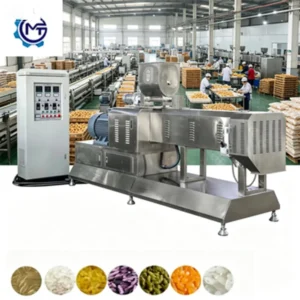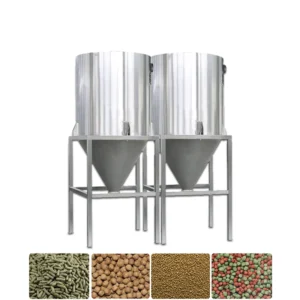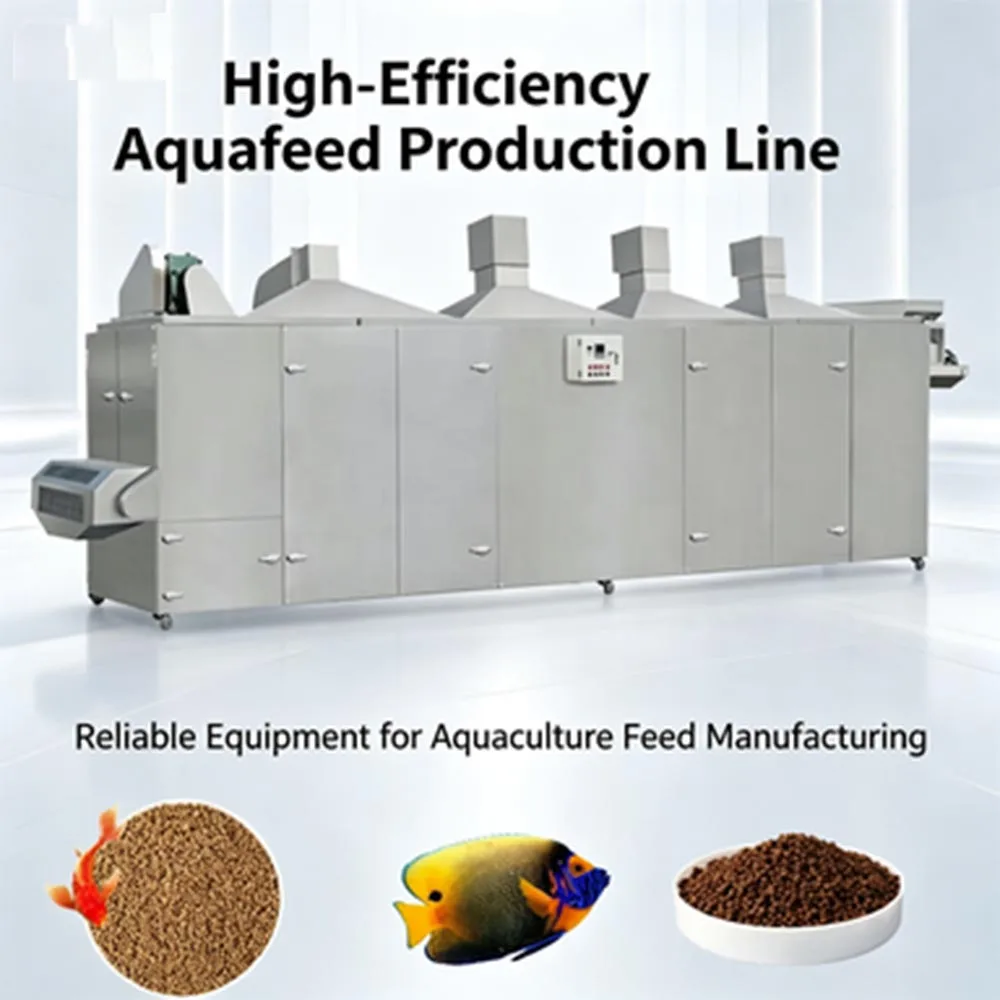
Integrated Line Throughput — every station from feeding to pelletizing is sized to hold continuous output without downstream bottleneck, verified on your raw material formulation before shipment.
Technical Specifications
| Parameter | Value |
|---|---|
| Product Type | Aquatic Feed Extrusion Production Line |
| Output Capacity | 500 kg/h (basis not stated in source — confirm raw material formulation, moisture content, pellet diameter) |
| Pellet Diameter Range | 0.5 mm – 12 mm |
| Extruder Type | Twin-screw |
| Control System | Simple control panel (PLC / MCC not specified in source) |
| Construction | Stainless steel main parts |
| Line Stations | Feeding, mixing, extruding, pelletizing (dryer, coating, cooling and packing not stated in source — confirm full line configuration) |
| Automation Level | Fully automatic continuous operation |
Application Suitability
| Application | Material or Output |
|---|---|
| Floating feed for catfish and tilapia | Starch-based formulations with protein and lipid blends producing buoyant pellets |
| Sinking feed for shrimp and bottom-feeders | High-protein formulations extruded at higher density for controlled water descent |
| Starter feed for fry and juvenile stages | Micro-pellets down to 0.5 mm diameter with uniform nutrient distribution |
| Grower and finisher feed batches | Pellets up to 12 mm diameter matched to fish mouth size and growth stage |
Why "500 kg/h" on Paper Often Fails on Your Actual Formulation
A line rated on generic starch cannot hold that same rate when you switch to high-fat aqua meal. The aqau feed production line full equipment you evaluate must be tested on your specific raw material blend, not a reference formula.
Many buyers receive a quotation stating a clean capacity number, only to find on commissioning day that their actual recipe — perhaps 30% fish meal with added lipid — drops throughput because the extruder barrel cannot deliver the same shear on denser material. Downstream dryers then receive uneven moisture loads and pellet quality fractures mid-run. These mismatches surface late, after shipping, when the cost to fix them is highest [NEED_CITE: twin-screw extrusion behaviour under varying lipid and protein ratios].
How Station Matching Controls Real Output
An aqau feed production line full equipment is only as productive as its most constrained station. When the extruder pushes a given mass flow, the dryer must remove a calculated moisture load within a fixed residence time, and the cooler must bring pellet temperature down before coating begins. If any single station is undersized, the entire line slows to that station’s ceiling.
Each station in this line is specified to hold throughput in sequence, so the continuous run rate you plan during layout design is the run rate you get on the production floor.
Why Die Selection Determines Your Pellet Density and Float Rate
The die plate is where extrudate pressure converts into pellet geometry. Hole diameter, land length and open-area ratio together control expansion at the die face — and expansion controls whether the pellet floats or sinks. A die specified for 2 mm floating pellets will not produce 6 mm sinking pellets at the same density simply by changing the cutter speed.
Dies on this line are selected against your target pellet size and buoyancy specification, not carried over from a previous customer’s build [NEED_CITE: die land length and expansion ratio in twin-screw extrusion].
Screw Geometry, Barrel Zones and What They Mean for Your Formula
Twin-screw extrusion relies on the intermeshing screw profile to convey, compress and shear raw material through distinct barrel zones. The length-to-diameter ratio determines residence time — longer barrels give more zones for staged heating and moisture injection, which matters when your formulation contains heat-sensitive additives like vitamin premix or live probiotic coatings applied post-extrusion.
Stainless steel contact parts across the main stations resist the corrosive effect of fish meal salts and lipid oxidation residues, reducing daily wash-down degradation and extending intervals between screw element replacement.
What Happens When You Skip the Trial Run
Lines shipped without a trial run on customer raw material arrive at the site as unverified assemblies. Commissioning then doubles as product development — screw elements are swapped, die plates are re-ordered and dryer temperatures are guessed, all while your production schedule waits. Buyers who have been through this cycle describe weeks of lost output before the line holds a stable pellet spec.
These delays are entirely preventable with a pre-shipment trial that locks screw configuration, die geometry and moisture profile before the crate closes [NEED_CITE: pre-shipment trial run protocols for extrusion equipment].
Why Sourcing the Complete Line From One Supplier Matters
Single-vendor supply means throughput is calculated end-to-end rather than assembled from independent machine quotations. The feeding rate, mixer batch cycle, extruder mass flow, dryer residence time and cooler capacity are all derived from the same capacity model.
Screw and die configurations are recorded against your specific formulation, so reorders of wear parts match the original build rather than reverting to a generic set. In-house machine testing on your raw material before dispatch confirms pellet density, diameter and float rate against your written specification. CE and ISO certification documentation ships with the line, supporting customs clearance and local regulatory registration without follow-up requests.
Documentation & Verification
- Line layout and capacity calculation based on your raw material and target pellet diameter
- Machine specification sheet covering every station from feeder through pelletizer
- Screw and die configuration record tied to your formulation and buoyancy requirement
- Trial run report on your raw material confirming pellet density and float rate before dispatch
- Electrical schematic with voltage, frequency and control language confirmed for your site
- CE declaration of conformity and ISO certificate for customs and regulatory filing
Installation, Commissioning & Support
- Foundation load plan matched to total line weight and vibration profile of the twin-screw extruder
- Dedicated power circuit sized to the line’s total connected load with correct voltage and frequency
- Modular station delivery allowing phased positioning in workshops with limited overhead clearance
- First-run parameter logging covering barrel temperatures, screw speed and moisture injection rates
- Operator training on die changes, screw element inspection and daily hygiene procedures
- Wear parts list identifying screws, dies and cutter blades with reorder intervals
What to Include in Your Inquiry
To move from general capacity discussion to a line layout that fits your facility, your enquiry should cover three areas: the raw material formulation you plan to run and the target pellet diameter range, the available workshop footprint and ceiling height, and the local voltage and frequency standard along with preferred control language. If you have existing upstream milling or downstream packing equipment, note the interface specifications so the line can be configured around them.
Frequently Asked Questions
Q: How is the stated capacity verified against my actual raw material?
A: Capacity is confirmed during a trial run using your formulation in the testing workshop. Screw speed, barrel temperature and die configuration are adjusted until pellet density, diameter and float rate match your written specification, and the sustained run rate is recorded in the trial report before dispatch.
Q: Which stations are included, and are downstream units matched to extruder output?
A: The base line covers feeding, mixing, extruding and pelletizing. Dryer, coating, cooling and packing stations are configured separately based on your throughput requirement and pellet finish specification, with each station sized to hold the extruder’s mass flow without bottleneck.
Q: Are screw and die sets specific to my target pellet density and float rate?
A: Yes. Screw element profile and die plate geometry are selected against your formulation and buoyancy requirement. The configuration is documented so that replacement wear parts match the original build when first reorder is due.
Q: Is a trial run performed on my raw material before the line ships?
A: A full trial run is conducted in the testing workshop using your raw material. Pellet diameter, density, float rate and moisture content are measured and recorded. You receive the trial report before the line is crated for dispatch.