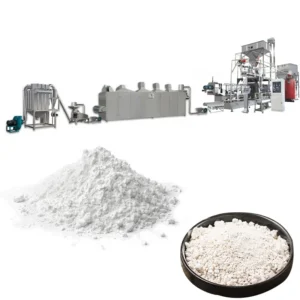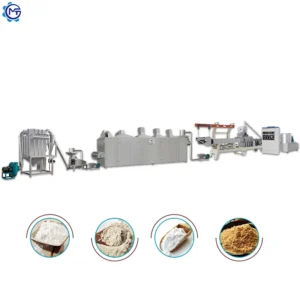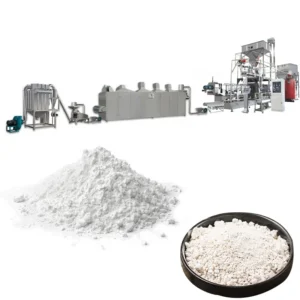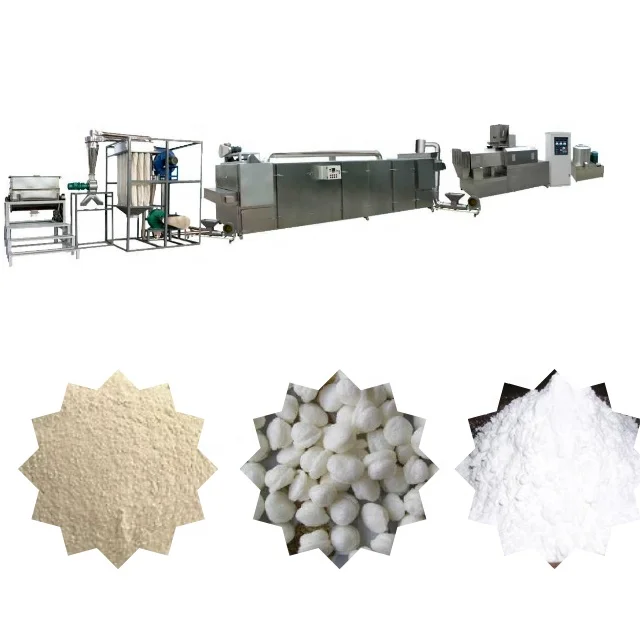
Throughput-Balanced Line Design — every station from mixer to packer is sized so no single machine chokes the modified starch processing line full equipment range output.
Technical Specifications
| Parameter | Value |
|---|---|
| Product Type | Modified Starch Twin Screw Extruder Production Line |
| Model Options | MT65 processing line / MT70 processing line / MT85 processing line |
| Screw Type | Twin screw |
| Line Stations | Mixing → Extrusion → Drying → Grinding → Blending → Packing |
| Rated Power | 60 kW (MT65); 80 kW (MT70); 145 kW (MT85) |
| Output Capacity | 100-150 kg/h (MT65); 200-250 kg/h (MT70); 300-500 kg/h (MT85) (basis not stated in source — confirm raw material type and moisture content) |
| Mixer Power | 3 kW |
| Mixer Output | 70-100 kg/h (basis not stated in source — confirm raw material type and moisture content) |
| Mixer Dimensions (L×W×H) | 900 × 700 × 1200 mm |
| Extruder Total Power | 22 kW |
| Extruder Dimensions (L×W×H) | 2800 × 800 × 1800 mm |
| Roasting Oven Power | 1.1 kW |
| Overall Line Dimensions (L×W×H) | 24000 × 1200 × 2200 mm (MT65); 26000 × 1500 × 2200 mm (MT70); 29000 × 3500 × 4300 mm (MT85) |
| Control System | Configurable PLC / MCC (confirm before order) |
| Voltage & Frequency | Configurable to plant supply (confirm before order) |
| Certification | CE, ISO |
Application Suitability
| Application | Material or Output |
|---|---|
| Pre-gelatinized starch for food processing | Corn starch, maize starch at controlled moisture |
| Modified starch for oil drilling fluids | Cassava starch, tapioca starch with cross-linking agents |
| Industrial starch for textile sizing | Potato starch, cassava starch with specific viscosity targets |
| Modified starch for paper making and chemicals | Corn starch, tapioca starch requiring precise gelatinization degree |
Why Starch Type Must Be Confirmed Before the Extruder Ships
A line rated on corn starch will not run cassava starch without reconfiguration.
I learned this the hard way not long ago. A customer in Southeast Asia ordered a modified starch processing line full equipment range setup based on corn starch trial data. Their actual raw material was cassava starch, which has a completely different gelatinization temperature profile. On day one at their plant, the expansion rate collapsed and an entire batch was scrapped. The extruder was fine — the screw configuration and barrel temperature curve were simply wrong for that material. [NEED_CITE: starch gelatinization temperature differences by source material]
Matching Screw Configuration to Your Raw Starch
Twin screw extrusion relies on shear force, residence time, and barrel temperature to achieve the target degree of starch modification. Corn starch, potato starch, cassava starch, and tapioca starch each demand a different screw element arrangement and die geometry. The modified starch processing line full equipment range is configured only after your specific raw material and target product specification are confirmed — not copied from a generic build sheet.
Trial Runs That Happen Before Your Line Leaves the Factory
Every modified starch processing line full equipment range order goes through an in-house testing workshop where your actual raw material is run on the exact extruder destined for your plant. The trial run produces a report documenting screw combination, barrel temperature zones, moisture input, and the resulting product properties. If the output does not meet your specification, the screw configuration is reworked and retested before the machines are cleared for packing. [NEED_CITE: in-house testing protocols for food extrusion machinery]
Reading the Specs That Actually Matter for Starch Modification
The twin screw design provides the shear and mixing intensity that single screw extruders cannot match for starch modification. The 22 kW extruder motor on this line delivers the torque needed to process high-viscosity starch melts without stalling. Line dimensions ranging from 24 meters to 29 meters in length reflect the physical footprint required for the full sequence — mixing, extrusion, drying, grinding, blending, and packing — with adequate spacing for maintenance access. The 3 kW mixer handles preconditioning at 70-100 kg/h, which must be verified against your material’s bulk density and moisture absorption rate to ensure continuous feeding without surging into the extruder barrel.
The Hidden Cost of Skipping Raw Material Verification
When an extruder ships without a trial run on the buyer’s actual starch, the first weeks of production become an expensive experiment. Wrong screw elements mean inconsistent gelatinization — some particles fully modified, others barely touched. The dryer then receives material with uneven moisture, forcing operators to slow the entire line or accept off-spec product. Wear parts like screws and dies degrade faster under mismatched conditions, and replacements may not arrive for weeks. [NEED_CITE: downstream quality impact of extruder misconfiguration]
Why This Line Is Built Under One Roof
Sourcing mixers, extruders, dryers, and packing stations from separate vendors creates throughput gaps that surface only after installation. This modified starch processing line full equipment range is designed as a single system where the mixer output, extruder feed rate, dryer belt speed, and grinder capacity are calculated together. Screw configuration and die design are specified to your raw starch material and target modification grade, not borrowed from a standard catalog. The in-house testing workshop runs your material before shipment so adjustments happen at the factory, not on your floor. CE certification covers the complete line rather than individual machines patched together.
Documentation & Verification
- Line layout drawing with capacity calculation showing throughput at each station
- Screw and die configuration record matched to your starch type and modification target
- Trial run report from in-house testing on your raw material before dispatch
- Electrical schematic with confirmed voltage and frequency for your plant
- Operation and maintenance manual covering all line stations
- Wear parts list with recommended spare inventory
Installation, Commissioning & Support
- Foundation and floor space planning based on the selected line dimensions up to 29000 × 3500 × 4300 mm
- Electrical connection verified against confirmed voltage, frequency, and the total rated power up to 145 kW
- Modular station assembly with alignment checks across the full mixing-to-packing sequence
- First-run parameter setting using the trial run report as the baseline configuration
- Operator training covering PLC or MCC control interface in the confirmed language
- Spare screw elements and die plates supplied with recommended inventory for initial production
What to Include in Your Inquiry
Send your raw starch material type — corn, cassava, potato, or tapioca — along with the target modification specification such as pre-gelatinized, cross-linked, or oxidized. Include your plant voltage and frequency, preferred control language, available floor area and ceiling height, and your target daily output so the line tier can be matched. If you have existing upstream or downstream equipment that must integrate, provide those details as well.
Frequently Asked Questions
Q: How is the stated output capacity verified for my specific starch material?
A: The kg/h figures depend on raw material type, moisture content, and target modification degree. A trial run on your actual starch in the in-house testing workshop generates a capacity report before shipment. This report documents the screw configuration, barrel temperatures, and measured throughput under your material conditions.
Q: What voltage and frequency options are confirmed before production begins?
A: Voltage and frequency are confirmed during the specification stage based on your plant’s utility supply. The electrical schematic and motor ratings are then aligned to your local standard before manufacturing starts, preventing commissioning delays caused by mismatched power configurations.
Q: How are screw elements and die geometry chosen for my starch type?
A: Each starch — corn, cassava, potato, tapioca — has a different gelatinization temperature and viscosity behavior. The screw combination and die design are specified after reviewing your raw material data and target product properties, then validated during the in-house trial run.
Q: What does the pre-shipment trial run report cover?
A: The report includes the screw configuration used, barrel temperature profile across all zones, moisture input level, measured output rate, and product quality parameters such as degree of gelatinization. It serves as the baseline for commissioning at your plant.
Q: Which spare wear parts should I stock for the first two years?
A: Screws, die plates, and barrel liners are the primary wear items. A recommended spare parts list is provided with your line documentation, sized for your production volume and the abrasiveness of your starch formulation and any added reagents.