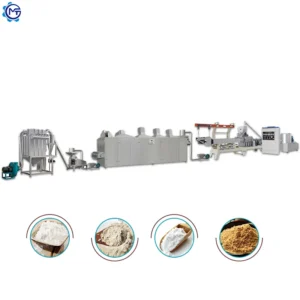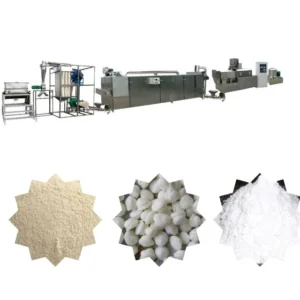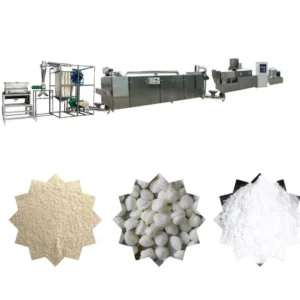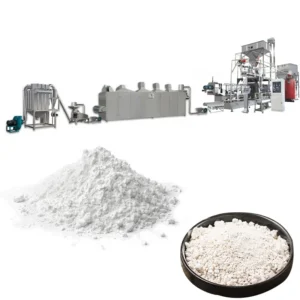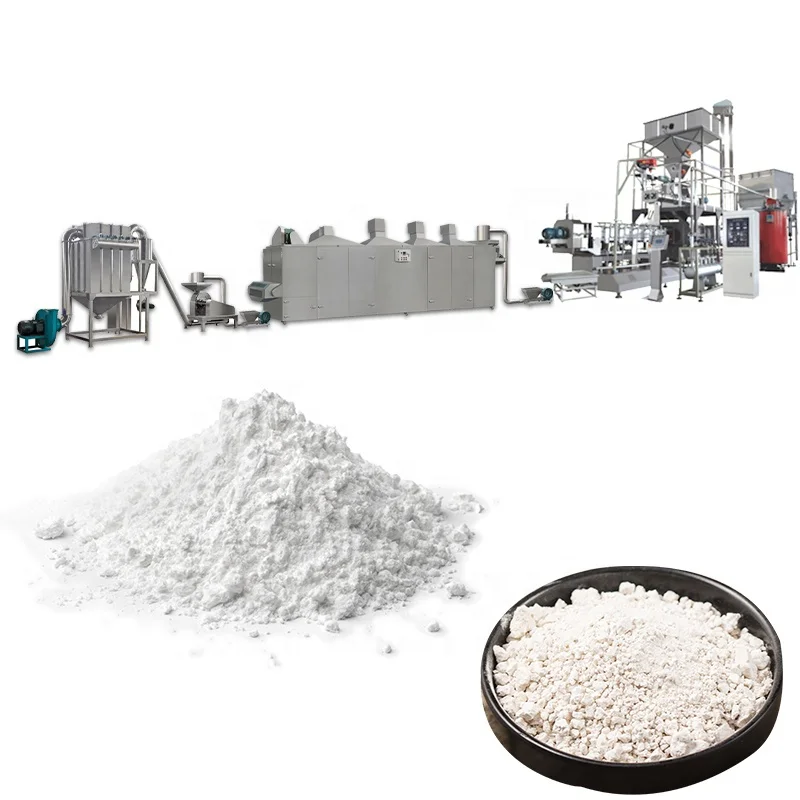
Screw Configuration Matched to Raw Material — Every modified starch processing line is trialled in the testing workshop on the buyer’s actual starch source before shipment, ensuring the screw profile and die geometry deliver the target gelatinisation and denaturation rather than a generic setting that fails on arrival.
Technical Specifications
| Parameter | Value |
|---|---|
| Product Type | Twin Screw Extrusion Modified Starch Processing Line |
| Extruder Type | Twin screw extruder |
| Raw Materials | Wheat flour, corn starch, potato starch |
| Capacity Range | 80–500 kg/h (basis not stated in source — confirm raw material type, moisture content and target modification degree) |
| Main Motor (Mixer) | 4.0 kW |
| Main Motor (Screw Conveyor) | 1.1 kW |
| Total Electrical Power | approx. 100 kW (electricity heating); 50–60 kW (gas or diesel heating) (rated or peak not specified in source) |
| Voltage & Frequency | Three phases 380V/50Hz; Single phase 220V/50Hz (customizable to local voltage) |
| Frame Material | Stainless steel 201 |
| Contact Material | Food grade stainless steel 304 |
| Control System | PLC and MCC (source value — verify against manufacturer catalog) |
| Process Flow | Mixer → Screw conveyor → Twin screw extruder → Air conveyor → Dryer → Air conveyor → Conditioning → Conveyor → Grinder |
| Energy Options | Electricity / gas / diesel / steam |
| Inverter & Electrical Components | Siemens (China-made) or China top brand motor; Delixi or Delta inverter |
| Assembly State | Complete line with supporting equipment |
| Standards | CE certified; ISO certified |
Application Suitability
| Application | Material or Output |
|---|---|
| Food-grade modified starch production | Corn starch, wheat flour and potato starch processed through gelatinisation and denaturation for use as thickeners, stabilisers and binders in food manufacturing |
| Industrial starch modification for paper manufacturing | Corn starch and wheat flour treated to alter viscosity and adhesive properties for paper coating and sizing applications |
| Adhesive-grade starch processing | Corn starch and potato starch modified to achieve specific tack and bonding characteristics for industrial adhesive formulations |
What "80–500 kg/h" Actually Depends On
Capacity on a modified starch processing line is not a fixed number — it moves with the raw material you feed in.
A line quoted at the top of the range on corn starch may only deliver mid-range output when you switch to potato starch, because the gelatinisation temperature, moisture absorption rate and shear sensitivity all change. I have watched buyers receive an extruder rated for their target capacity, only to discover during commissioning that their actual starch source — with a different amylose ratio or moisture content — demands a completely different screw speed and feed rate to achieve the same modification degree. The throughput gap between the quoted figure and the real output can stretch commissioning by weeks. This is why the modified starch making machine manufacturer must see your specific material before the screw configuration is locked in. [NEED_CITE: starch gelatinisation temperature variation across botanical sources]
How Each Station Connects to the Next
A modified starch processing line is not just an extruder with auxiliary machines bolted on. The mixer must discharge at a rate the screw conveyor can sustain without surging, the extruder must output at a moisture level the dryer can handle within its residence time, and the conditioning station must receive material cool and dry enough to accept surface treatment without clumping. When any one station is sized independently, the bottleneck appears at start-up — typically at the dryer, where insufficient capacity forces the extruder to throttle back. Specifying the full modified starch processing line equipment set under one supplier means the throughput calculation flows from the raw material forward through every station, not backward from a nominal extruder rating.
Why Starch Source Changes Everything About the Screw Profile
Corn starch, wheat flour and potato starch differ in granule size, amylose-to-amylopectin ratio and gelatinisation onset temperature. A screw configuration that delivers correct shear and residence time for corn starch may under-process potato starch, leaving unmodified granules that fail downstream viscosity tests. The die design also shifts: potato starch tends to expand more aggressively at the die face, requiring a different land length and orifice geometry to control density. This is why generic screw builds — copied from one starch type and applied to another — produce inconsistent modification. The twin screw extruder in this line is configured after a trial run on the buyer’s actual material in the testing workshop, so the screw elements, barrel temperature profile and die geometry are documented before production begins. [NEED_CITE: twin screw extrusion screw element selection for starch modification]
Reading the Spec Sheet Against Your Production Reality
The total electrical power draw sits at approximately 100 kW when the line runs with electric heating, dropping to 50–60 kW with gas or diesel heating — this distinction directly affects your transformer sizing and utility application at the destination site. The PLC and MCC control system manages the full sequence from mixer discharge through grinder output, but the control language and HMI labels must be confirmed before the panel is wired, not after arrival. Food grade stainless steel 304 on all contact surfaces prevents iron contamination that would discolour white starch products, while the stainless steel 201 frame keeps the non-contact structure corrosion-resistant without over-specifying the alloy. The inverter options — Delixi or Delta — determine which spare parts are locally serviceable in your market, a detail that matters when a drive fault halts production and the replacement must come from a regional distributor rather than overseas. [NEED_CITE: industrial voltage and frequency standards by export market]
The Hidden Cost of Skipping the Dryer Calculation
When the dryer is undersized relative to the extruder output, the line does not fail immediately — it degrades slowly. Moisture content at the conditioning station creeps above specification, causing the starch to clump during surface treatment. The grinder then receives material that is too soft, producing inconsistent particle size and forcing the operator to reduce extruder feed rate to compensate. The quoted capacity becomes irrelevant because the real throughput is now dictated by the slowest station. I have seen this pattern repeat with modified starch processing line equipment assembled from separate vendors, where each machine was rated correctly in isolation but the line as a whole could never hold its nominal output on the buyer’s actual starch material. [NEED_CITE: dryer capacity matching in extrusion-based starch processing]
Why Procurement Through One Supplier Changes the Outcome
The complete line from mixer to grinder is configured as a single throughput calculation, so the screw conveyor rate, extruder output and dryer residence time are all derived from the same raw material data rather than assembled from independent quotations. Screw configuration and die design are specified to the buyer’s starch source and target modification degree, not copied from a generic build. The in-house testing workshop runs your actual corn starch, wheat flour or potato starch before shipment, producing a trial run report that documents screw speed, feed rate, barrel temperature profile and output moisture. Energy flexibility across electricity, gas, diesel and steam lets the line match local utility infrastructure without requiring a separate heater retrofit. Electrical schematics confirm voltage, frequency and control language for the destination country before the panel is wired, eliminating the commissioning delays that occur when a 380V/50Hz machine arrives at a 440V/60Hz site.
Documentation & Verification
- Line layout and capacity calculation based on your specific starch type, moisture content and target modification degree
- Screw and die configuration record documenting element arrangement, land length and orifice geometry for your material
- Electrical schematic with voltage, frequency and control language confirmed for the destination country before panel assembly
- Trial run report from the testing workshop on your actual raw material, including barrel temperature profile and output moisture data
- CE declaration of conformity and ISO certificate covering the complete line
- Wear parts list specifying screws, dies and conveyor components included with the first shipment
Installation, Commissioning & Support
- Foundation and floor space planning based on the full line footprint from mixer through grinder, including air conveyor routing and dryer clearance
- Dedicated electrical circuit sized for approximately 100 kW total draw with electric heating, or 50–60 kW with gas or diesel heating options
- Line arrives as a complete set of stations with assembly instructions and connection points between each machine clearly marked
- First-run parameter setting covers screw speed, feed rate, barrel temperature zones and dryer residence time, calibrated to your starch material
- Operator training covers PLC and MCC interface navigation, screw and die changeover procedures, and daily inspection routines
- Spare wear parts including screws, dies and conveyor components shipped with the line to cover the first replacement cycle
Before You Request a Quote
To configure a modified starch processing line that holds its rated output on your material, the following details shape the proposal. Provide the botanical source and grade of starch you will process — corn, wheat or potato — along with its moisture content and the target modification specification your downstream application requires. Specify the local voltage, frequency and available energy source at your facility so the heating system and motor ratings are set correctly before production. If you can ship a sample of your raw material to the testing workshop, the screw configuration and dryer sizing will be based on actual trial data rather than a generic calculation.
Frequently Asked Questions
Q: How is the 80–500 kg/h capacity range verified against my specific starch material and moisture level?
A: The capacity range is a reference window, not a guaranteed output. Your actual throughput depends on the botanical source of the starch, its incoming moisture content and the target modification degree. We run your material in the testing workshop and document the achievable output, screw speed and barrel temperature profile in a trial run report before the line is finalised for production.
Q: What voltage, frequency and control language options are confirmed before production begins?
A: The standard configuration is three-phase 380V/50Hz with single-phase 220V/50Hz, but both are customisable to match your local utility supply. Voltage, frequency and HMI control language are confirmed in the electrical schematic before the control panel is assembled, so the PLC interface and motor ratings arrive ready for your site without rewiring or reprogramming delays.
Q: How are the dryer and conditioning stations sized to avoid bottlenecking the extruder output?
A: The dryer capacity is calculated from the extruder discharge rate and the moisture reduction required before conditioning. Residence time, airflow temperature and belt length are all derived from the same raw material data used to set the extruder screw speed, ensuring every station in the modified starch processing line equipment set sustains the same throughput.
Q: Can I send my raw material for a trial run in your testing workshop before the line ships?
A: Yes. We request a sample of your actual starch material — corn, wheat or potato — so the trial run reflects your real production conditions. The resulting report documents screw configuration, barrel temperature profile and output quality, and it forms the basis for the final machine specification before shipment.
Q: What spare wear parts such as screws, dies and conveyor components are included with the first shipment?
A: A wear parts list is prepared for each line based on the screw elements, die plates and conveyor components most subject to wear during starch extrusion. The first shipment includes a replacement set so you can schedule changeovers without waiting for overseas delivery when the initial parts reach their service limit.