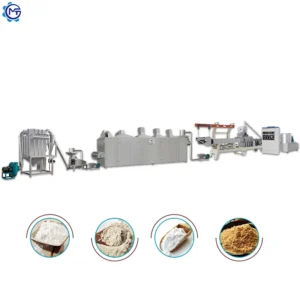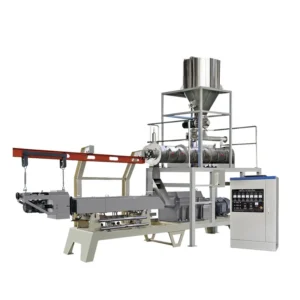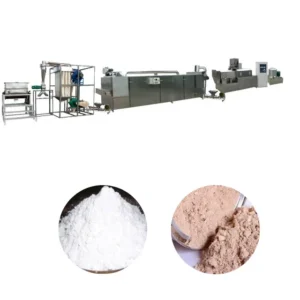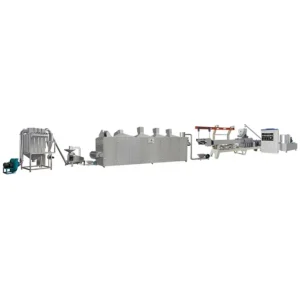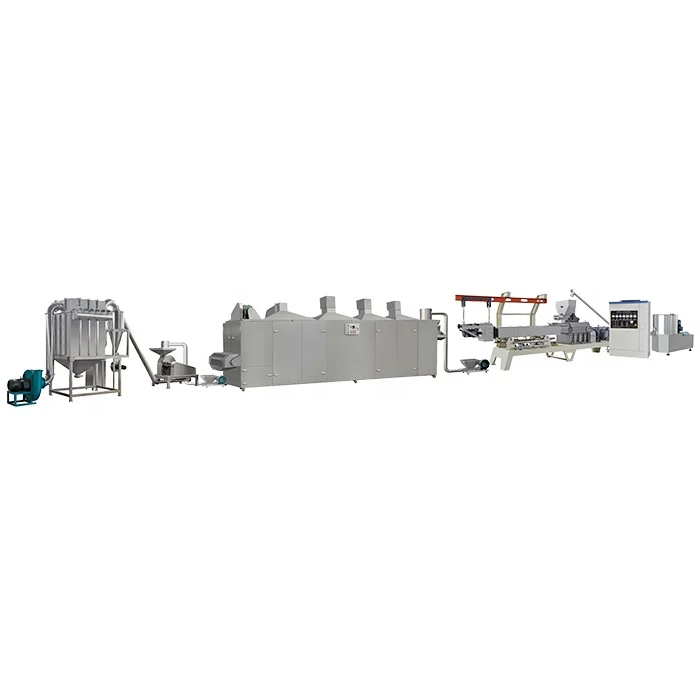
Throughput-Matched Line Design — every station from the batching mixer through the twin-screw extruder to the pulse grinder is sized under one supplier so the modified starch processing line equipment holds its rate without one section starving or flooding the next.
Technical Specifications
| Parameter | Value |
|---|---|
| Product Type | Modified Starch Twin-Screw Extrusion Processing Line |
| Models Available | MT70 / MT85 / MT75 |
| Screw Type | Twin-screw, 38CrMoAl |
| Screw Diameter (MT70) | 70 mm |
| Screw Length (MT70) | 1520 mm |
| Main Motor Power (MT70) | 30 kW |
| Installed Power Range | 160–210 kW (model dependent) |
| Power Consumption Range | 120–150 kW (model dependent) |
| Output Capacity | 150–500 kg/h (basis not stated in source — confirm raw material type, moisture content, and target modification grade) |
| Barrel Heating | 7-zone, 14 kW total |
| Barrel Cooling | Integrated temperature control system |
| Mixer Capacity Options | 20–30 / 70–80 / 170–180 kg per batch |
| Mixer Power | 4 / 7.5 / 15 kW (model dependent) |
| Dryer Type | 5-layer baking oven, 201 stainless steel |
| Dryer Fuel Options | Gas / Diesel / Electricity / Steam (buyer to confirm) |
| Dryer Dimensions | 5.0 × 1.2 × 2.3 m |
| Grinding System | Pulse grinder with cyclone discharge and dust collector |
| Voltage Options | 380V/50Hz, 380V/60Hz, 415V/60Hz, 220V/60Hz (three phase) |
| Contact Material | Food-grade stainless steel |
| Standards | CE, ISO |
Application Suitability
| Application | Material or Output |
|---|---|
| Food-grade modified starch (E1422 acetylated distarch adipate, others) | Corn starch, wheat flour, native starches — for sauces, dressings, dairy, bakery |
| Industrial starch for textile sizing | Native starch modified for warp yarn adhesion and abrasion resistance |
| Papermaking and building material starch | Modified starches targeting specific viscosity and binding profiles |
| Starch for oil drilling and casting | Pregelatinised and chemically modified grades for fluid loss control |
Why Nominal Capacity Numbers Mislead on Modified Starch Lines
A rated throughput means nothing if it was measured on a different starch source than yours.
I have watched buyers sign off on a modified starch processing line equipment package quoted at a clean hourly figure, only to find during commissioning that their local corn starch — different amylose ratio, different moisture — gelatinises at a different temperature and either runs too wet or blocks the die entirely. The extruder runs, but the dryer cannot keep up, and the grinder chokes on material that never dried properly. That bottleneck is not a machine fault; it is a specification gap [NEED_CITE: common causes of extrusion line throughput mismatch]. Asking for the test basis behind every capacity claim is not being difficult — it is the only way to compare two quotes on equal terms.
Seven-Zone Barrel Control and Starch Gelatinisation Precision
The twin-screw extruder on this modified starch processing line equipment carries seven independent heating zones totalling 14 kW, paired with an integrated barrel cooling circuit. Starch modification depends on hitting a narrow gelatinisation window: too cool and the granules remain native, too hot and you get excessive dextrinisation that ruins the viscosity profile the buyer needs. Separate zone control lets the operator build a temperature ramp that matches the specific thermal behaviour of the raw starch being fed, rather than relying on a single averaged barrel temperature that works for nothing in particular.
Five-Layer Dryer Configuration and Residence Time Matching
After extrusion, the modified starch enters a five-layer baking oven measuring 5.0 × 1.2 × 2.3 m with inverter-driven belt speed. The multi-pass design gives the material enough residence time to reach target moisture without requiring an excessively long single-belt dryer that would dominate the factory floor. Fuel flexibility — gas, diesel, electricity, or steam — means the dryer can be specified against the utility infrastructure available at the installation site rather than forcing the buyer to add a dedicated energy supply [NEED_CITE: industrial dryer fuel selection criteria for starch processing].
Reading the Specs That Actually Matter
The screw diameter and length together define the L/D ratio, which governs how long the starch stays inside the barrel and how much shear it receives. The MT70 at 70 mm diameter and 1520 mm length offers a moderate L/D suitable for standard modification grades; higher-capacity models (MT85, MT75) scale barrel volume and motor power together so throughput increases without cutting residence time short. The 38CrMoAl screw material resists the abrasive wear that starch granules cause over thousands of hours, maintaining the tight clearance between screw flight and barrel wall that consistent modification requires. Voltage customisation across four common industrial standards prevents the situation where a line arrives on site and the local panel builder has to rewire motor starters before commissioning can begin.
The Hidden Cost of Assembling a Line from Separate Vendors
When the mixer, extruder, dryer, and grinder come from different suppliers, nobody owns the throughput balance. A mixer that batches faster than the extruder can accept means wet starch sitting in the trough, fermenting. A dryer sized for a lighter snack product rather than dense modified starch leaves moisture in the material, and the grinder produces a gummy powder that packs out the cyclone. These are not warranty claims — each vendor’s machine performs to its own spec sheet — but the line as a whole never reaches the rate the buyer planned around [NEED_CITE: throughput balancing in multi-vendor food processing lines].
Why Source This Modified Starch Line Here
Complete line supply from batching through grinding means every station is selected to match the next, not quoted as standalone machines. Screw configuration and die design are specified against the buyer’s actual raw starch and target modification grade, not copied from a generic build. An in-house testing workshop allows trial runs on the customer’s own material before the line ships, so gelatinisation behaviour and powder characteristics are confirmed early. Voltage, frequency, and control language are locked down during the quotation stage to match the destination site. Twin-screw extrusion expertise covers modified starch alongside pet food, aquatic feed, snacks, and cereals, meaning process knowledge transfers across product categories.
Documentation & Verification
- Line layout drawing showing station spacing and utility connection points for your factory floor
- Screw and die configuration record matched to your starch source and target E-number grade
- Trial run report on your raw material covering temperature curve, moisture, and powder analysis
- Electrical schematic with confirmed voltage, frequency, and component language before production
- Factory test record documenting run-in hours and throughput observations prior to crating
Installation, Commissioning & Support
- Overall line length up to 45 m requires level concrete floor with anchor provisions at each station
- Installed power up to 210 kW demands a dedicated three-phase supply with appropriate breaker rating
- Dryer fuel connection to be confirmed at order — gas train, steam header, or electrical bus
- First commissioning includes barrel temperature profiling and screw speed tuning on your starch
- Operator training covers mixer batch timing, extruder zone settings, and grinder screen changes
- Wear parts list covers screws, dies, heating rings, and dryer belt sections with reorder references
What to Prepare Before Requesting a Quote
Send the specific native starch you will process — corn, wheat, tapioca, or other — along with its typical moisture content and the modification grade or E-number you target. Confirm your site voltage, frequency, and preferred control interface language. Share available floor space and ceiling height so the line layout can be drafted to fit. If you have existing upstream silos or downstream packing equipment, provide their capacity ratings so the new line can be matched to them.
Frequently Asked Questions
Q: On what basis is the output capacity measured?
A: The stated capacity range of 150–500 kg/h across the three models is based on specific raw material and moisture conditions to be confirmed during the quotation stage. We validate throughput against your actual starch source and target modification grade during an in-house trial run, so the figure you receive reflects your product rather than a generic test material.
Q: Can voltage and frequency be adapted before the line ships?
A: Yes. The line is configurable across 380V/50Hz, 380V/60Hz, 415V/60Hz, and 220V/60Hz three-phase supplies. Voltage, frequency, and control panel language are confirmed with the buyer before production begins, so motor starters, heaters, and PLC interfaces match the destination site without field modification.
Q: Is a trial run performed before delivery, and what does the report cover?
A: A trial run using your raw starch is conducted in the manufacturer’s testing workshop before shipment. The resulting report documents barrel temperature settings across all seven zones, screw speed, moisture readings at extruder discharge and dryer exit, and the final ground powder characteristics relevant to your target application.
Q: How is throughput balanced between mixer, extruder, dryer, and grinder?
A: Each station is selected and sized by the same supplier based on the target output and material behaviour. Mixer batch cycle time, extruder feed rate, dryer belt speed and residence time, and grinder capacity are all calculated together so no single station becomes a bottleneck that limits the modified starch processing line equipment below its intended rate.
Q: What spare wear parts ship with the line?
A: The initial delivery includes a wear parts set covering screw sections, die plates, and heating rings. A detailed wear parts list with part numbers is provided so replacements can be sourced directly when the first changeover is due, minimising unplanned downtime during early production months.