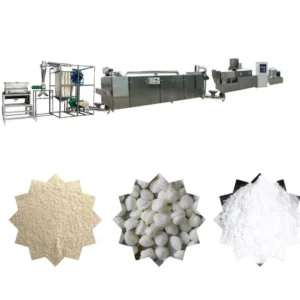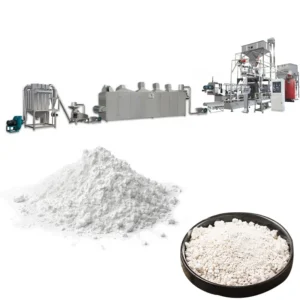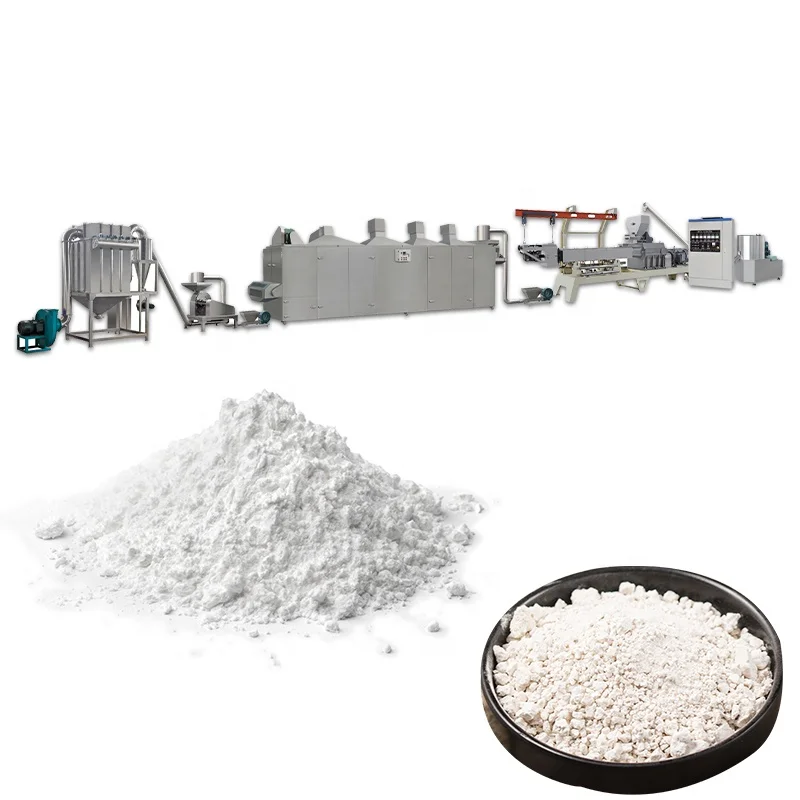
Balanced throughput across every station — the modified starch processing line is configured so extruder, dryer, and packing capacities align to your raw material and target output rather than assembled from mismatched standalone machines.
Technical Specifications
| Parameter | Value |
|---|---|
| Product Type | Modified Starch Twin-Screw Extrusion Production Line |
| Model | MT70 |
| Alternative Models Available | MT85, MT100 |
| Screw Type | Twin-screw |
| Screw Diameter | 70 mm |
| Screw Length | 1520 mm |
| Screw Material | 38CrMo |
| Installed Power | 160 kW |
| Power Consumption | 120 kW |
| Main Motor Power | 30 kW |
| Output Capacity | 150–200 kg/h (basis not stated in source — confirm raw material type, moisture content, and target starch modification level) |
| Feeding Power | 0.75 kW |
| Cutting Power | 0.75 kW |
| Oil Pump | 0.37 kW |
| Heating Ring | 7 × 2 kW = 14 kW |
| Voltage & Frequency | 380V 50Hz Three Phase |
| Extruder Dimensions | 2900 × 900 × 1820 mm |
| Complete Line Dimensions | 41000 × 1500 × 2200 mm |
| Cooling System | Integrated barrel cooling |
| Control System | PLC and MCC control |
| Fuel/Energy Options | Gas, diesel, electricity, steam (buyer selectable) |
| Food Contact Materials | Food-grade stainless steel (PVC on select conveyors) |
| Standards | CE, ISO |
| Warranty | 1 year, lifetime maintenance service |
Application Suitability
| Application | Material or Output |
|---|---|
| Food-grade modified starch | Wheat flour, corn flour as base starch for thickeners and stabilisers |
| Industrial starch for textile sizing | Corn-based starch modified for warp yarn treatment |
| Paper coating starch | Wheat or corn starch modified for surface strength and printability |
| Oil drilling fluid starch | Corn or cassava starch modified for thermal stability and viscosity control |
| Pre-gelatinised starch production | Native starch sources processed for instant thickening in dry-mix applications |
Why a Nominal Capacity Figure Cannot Stand Alone
A modified starch processing line full equipment range quoted on a single throughput number means very little until you pin down the raw material and the modification target. Capacity depends on the starch source, incoming moisture, and the degree of gelatinisation or cross-linking required.
I have watched lines that ran smooth on cassava starch stall when the buyer switched to corn flour because the gelatinisation temperature window shifted and the barrel profile was never recalibrated. The extruder barrel on the MT70 carries seven independent heating zones plus integrated cooling, which gives the operator room to match a new starch source — but only if the screw configuration and temperature curve are set against that specific material from the start. When suppliers quote a flat number without stating the basis, the buyer ends up discovering the real output during commissioning on the factory floor [NEED_CITE: starch gelatinisation temperature ranges across common raw materials]. That is an expensive place to learn the truth.
How Barrel Temperature Zones Shape Starch Modification
Starch modification inside a twin-screw extruder depends on holding the material within a narrow thermal band long enough for gelatinisation but not so long that molecular degradation begins. The seven heating rings on the MT70 allow staged temperature ramping along the 1520 mm screw length, which is critical when processing modified starch for applications like oil drilling where thermal stability of the final product is non-negotiable. Integrated barrel cooling prevents runaway heat in high-shear zones, keeping the starch modification level consistent from the first hour of a run to the last.
Matching Screw Configuration to the Starch Source
Every starch source behaves differently under shear and heat. Corn starch requires a different compression ratio and residence time compared to wheat or cassava starch to achieve the same degree of modification. The twin-screw configuration on the MT70 allows the screw element sequence to be rearranged — adjusting kneading block placement and pitch — so that the mechanical energy input matches what the raw material actually needs. Running a generic screw profile copied from another product is a common reason buyers see incomplete gelatinisation or uneven viscosity in their output [NEED_CITE: twin-screw element arrangement and starch shear behaviour].
Reading the Specification Table Against Your Production Target
The installed power of 160 kW with operating consumption around 120 kW tells you the line has headroom for demanding modification levels such as cross-linking or esterification that require sustained barrel heat and high shear. The 30 kW main motor drives the twin screws through a gearbox rated for continuous duty, which matters when processing industrial starch for textile or paper applications where the line may run multiple shifts. Overall line dimensions of 41000 × 1500 × 2200 mm indicate the full footprint from batching through drying and packing, so buyers can verify workshop clearance before committing to a layout. The PLC and MCC control architecture centralises parameter monitoring, meaning an operator can track barrel temperatures, screw speed, and feed rate from a single interface rather than walking the line to adjust individual stations.
The Cost of Mismatched Stations Downstream
An extruder that outpaces its dryer creates a pile of wet, partially modified starch that clumps before it ever reaches the coating or packing stage. I have seen buyers add a dryer after the fact, only to find the footprint and utility connections do not align with the existing line layout. When the dryer is undersized, moisture content in the final product drifts above specification, and downstream packing equipment jams or seals poorly. These are not problems that surface during a factory demo — they appear weeks into production when throughput demands are real [NEED_CITE: moisture content tolerances for modified starch packaging].
What Distinguishes a Single-Source Line Build
Sourcing the entire modified starch processing line full equipment range from one manufacturer means throughput calculations are done across every station before metal is cut. The batching system feeds at a rate the extruder can absorb, the extruder discharges at a rate the dryer can handle, and the dryer delivers material at a moisture level the packing station is rated for. Screw configuration and die design are documented against the buyer’s specific raw material rather than carried over from a previous project. An in-house testing workshop runs trial batches on the buyer’s actual starch source before shipment, producing a trial report that records temperature profiles, screw speed, and output quality. Fuel and energy options — gas, diesel, electricity, or steam — are selected to match the utility infrastructure at the installation site. Every machine contact surface is food-grade stainless steel, meeting requirements for both food and industrial starch applications.
Documentation & Verification
- Line layout drawing showing station-by-station throughput matching for your target output
- Screw and die configuration record matched to your specific starch source and modification level
- Electrical schematic with voltage and frequency confirmed against your facility supply
- Trial run report from in-house testing workshop using your actual raw material batch
- Factory test record documenting barrel temperature stability and output consistency before dispatch
- Operation and maintenance manual with wear parts list for screws, dies, and heating rings
Installation, Commissioning & Support
- Foundation plan based on 41000 × 1500 × 2200 mm line footprint with utility connection points marked
- Dedicated three-phase 380V 50Hz circuit with 160 kW installed capacity confirmed before energising
- Extruder and dryer delivered in sectional modules for assembly inside existing workshop clearances
- First-run commissioning includes barrel temperature calibration and screw speed mapping to your starch source
- Operator training covers PLC interface navigation, recipe storage, and alarm response procedures
- Wear parts inventory including 38CrMo screw elements and heating rings stocked for rapid dispatch
- Preventive maintenance schedule aligned to heating ring inspection and screw wear measurement intervals
What to Prepare Before Requesting a Quotation
Share the specific starch source you plan to process — corn, wheat, cassava, or a blend — along with the target modification type and end-use application. Provide your workshop dimensions and ceiling height so the line layout can be drafted around existing columns and utility drops. Confirm the local voltage and frequency standard and whether your preference for dryer fuel is gas, steam, electricity, or diesel. If you have existing upstream mixers or downstream packing equipment, note their throughput ratings so the new modified starch processing line can be matched accordingly.
Frequently Asked Questions
Q: What supporting stations are included and how is throughput matched across the full line?
A: The line covers batching, mixing, twin-screw extrusion, drying, cooling, and packing as one integrated system. Each station is sized so its maximum throughput aligns with the extruder output rate, preventing bottlenecks. Capacity calculations are documented against your raw material and target modification before the layout is finalised.
Q: Can the screw configuration and barrel profile be tailored to my specific starch source?
A: Yes. The twin-screw assembly on the MT70 allows kneading blocks and conveying elements to be rearranged along the 1520 mm barrel. Heating zones and cooling channels are then calibrated to the gelatinisation window of your starch source, whether corn, wheat, or cassava.
Q: Is a trial run on my raw material conducted before shipment?
A: The in-house testing workshop processes a sample batch of your actual starch source through the extruder and records barrel temperature profiles, screw speed settings, and product quality data. A full trial report accompanies the shipment so commissioning starts from a verified baseline.
Q: What voltage, frequency, and control language options are available?
A: The standard configuration is 380V 50Hz three-phase, but voltage and frequency are confirmed against your facility supply before production. The PLC and MCC control interface can be set to the operator language required at your site to prevent miscommunication during production runs.
Q: How is the line layout adapted to my workshop area and utility points?
A: The complete line spans approximately 41 metres in length. Layout drawings are drafted around your workshop columns, ceiling height, and existing utility connections for water, gas, steam, or electricity. Dryer fuel type is selected to match the energy infrastructure available at your facility.