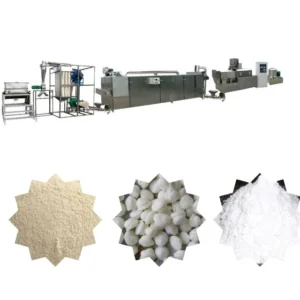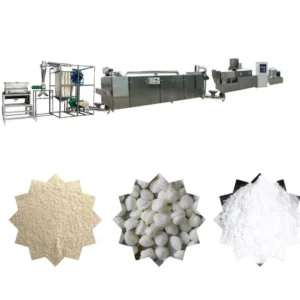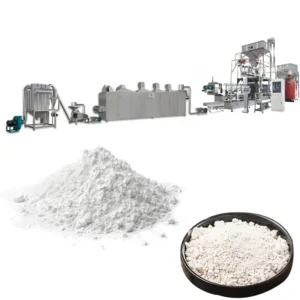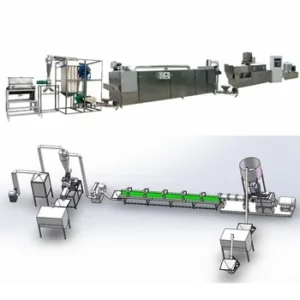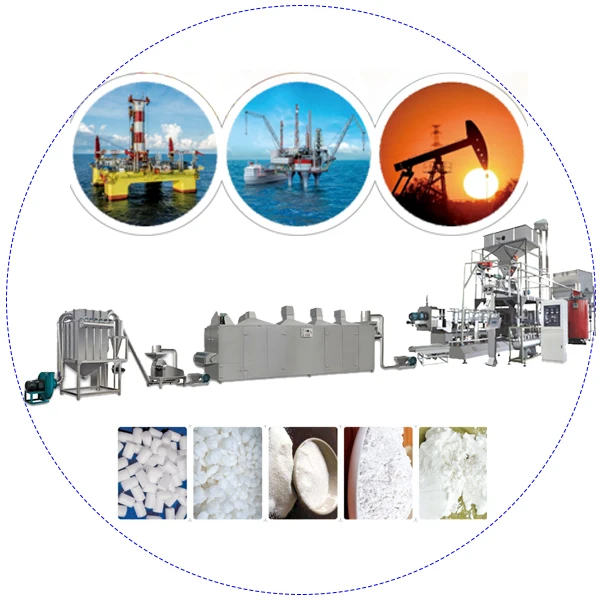
Integrated Line Matching — throughput across every station from batching to grinding is calculated against your raw material rather than assembled from standalone machines.
Technical Specifications
| Parameter | Value |
|---|---|
| Product Type | Modified Starch Processing Line |
| Equipment Type | Twin screw extruder machine |
| Raw Materials | Wheat flour, corn starch, potato starch |
| Capacity Range | 80–500 kg/h (basis not stated in source — confirm raw material type / moisture content) |
| Process Flow | Mixer → Screw conveyor → Twin screw extruder → Shifter → Air conveyor → Dryer → Air conveyor → Conditioning → Conveyor → Grinder |
| Voltage | Three phases 380V/50Hz, Single phase 220V/50Hz (customizable to local voltage) |
| Frame Material | Stainless steel 201 |
| Contact Parts Material | Food grade stainless steel 304 |
| Energy Options | Electricity / Gas / Diesel / Steam |
| Power (electricity) | ~100 kW (rated or peak not specified in source) |
| Power (gas/diesel) | 50–60 kW (rated or peak not specified in source) |
| Mixer Main Motor | 4.0 kW |
| Mixer Size | 1.2 × 0.9 × 1.4 m |
| Mixer Output | 3.0–4.0 kg/time (basis not stated in source — confirm batch material and moisture) |
| Screw Conveyor Output | 0–150 kg/h (basis not stated in source — confirm material density) |
| Screw Conveyor Main Motor | 1.1 kW |
| Screw Conveyor Size | 2.5 × 0.6 × 2.3 m |
| Screw Type | Twin screw |
| Assembly State | Complete line (batching through grinding) |
| Warranty | One year warranty and life-time technical guidance support |
Application Suitability
| Application | Material or Output |
|---|---|
| Pregelatinized starch for food ingredients | Corn starch, potato starch, wheat flour |
| Modified starch for paper and textile sizing | Wheat flour, corn starch |
| Denatured starch for adhesive production | Potato starch, corn starch |
| Hydrolyzed starch for industrial binders | Corn starch, wheat flour |
Why the Extruder Is Only Half the Modified Starch Processing Line Equipment Manufacturer Story
An extruder that runs perfectly in isolation becomes a bottleneck the moment downstream stations cannot keep pace.
Buyers often focus on screw diameter and motor power, yet the dryer capacity, conditioning dwell time, and grinder throughput determine whether the line actually holds its rated output on your specific starch. When the dryer is undersized, gelatinised material backs up in the air conveyor, moisture stays trapped, and the final product fails the viscosity spec the market demands [NEED_CITE: typical moisture content requirements for pregelatinized starch in food applications]. I have walked into plants where the twin-screw extruder was oversized relative to the dryer belt length, forcing operators to slow the entire modified starch processing line to avoid clumping at the grinder inlet.
Barrel Zones and Screw Elements That Control Gelatinisation
Starch modification happens inside the barrel, where mechanical shear and thermal energy break crystalline granule structures. The twin-screw extruder on this line uses configurable screw elements and a multi-zone barrel temperature profile so you can match the gelatinisation onset temperature of your raw material. Potato starch, for instance, gelatinises at a noticeably lower threshold than corn starch, meaning the first two barrel zones must deliver heat gently to avoid premature expansion before the die. Getting this wrong results in uneven modification and a product that rehydrates inconsistently downstream. A modified starch processing line equipment manufacturer that does not ask for your raw material certificate of analysis before specifying screw elements is guessing at your process.
Dryer and Conditioning Stations That Protect Product Integrity
Once extruded, the expanded starch must lose moisture quickly and evenly. The dryer section on this line is sized to match the extruder output so material does not pile up or over-dry at the edges. After drying, the conditioning station reintroduces controlled moisture and temperature to stabilise the starch before grinding. Skipping or undersizing this conditioning step leads to excessive fines at the grinder and a broad particle size distribution that food formulators reject [NEED_CITE: particle size uniformity expectations in modified starch for food ingredient blending]. Every station on this modified starch processing line equipment manufacturer catalogue page is throughput-matched so the dryer, conditioner, and grinder each handle what the extruder delivers.
Reading the Specification Sheet Against Your Raw Material
The 4.0 kW mixer motor is adequate for dry blending of starch powders at the stated batch size, but if your formulation includes high-moisture additives or liquid plasticisers, the effective batch weight changes and mixing time must be recalculated. The screw conveyor is rated at 0–150 kg/h, yet that figure depends on material bulk density; potato starch is lighter than corn starch per unit volume, so volumetric feed rate must be adjusted. The twin-screw extruder’s ~100 kW electrical draw assumes a specific barrel fill ratio and screw speed, both of which shift when you change from wheat flour to a high-amylose corn variety. These are not defects in the modified starch processing line equipment manufacturer specification — they are variables that only a trial run on your actual raw material can resolve.
The Hidden Cost of Ignoring Downstream Matching
When a line is quoted on nominal extruder capacity without verifying dryer and grinder throughput, the buyer discovers the mismatch only after installation. Operators are forced to run the extruder below its design speed, which alters shear rate and residence time inside the barrel, producing a different degree of modification than what was validated during lab trials. The grinder then receives material at inconsistent moisture levels, accelerating screen wear and producing off-spec particle sizes [NEED_CITE: effects of variable moisture on hammer mill screen wear in starch grinding]. These compounding problems rarely appear in a single shift — they surface over weeks as customer complaints about viscosity drift and solubility inconsistency.
Why Source the Full Catalogue From One Supplier
Complete station coverage from mixer through grinder means throughput is calculated across every transfer point rather than left to the buyer to reconcile. Screw configuration and die design are specified to the buyer’s raw material and target modification degree, not copied from a generic starch build. An in-house testing workshop allows trial runs on your actual corn starch, potato starch, or wheat flour before the line ships, so screw elements and barrel temperatures are validated in advance. Food-grade stainless steel 304 contact parts and stainless steel 201 frames meet sanitary requirements for food ingredient production. Multiple energy options — electricity, gas, diesel, steam — let you match the line to your plant’s available utilities rather than retrofitting the facility.
Documentation & Verification
- Line layout and capacity calculation matched to your starch type and target output
- Machine specification sheet with screw and die configuration record for your raw material
- Electrical schematic and voltage confirmation for your country’s power supply standard
- Trial run report on your actual starch before shipment from the testing workshop
- CE declaration of conformity for machinery entering regulated markets
Installation, Commissioning & Support
- Foundation plan accounts for mixer, extruder, and dryer footprint and vibration isolation
- Three-phase 380V/50Hz supply verified against local voltage before motor wiring begins
- Line arrives in modular sections for staged assembly inside existing plant buildings
- First run includes barrel temperature profiling and screw speed tuning on your starch
- Operators trained on PLC or MCC control interface and emergency stop sequences
- Wear parts list covers screws, dies, and grinder screens with recommended replacement intervals
What to Prepare Before Requesting a Quote
Share your raw material type — corn starch, potato starch, wheat flour, or a blend — along with its moisture content and any pre-treatment it receives. Specify the target modification type (pregelatinisation, hydrolysis, denaturation) and the end-use application so screw configuration can be matched. Confirm your plant’s available voltage, frequency, and preferred energy source for the dryer and conditioning sections. If you have an existing grinder or packing station you intend to keep, provide its throughput rating so the new line can be balanced accordingly.
Frequently Asked Questions
Q: How is the output capacity of each station verified for my raw material?
A: Each station — mixer, extruder, dryer, grinder — is sized based on a capacity calculation that uses your specific starch type, moisture content, and target modification degree. A trial run in the testing workshop validates the calculation before the modified starch processing line equipment manufacturer ships the equipment, so you receive a test report rather than a theoretical figure.
Q: What voltage and frequency options are available for export markets?
A: The standard configuration is three-phase 380V/50Hz and single-phase 220V/50Hz, but motors and control panels can be wired for other voltages. The electrical schematic and voltage confirmation document are prepared once your target country’s power supply is verified, preventing commissioning delays caused by mismatched frequency or phase.
Q: How are screw elements and die plates selected for different starch types?
A: Screw configuration and die design are chosen after reviewing your raw material certificate of analysis and target product specification. Potato starch, corn starch, and wheat flour each have different gelatinisation temperatures and shear sensitivities, so the barrel temperature profile and element arrangement are adjusted accordingly and recorded in the configuration document.
Q: Which supporting stations are included and how is throughput balanced?
A: The line includes mixer, screw conveyor, twin-screw extruder, shifter, air conveyor, dryer, conditioning unit, conveyor, and grinder. Throughput at each transfer point is calculated so no station creates a bottleneck, and the capacity calculation document shows the matched output across every section of the modified starch processing line.
Q: What spare wear parts should I stock for the first year of operation?
A: Screws, die plates, barrel liners, and grinder screens experience the most wear during starch extrusion and grinding. A wear parts list is included with the documentation package, indicating recommended replacement intervals based on your raw material abrasiveness and production schedule so you can order spares before the first changeover is due.