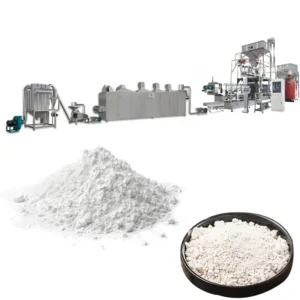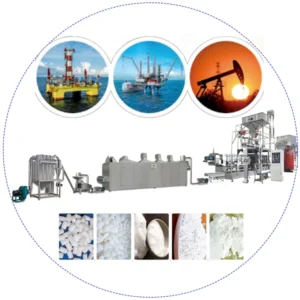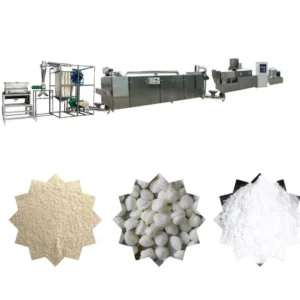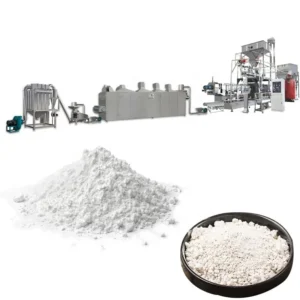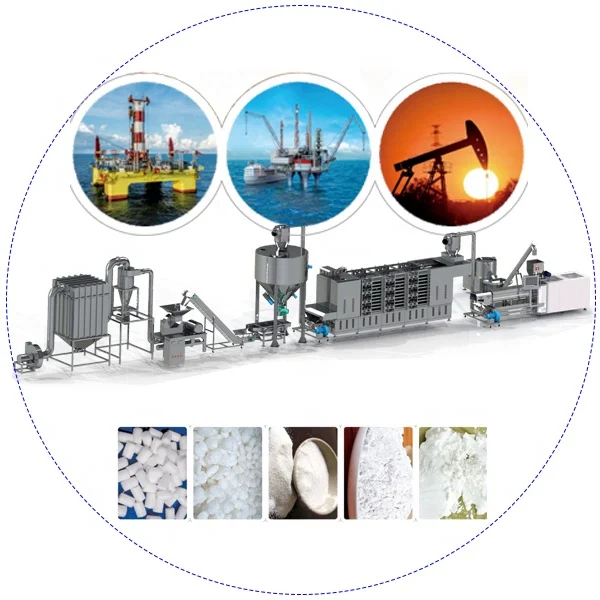
Throughput-Matched Stations — Every machine from mixer to dryer is specified by utility draw and physical footprint so upstream and downstream capacities align before the modified starch processing line full equipment range ships.
Technical Specifications
| Parameter | Value |
|---|---|
| Model | MT65 |
| Product Type | Modified Starch Twin-Screw Extrusion Line |
| Installed Power | 72 kW |
| Power Consumption | 50 kW |
| Output Capacity | 140–160 kg/h (basis not stated in source — confirm raw material type, moisture content, and starch variety) |
| Overall Dimensions (Extruder) | 2200 × 1000 × 2300 mm |
| Screw Type | Twin-screw, co-rotating, sectional modules |
| Barrel & Screw Structure | Modular sectional configuration |
| System Composition | Feeding, extruding, cutting, heating, conveying, cooling |
| Line Stations | Mixer → Twin-screw extruder → Dryer |
| Mixer Construction | Stainless steel contact parts, handle-opened discharge with safety interlock |
| Dryer | Net belt speed and temperature controllable |
| Control System | PLC and MCC available |
| Raw Material Compatibility | Corn starch, cassava starch, tapioca starch |
| Certification | CE, ISO |
| Warranty | 24 months, lifetime service |
Application Suitability
| Application | Material or Output |
|---|---|
| Pre-gelatinized starch for food thickeners | Corn starch at controlled moisture and barrel temperature profile |
| Denatured starch for textile sizing | Cassava starch processed through configurable shear and residence time |
| Modified starch for papermaking and corrugated board | Tapioca starch with adjusted screw module arrangement |
| Industrial starch for building materials and casting | Corn or cassava starch at higher barrel zone temperatures |
| Pre-gelatinized starch for oil drilling fluids | Cassava starch with extended residence time in heating zones |
Why "140 kg/h" Means Nothing Without the Raw Material
Capacity on modified starch lines is a function of feedstock gelatinization temperature, not motor nameplate.
I spent two extra weeks on a site in the Gulf because the trial ran on standard corn starch while the buyer’s actual feedstock was waxy maize. The gelatinization onset was nearly ten degrees apart, and the screw combination had to be rebuilt from scratch after arrival. When evaluating any modified starch processing line full equipment range, the output figure only holds meaning when paired with your exact starch variety, moisture content, and target modification degree [NEED_CITE: starch gelatinization temperature ranges by variety]. Without that context, a capacity number is a guess.
Six Systems Laid Out as Independent Equipment Units
The MT65 architecture separates feeding, extruding, cutting, heating, conveying, and cooling into discrete stations, each with its own utility requirement and footprint. This means you can survey the modified starch processing line full equipment range and identify exactly which machine handles which stage, rather than treating the extruder as a black box. Buyers replacing a single station within an existing line can pull the specification for just that unit.
Matching the Mixer Discharge to the Extruder Inlet
Stainless steel contact parts in the mixer keep contamination risk low across corn, cassava, and tapioca batches. The handle-opened discharge with safety interlock ensures the operator cannot release material while the extruder hopper is still aligning. When the mixer batch size and discharge rate do not match the twin-screw feed rate, you get either starvation or surge feeding — both of which shift the degree of starch modification unpredictably [NEED_CITE: feed consistency requirements in twin-screw extrusion].
Reading the Specs That Actually Matter on Starch Lines
The 72 kW installed power and 50 kW operating consumption tell you the thermal and mechanical headroom available for gelatinization. Co-rotating twin-screw geometry with modular sectional barrels lets you rearrange screw elements and barrel zones to control shear intensity and residence time — the two variables that determine whether starch granules fully gelatinize, partially denature, or pass through unchanged. The 2200 × 1000 × 2300 mm extruder footprint sets the minimum bay width and ceiling clearance, while the net belt dryer with controllable speed and temperature handles the moisture removal that fixes the modified starch properties after extrusion. PLC and MCC control options determine whether the line runs on recipe-based automation or manual relay logic, a choice that directly affects batch-to-batch consistency.
What Happens When Downstream Capacity Does Not Match
An extruder running at full screw speed pushes product into a dryer that cannot remove moisture fast enough. The belt slows, product backs up, and the gelatinization window shifts because residence time in the cooling zone extends beyond what the starch chemistry tolerates. I have walked onto sites where the dryer was swapped twice before the line stabilized — each swap costing weeks of downtime and a second round of commissioning [NEED_CITE: throughput balancing across extrusion line stations].
Evidence-Based Reasons to Source Here
Complete line coverage from batching through drying means every station’s throughput is calculated against the same raw material profile, not assembled from vendors who quote independently. Screw configuration and die design are documented against your specific starch variety before production begins. The in-house testing workshop runs your actual feedstock through the extruder before shipment, so gelatinization behavior is confirmed in advance rather than discovered during installation. Electrical schematics and voltage are locked to your facility’s supply before the control cabinet is wired. Operator training covers the specific screw arrangement and barrel temperature profile your line uses, not a generic overview.
Documentation & Verification
- Line layout showing each station’s footprint and utility connection point
- Screw and die configuration record matched to your starch variety
- Electrical schematic with voltage and frequency confirmed per your facility
- Trial run report on your actual raw material from the testing workshop
- CE declaration of conformity covering the complete extrusion assembly
- Wear parts list with reorder codes for screw modules and barrel liners
Installation, Commissioning & Support
- Foundation must support the 2200 × 1000 × 2300 mm extruder footprint with level tolerance specified in the layout drawing
- Dedicated 72 kW circuit with voltage and frequency confirmed before the MCC panel ships
- Modular barrel sections arrive separated and require on-site assembly with alignment verification
- First run uses the trial report parameters as baseline, then adjusts to actual site ambient conditions
- Operator training covers PLC recipe entry and safety interlock procedures on the mixer discharge
- Spare screw modules and barrel liners shipped with the initial order to cover the first replacement cycle
Before You Send an Inquiry
Provide your exact starch type — corn, cassava, tapioca, or a blend — along with the moisture content at the hopper and the target modification application. Include your facility voltage, frequency, and preferred control panel language. If you are integrating this modified starch processing line full equipment range into an existing plant, note the upstream and downstream equipment already in place so the layout can be configured around those connection points.
Frequently Asked Questions
Q: How do I confirm the output capacity for my specific starch type?
A: The published range assumes conditions that may not match your feedstock. Request a trial run using your actual starch variety and moisture level in the testing workshop. The resulting report documents throughput, degree of gelatinization, and screw configuration, giving you a verified capacity figure tied to your raw material rather than a generic estimate.
Q: How do I ensure the dryer can keep up with the extruder?
A: Each station’s throughput is calculated during the line layout phase using your target output and starch moisture data. The net belt dryer speed and temperature range are matched to the extruder discharge rate so that product does not accumulate on the belt or exit with residual moisture above your specification.
Q: What screw configuration works best for pre-gelatinized versus denatured starch?
A: Pre-gelatinized starch typically requires higher barrel zone temperatures and longer residence time with moderate shear. Denatured starch often needs intense shear in specific barrel sections. The modular sectional screw design allows the element arrangement to be documented and adjusted for each target product before the line ships.
Q: Can the control panel be configured for my local voltage and language?
A: Voltage, frequency, and control language are confirmed during the specification stage before the electrical cabinet is built. PLC and MCC options are both available, and the schematic reflects your facility’s supply standard so that commissioning does not stall on electrical mismatches at the site.