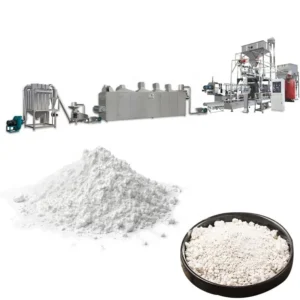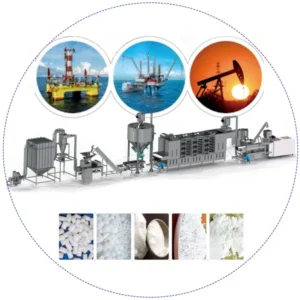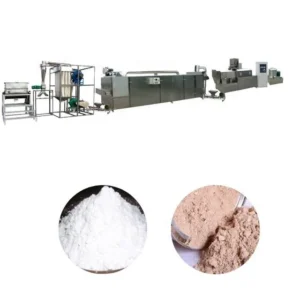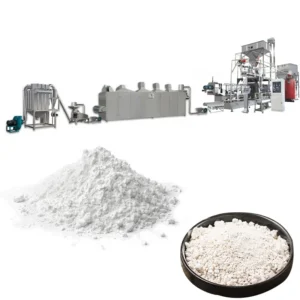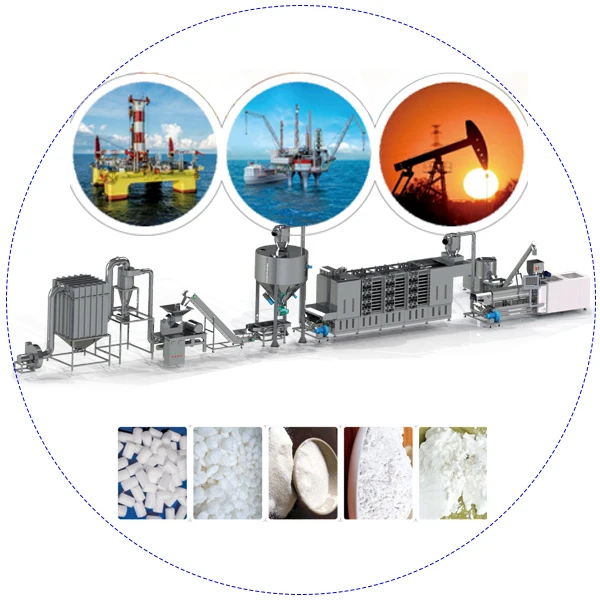
Matched Throughput Across Stations — every machine from the batching hopper to the pulse grinder is sized together so the extruder never waits and the cooler never bottlenecks the modified starch output.
Technical Specifications
| Parameter | Value |
|---|---|
| Product Type | Modified Starch Processing Production Line |
| Extruder Type | Twin-screw extruder |
| Installed Power Range | 45–200 kW |
| Capacity Range | 100–1500 kg/h (basis not stated in source — confirm raw material type, moisture content and degree of modification) |
| Line Weight Range | 1000–5000 kg (verify against specific line configuration) |
| Voltage | 220–440 V, tri-phase |
| Frequency | 50/60 Hz |
| Control System | PLC and MCC (configuration confirmed per project) |
| Raw Materials | Corn starch, wheat flour, rice flour, soybean flour, potato starch, additive materials |
| Cooling Conveyor Air Supply | Low-power fan with wind-knife blowing mouth, ambient air |
| Pulse Grinder Discharge | Cyclone separator with dust collector and filter pockets |
| Contact Materials | Food-grade stainless steel (selected conveyors use PVC belt) |
| Fuel / Energy Options | Gas, diesel, electricity, steam (specified at quotation) |
| Assembly State | Complete line, turnkey delivery |
| Certifications | CE, ISO |
Application Suitability
| Application | Material or Output |
|---|---|
| Food-grade modified starch for bakery, sauce and dairy thickeners | Corn starch, wheat flour, potato starch with food-grade additives |
| Oil-drilling starch for viscosity control in drilling mud | Corn starch or cassava starch with cross-linking agents |
| Paper-making grade starch for surface sizing and coating | Corn or wheat starch with cationic reagents |
| Industrial adhesive starch for corrugated board | Corn starch, tapioca starch with alkaline modifiers |
Why Nominal Capacity Numbers Mislead Starch Buyers
A capacity figure means nothing until it is proven on the exact starch base and additive blend you will run in your plant.
I watched a line ship out after smooth factory trials on standard corn starch, then lose most of its gelatinisation when the buyer switched to local cassava starch on arrival. The barrel temperature zones, screw speed and moisture feed all needed reworking. A modified starch processing line manufacturer should verify output on the buyer’s actual formulation before the machines leave the factory, not after they cross an ocean [NEED_CITE: starch gelatinisation temperature variance by botanical source].
How Twin-Screw Geometry Controls Starch Modification
The twin-screw extruder sits at the centre of this modified starch processing line. Screw element sequence and barrel zone temperatures determine how thoroughly the starch granules undergo gelatinisation and molecular rearrangement. Different target applications — food thickener versus oil-drilling fluid — demand different degrees of modification, which means the screw configuration must be rebuilt for each project rather than copied from a standard template.
Matching the Grinder to the Extruder Output
After extrusion, the cooled starch pellets enter a pulse grinder equipped with a speed-controlled auger feeder, rotor-stator milling chamber and an integrated classifier. Particle size distribution directly affects how the modified starch performs in the buyer’s end application, whether that is a bakery dough or a drilling mud slurry. The cyclone discharge and filter-pocket dust collector keep fines contained instead of letting them contaminate the packaging area [NEED_CITE: particle size influence on starch functionality in industrial applications].
Reading the Specs That Actually Matter
Motor power across the line ranges from 45 to 200 kW depending on throughput target and screw diameter. Higher installed power allows the extruder to maintain shear force on viscous starch melts without stalling at higher feed rates. The voltage range of 220–440 V tri-phase with 50/60 Hz adaptability means the electrical cabinet can be wound for the buyer’s local grid before production starts, avoiding on-site transformer work. Food-grade stainless steel contact surfaces prevent iron contamination that would discolour light starches and fail food safety audits. The PLC and MCC control architecture allows recipe storage for multiple starch formulations, so operators can switch between food-grade and industrial-grade runs without manual recalibration.
What Happens When Stations Are Mismatched
An extruder running at full output into an undersized cooling conveyor means hot starch pellets pile up, stick together and jam the grinder infeed. I have seen crews manually shovelling material off a belt because the cooler fan capacity was specified for a lighter snack product, not dense starch pellets. This kind of bottleneck does not show up in a brochure [NEED_CITE: throughput balancing principles in continuous processing lines].
Why Buyers Source This Line From MT
Every station — batching, extrusion, cooling, grinding, packing — is configured under a single supplier so throughput calculations cover the full chain. Screw and die designs are specified to the buyer’s raw starch type and target modification degree rather than pulled from a generic catalogue. The in-house testing workshop runs the buyer’s actual starch material before shipment, catching gelatinisation and expansion issues while adjustments still cost days instead of weeks. Voltage, frequency and PLC language are confirmed in writing before production begins. CE and ISO documentation accompanies every shipment, supporting customs clearance and local regulatory registration.
Documentation & Verification
- Line layout and capacity calculation showing matched throughput at every station
- Screw and die configuration record tied to your starch base and target application
- Trial run report on your raw starch material from the in-house testing workshop
- Electrical schematic with confirmed voltage, frequency and control language
- CE declaration of conformity and ISO certificate for customs and compliance
- Wear parts list with recommended first-order quantities for screws and dies
Installation, Commissioning & Support
- Foundation plan sized to the specific line weight configuration up to 5000 kg
- Dedicated power circuit matching the confirmed 220–440 V tri-phase supply
- Cooling conveyor and pulse grinder assembled and aligned on site after transit
- First-run parameter tuning for screw speed, barrel zones and grinder classifier
- Operator training covering PLC recipe management across multiple starch grades
- Spare screw elements and die plates supplied with initial shipment
What to Include in Your Inquiry
Send your raw starch type, additive formulation and target modification grade so the screw configuration can be designed before quoting. Confirm local voltage, frequency and preferred control language to avoid electrical rework during commissioning. Provide workshop dimensions and ceiling height so the line layout fits your building without structural modification.
Frequently Asked Questions
Q: How is line capacity verified against my specific starch base material and moisture content?
A: We run your actual raw starch and additive blend in the in-house testing workshop before shipment. The trial covers extruder screw speed, barrel temperature profile and moisture feed rate, then documents the achievable throughput. This report travels with the shipment so your team knows the proven baseline from day one.
Q: What screw configuration is used for different degrees of starch modification?
A: Food-grade modification for bakery thickeners typically needs gentler shear and lower barrel temperatures than industrial cross-linking for oil-drilling starch. The screw element sequence, kneading block arrangement and die geometry are selected based on your target application and confirmed during the pre-shipment trial run.
Q: Can the line voltage, frequency and PLC language be matched to my country’s electrical standard?
A: Yes. The system supports 220–440 V tri-phase at 50 or 60 Hz. Voltage and frequency are confirmed before the electrical cabinet is built, and the PLC interface language is set to your preference. This avoids transformer rental and reprogramming costs during on-site commissioning.
Q: What downstream stations are included, and how is throughput balanced?
A: The line covers batching, twin-screw extrusion, cooling conveyor, pulse grinding, cyclone separation and packing. Each station is sized so the extruder output matches the cooler capacity and the grinder infeed rate, preventing material pile-up or idle time at any point in the chain.
Q: Is a trial run on my raw material possible before the line is shipped?
A: Yes. Send a sample of your starch base and additives to the testing workshop. We run the full extrusion and grinding sequence, record screw configuration, temperature settings and output rate, then share the trial report. Any adjustments are made before the machines are crated for dispatch.