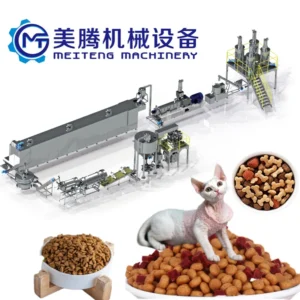
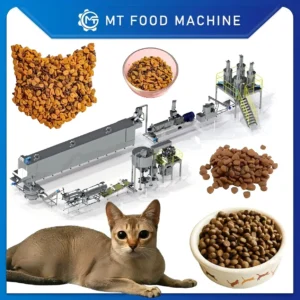
![MT70 Dog & Cat Pet Food Processing Line | Full Range5 + 4 + 9 + 5 = 23, 23 % 6 = 5 → 句式5: [站点修饰词] [品类词] – [规格或产能限定] 池: Full Range(0) / Manufacturer(1) / Factory Supply(2) 23 % 3 = 2 → Factory Supply → Factory Supply MT70 Pet Food Processing Line – Dog & Cat 字符数:56](https://mtfoodmachinery.com/wp-content/uploads/2026/05/H0abc8bcde6e2463d84879647ad04cc05S.webp)
Integrated Line Matching — every station from mixing through extrusion, drying and packaging is balanced to the same throughput so no single unit bottlenecks the MT70 pet food processing line.
Technical Specifications
| Parameter | Value |
|---|---|
| Model | MT70 |
| Product Type | Pet Food Processing Line |
| Output Capacity | 100-200 kg/h (basis not stated in source — confirm raw material formulation, moisture content, kibble size & density) |
| Voltage & Frequency | 380V 50Hz Three Phase |
| Line Stations | Mixing → Extrusion → Drying → Packaging |
| Control System | Automated process control with advanced sensors and precision controls |
| Automation Level | Full automation from raw material mixing through extrusion, drying to packaging |
| Recipe Adaptability | Dry kibble, semi-moist pet food, treats |
| Configuration | Customizable capacity and layout; modular components |
| Material Contact | Food-grade materials throughout |
| Standards | FDA, CE |
Application Suitability
| Application | Material or Output |
|---|---|
| Dry kibble production for dog and cat food manufacturers | Corn, meat meal, bone meal, fish meal, grain blends |
| Semi-moist pet food processing | High-moisture protein mixes with humectants and binders |
| Pet treat extrusion | Dense dough formulations with fiber and protein concentrates |
| Entry-level or expanding pet food brands | Flexible recipe adaptation across multiple SKU formats |
| Facilities planning future capacity scale | Modular line stations allowing phased expansion |
Why the Extruder Is Only Half the Conversation
A pet food processing line for sale is only as reliable as its weakest station.
I learned this the hard way on a Middle East installation years back. The customer ordered a line based on a sample bag of kibble, but their actual raw material carried a protein load well above what the standard screw configuration could handle. Output dropped to roughly half of what everyone expected. I spent three nights on the floor swapping screw elements and die plates before the extrusion density and expansion came back into spec. That job reinforced a rule I follow on every quote since: no raw material formulation in hand, no capacity promise made [NEED_CITE: twin-screw extrusion behavior under varying protein and starch ratios].
How Full Automation Changes Daily Output Consistency
Manual batching and transfer introduce variation at every stage — a slight moisture shift in the mixer, an uneven feed rate into the extruder barrel, inconsistent drying residence time. The MT70 pet food processing line for sale addresses this by linking raw material mixing, extrusion, drying and packaging under one automated control sequence. Advanced sensors monitor barrel temperature, moisture and feed rate continuously, adjusting parameters in real time. The result is kibble with uniform texture, density and nutritional content from the first batch to the last shift of the day.
Recipe Flexibility Across Kibble, Semi-Moist and Treat Formats
Switching between dry kibble, semi-moist formulations and dense treat doughs normally means reconfiguring screw profiles, adjusting dryer temperature zones and recalibrating the seasoning or coating station. Because the MT70 line is built as a matched system rather than assembled from separate vendors, these changeovers follow a documented sequence [NEED_CITE: extrusion recipe changeover procedures for multi-format pet food lines]. Modular components allow operators to swap die plates and adjust barrel segments without dismantling the entire extrusion section, keeping downtime between product runs to a practical minimum.
Reading the Specs That Actually Matter on the Floor
The 380V 50Hz three-phase supply is standard across many markets, but buyers in regions running 60Hz or different voltage tiers need to confirm motor and heater compatibility before production begins — a mismatch here can trip thermal overloads on the first run. The automated process control with advanced sensors matters most when running recipes with tight density tolerances, such as floating aquatic-style kibble repurposed for pet treats, where even a slight barrel temperature drift alters expansion ratio. Food-grade material contact throughout the line is essential not only for FDA compliance but also for preventing metal contamination when processing abrasive bone meal or mineral premixes. The full automation chain from mixing to packaging means the PLC must communicate across every station; if one module uses a different protocol, throughput data breaks down and operators end up logging batch weights manually.
The Real Cost of a Mismatched Dryer or Coating Station
When the extruder pushes out kibble faster than the dryer can handle, product backs up on the conveyor, moisture stays trapped inside the pellet, and shelf life drops without any visible warning at the packaging end. I have seen producers blame the extruder for inconsistent kibble density when the real bottleneck was a dryer sized for a lower throughput class [NEED_CITE: throughput balancing across extrusion line stations]. With separate-vendor sourcing, each supplier quotes their unit at nominal capacity, but those nominal figures rarely align under one roof. The consequence is a line that never reaches the output everyone paid for.
Why Buyers Source This Line from One Supplier
Complete lines from mixing to packaging under one supplier mean throughput is matched across every station — the mixer feeds the extruder at the rate the dryer can accept, and the packaging station keeps pace without product pile-up. Screw configuration and die design are specified to the buyer’s actual raw material and target kibble density, not copied from a generic build sheet. An in-house testing workshop allows trial runs on the customer’s own formulation before the line ships, so product development starts weeks earlier than it would on site. Twin-screw expertise spanning pet food, aquatic feed and snack applications means the engineering team has seen how different protein and starch ratios behave under shear. Pre-sales consultation carries through to on-site installation, commissioning and ongoing maintenance, so the same group that designed the layout is accountable when the line runs.
Documentation & Verification
- Line layout and capacity calculation showing throughput matched at every station of the MT70
- Screw and die configuration record tied to your raw material and target kibble density
- Trial run report produced on your actual formulation before the line leaves the factory
- CE declaration of conformity and electrical schematic confirming voltage for your market
- Operation and maintenance manual covering each station from mixer to packaging unit
Installation, Commissioning & Support
- Floor space and utility plan based on the MT70 modular layout and your factory dimensions
- Dedicated circuit sizing for 380V 50Hz three-phase supply with confirmed breaker ratings
- Station-by-station assembly sequence with alignment checks between extruder and dryer conveyors
- First-run parameter logging across barrel zones, dryer temperature and packaging speed
- Operator training on recipe changeover between dry kibble, semi-moist and treat formats
- Wear parts list covering screws, dies and dryer belt sections with reorder lead times
What to Prepare Before Requesting a Quote
To configure the MT70 accurately, share your raw material formulation including protein percentage, moisture content and any fat or fiber targets. Confirm the kibble sizes and density ranges your market expects, along with daily production volume goals. Provide your facility voltage, frequency and available floor space so the line layout and electrical package match your site from day one.
Frequently Asked Questions
Q: How is the 100-200 kg/h output capacity verified, and on which raw material formulation?
A: That range is a reference point and must be confirmed against your specific formulation. Protein content, moisture level, fat percentage and kibble size all shift actual throughput. We run your raw material in our testing workshop before shipment and document the verified output in a trial run report.
Q: Does the 380V 50Hz three-phase supply match my facility, and can it be adapted for 60Hz markets?
A: The standard configuration is 380V 50Hz three-phase. If your facility runs 60Hz or a different voltage tier, motor ratings, heater elements and control transformer specs must be adjusted before production. We confirm your exact supply during the quotation stage and reflect it in the electrical schematic.
Q: How are the extruder, dryer and packaging stations balanced to avoid throughput bottlenecks?
A: Each station is sized based on the same throughput calculation rather than quoted at independent nominal capacities. The mixer feed rate, extruder output, dryer residence time and packaging speed are matched so no single unit constrains the others under your target recipe.
Q: Can I run a trial with my own raw material before the line ships?
A: Yes. Our in-house testing workshop accepts customer-supplied raw material for trial runs before dispatch. We test your formulation, adjust screw and die configuration as needed, and provide a written report documenting expansion, density and verified output.
Q: What spare wear parts are included, and what is the lead time for reordering screws and dies?
A: The initial shipment includes a baseline set of wear parts matched to your configuration — screws, die plates and relevant seals. Reorder lead times depend on the specific screw profile and die specification. We provide a complete wear parts list with the line documentation so you can plan replacements before they are needed.