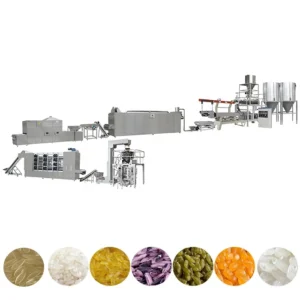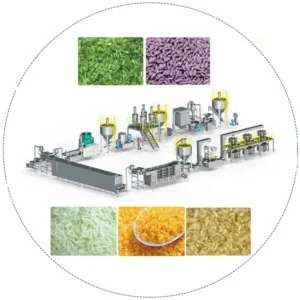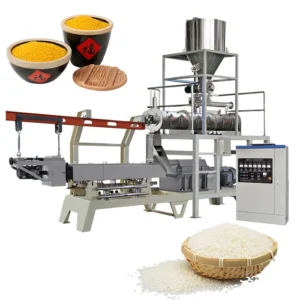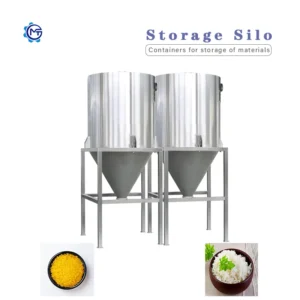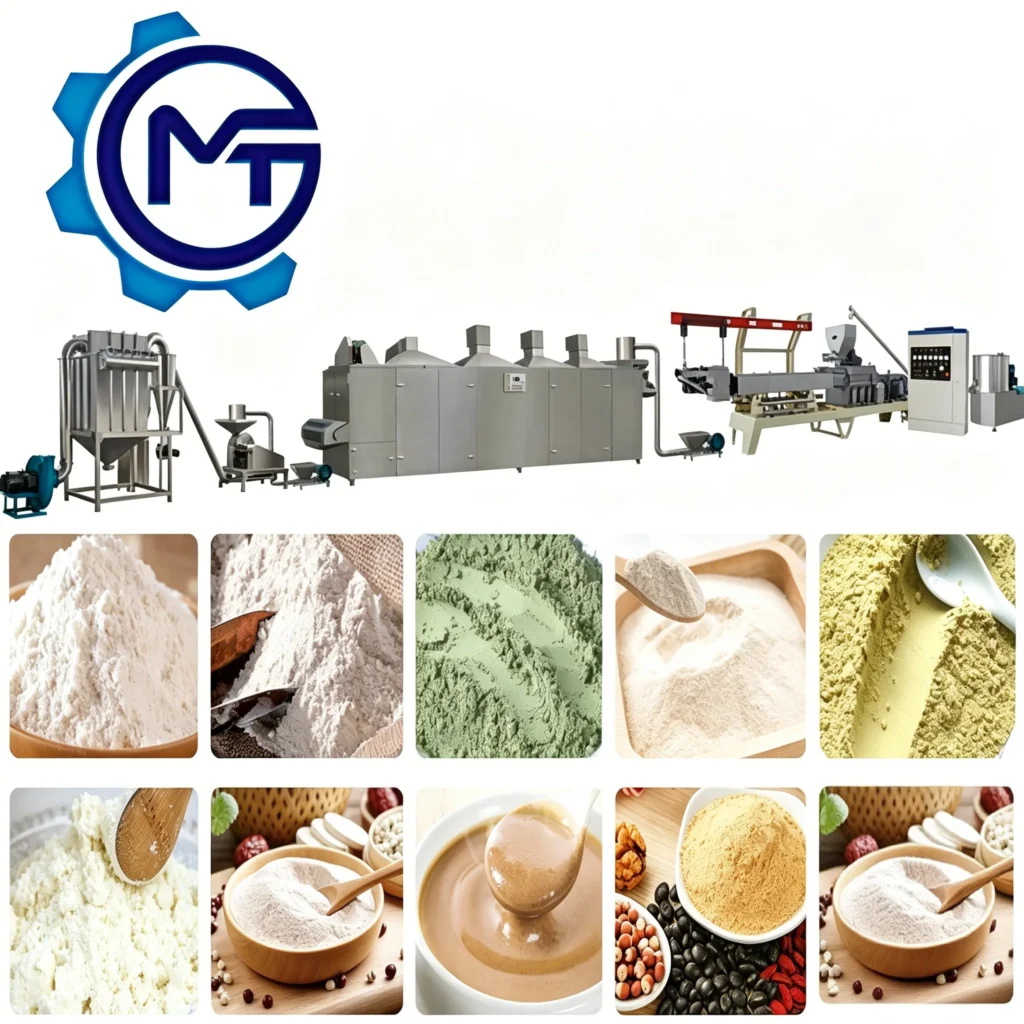
Matching throughput at every station — our in-house testing workshop runs your grain formulation through the entire line before dispatch, so each machine from mixer to oven is confirmed against your actual raw material rather than a generic benchmark.
Technical Specifications
| Parameter | Value |
|---|---|
| Product Type | Nutrition Powder Processing Line |
| Output Capacity | 200–500 kg/h (basis not stated in source — confirm raw material type, moisture content, and formulation) |
| Construction Material | Food-Grade 304 Stainless Steel |
| Heat Source Options | Electric / Gas / Steam |
| Control System | Touch Control Panel with Digital System |
| Line Stations | Mixers, Baking Ovens, Supporting Conveying and Cooling Units |
| Warranty | 1 Year |
| After-Sales Service | Overseas Engineer Service Available |
| Assembly State | Complete Production Line |
| Certification | CE (inferred from company profile — verify against current certificate) |
Application Suitability
| Application | Material or Output |
|---|---|
| Baby food and infant nutrition powder | Rice, corn, and multi-grain blends processed into fine powder formulations |
| Breakfast cereal and porridge powder | Oat, barley, and wheat-based cereal mixes requiring consistent thermal processing |
| Fortified food and nutritional programme supply | Blends of rice, corn, beans, and pulse flours with added micronutrients |
| Specialty grain-based nutritional products | Organic brown rice, quinoa, and millet formulations for premium infant food markets |
Why Capacity Claims Break Down Once Your Grain Hits the Line
A rated output only matters when the raw material matches the test conditions.
When buyers evaluate a nutrition powder processing line full equipment range, the capacity figure on the quotation is often the first number they compare. I spent years on the assembly floor before moving into technical sales, and I have watched lines rated at a specific throughput fall noticeably short once the customer’s actual grain blend entered the hopper. Last year, a Middle East client sent us an organic brown rice formulation for an infant porridge line we had quoted at 500 kg/h. The gelatinization temperature of their rice was different from our test sample, expansion dropped, and the line settled at roughly 300 kg/h. [NEED_CITE: grain gelatinization behaviour and extrusion throughput] Now every nutrition powder project I handle starts with the customer shipping raw material to our testing workshop so we can lock the parameters before the contract is signed.
How Each Station in the Line Fits Together
A nutrition powder processing line full equipment range is more than a collection of individual machines bolted in sequence. The mixer output rate must align with oven residence time, and the cooling conveyor has to keep pace without letting product accumulate. When stations are sourced from separate vendors, throughput gaps appear — one station runs faster than the next can accept, and operators end up manually feeding or stopping upstream equipment. Our line is configured so that every station is sized against the same throughput target, which is the angle buyers on mtfoodmachinery.com tend to focus on when comparing equipment options.
What the Heat Source Choice Means for Your Factory
Electric, gas, and steam heating each behave differently inside a baking oven used for nutritional powder production. Electric elements give precise zone control and suit facilities without a gas supply, though they draw significant power and require dedicated circuits. Gas-fired ovens heat faster and often cost less to run where fuel is cheap, but they need proper ventilation and combustion exhaust routing. Steam heating integrates well if the factory already runs a boiler for other processes, keeping utility infrastructure consolidated. Selecting the right option depends on the utilities already available on-site rather than on the oven specification alone. [NEED_CITE: industrial heat source selection for food processing facilities]
Reading the Specs That Actually Affect Powder Quality
Food-grade 304 stainless steel across contact surfaces is not just a hygiene checkbox — it resists the mild acids produced when certain grains break down during mixing and baking, preventing corrosion pits that harbour bacteria between production runs. The touch control panel with digital system reduces the chance of operator error during recipe changeovers, which matters when a facility switches between infant rice powder and a multi-grain porridge blend in the same shift. Oven temperature uniformity directly controls the degree of starch gelatinization: too low and the nutritional profile remains locked inside ungelatinized starch granules, too high and Maillard browning alters both colour and flavour in ways that infant food specifications reject. Heat source selection — electric, gas, or steam — determines how quickly the oven recovers temperature after a door opening or a belt load change, which in turn affects batch-to-batch consistency across long production runs.
The Hidden Cost of Ignoring Station-to-Station Matching
When a mixer outfeeds the oven, wet product piles up on the transfer belt, surface moisture evaporates unevenly, and the downstream powder grinder receives material with inconsistent moisture content. I have seen lines where the oven was correctly specified but the cooling conveyor was too short, causing warm powder to condense moisture inside the packaging and shorten shelf life. [NEED_CITE: moisture migration in packaged nutritional powders] These problems do not show up on a quotation — they surface three months after commissioning, usually as customer complaints about clumping or off-flavour, and by then the original vendor has moved on to the next sale.
Why Buyers Source This Line Here
Every station from mixing through cooling is supplied under one configuration, so throughput matching is calculated before the line is built rather than discovered during commissioning. Screw and die geometry — where applicable in pre-processing — is specified against the buyer’s actual grain blend, not pulled from a standard catalogue. Our testing workshop runs customer-supplied raw material before shipment, producing a trial report that documents the exact parameters needed. The line supports electric, gas, or steam heating, allowing adaptation to whatever utility setup the buyer’s factory already has in place. Pre-sales consultation covers layout design, and the same engineering team follows through installation, operator training, and ongoing maintenance.
Documentation & Verification
- Line layout drawing showing station spacing and throughput calculation for your target output
- Machine specification sheet for each station with voltage, frequency, and utility requirements
- Trial run report documenting results on your specific grain formulation before dispatch
- CE declaration of conformity covering the complete production line assembly
- Operation and maintenance manual with cleaning procedures for 304 stainless steel surfaces
- Wear parts list identifying replaceable components for mixers, ovens, and conveyors
Installation, Commissioning & Support
- Foundation must be level concrete capable of supporting the combined weight of all stainless steel stations
- Dedicated electrical circuit required matching the confirmed voltage and frequency for the touch control panel
- Line arrives in modular sections; assembly sequence documented in the installation manual
- First production run supervised by an engineer who sets oven temperature profiles to your grain blend
- Operator training covers recipe changeover on the digital control system and daily sanitation routines
- Wear parts shipment arranged before first scheduled replacement based on the provided parts list
What We Need to Configure Your Line
Before we lay out a nutrition powder processing line full equipment range for your facility, share the specific grains or grain blends you plan to process along with any formulation details. We also need your factory’s available voltage and frequency, plus the floor space and ceiling height where the line will be installed. If you can send a sample of your raw material, we will run it through our testing workshop and return a trial report with confirmed parameters before any contract is finalized.
Frequently Asked Questions
Q: What stations are included in the full line and how is throughput matched between them?
A: The line typically covers mixing, baking, cooling, and conveying stations, each sized so that material flow remains continuous without bottlenecks. Throughput matching is calculated during the layout phase based on your target capacity and raw material characteristics, and validated during a pre-shipment trial run in our testing workshop.
Q: Can individual machines be ordered separately or only as a complete line?
A: Individual stations such as mixers or baking ovens can be ordered on their own, though we recommend providing details about the upstream and downstream equipment already in your facility so that capacity and transfer heights are aligned with what you already have running.
Q: What heat source options are available and how do they affect station selection?
A: Electric, gas, and steam heating are all available for the baking ovens. The choice depends on your factory’s existing utility infrastructure — electric suits sites without gas lines, gas offers faster heat recovery where fuel is affordable, and steam integrates with facilities that already operate a central boiler system.
Q: How is the control system configured across different machines in the line?
A: Each station uses a touch control panel with digital system, allowing operators to set and monitor temperature, belt speed, and mixing time from a consistent interface. The control language is confirmed before production so that the displayed text matches the operators who will be running the line daily.