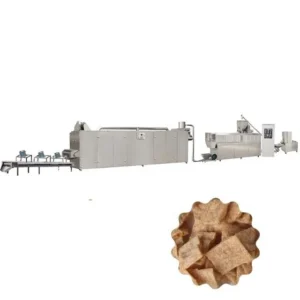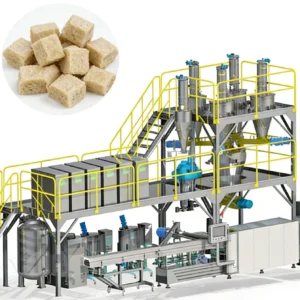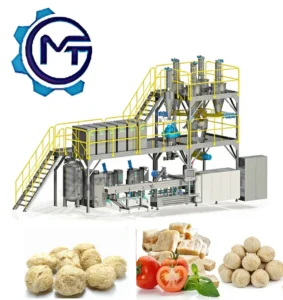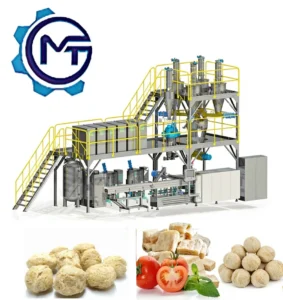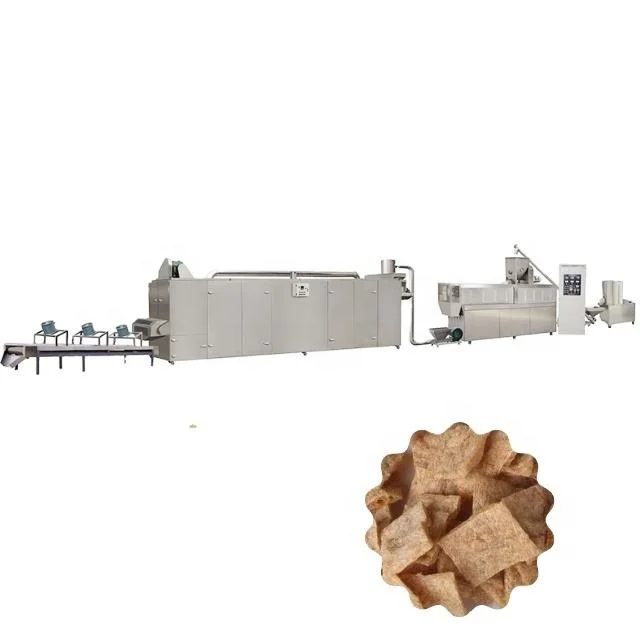
Integrated Line Configuration — every station from powder mixing through cooling is sized to the extruder output, eliminating mid-line bottlenecks on the MT65, MT70, and MT85 textured vegetable protein processing line models.
Technical Specifications
| Parameter | Value |
|---|---|
| Product Type | Textured Vegetable Protein Extrusion Line |
| Available Models | MT65 / MT70 / MT85 |
| Screw Type | Twin-screw |
| Installed Power | 85 kW (MT65) / 120 kW (MT70) / 195 kW (MT85) |
| Actual Power Consumption | 65 kW (MT65) / 90 kW (MT70) / 165 kW (MT85) |
| Output Capacity | 150–200 kg/h (MT65) / 200–300 kg/h (MT70) / 600–800 kg/h (MT85) — basis to be confirmed by raw material, moisture content and target texture |
| Overall Dimensions (L×W×H) | 18000×1300×2300 mm (MT65) / 20000×1500×2400 mm (MT70) / 24000×3500×4300 mm (MT85) |
| Powder Mixer Tank Volume | 150 kg |
| Powder Mixer Power | 4 kW |
| Powder Mixer Output | 300–600 kg/h (basis to be confirmed by batch time and raw material) |
| Roaster Belt Effective Length | 3.5 m |
| Roaster Heating | Far infrared 3.9 kW × 24, gas option available |
| Roaster Belt Motor Power | 0.55 kW |
| Cooling Machine Operating Temperature | 0–260 °C |
| Construction Material | Stainless steel (all machinery) |
| Control System | Available with PLC or MCC control — confirm configuration |
| Voltage & Frequency | Configurable to target market — confirm before production |
| Assembly State | Complete line from batching to packing |
| Certifications | CE, ISO |
Application Suitability
| Application | Material or Output |
|---|---|
| Textured soybean protein for meat alternatives | Low-temperature soybean meal, soy protein isolate |
| Plant-based meat ingredient for sausages and ham | Soybean meal blended with peanut meal |
| TVP granules for canned and quick-frozen foods | Defatted soy flour, protein concentrates |
| Fortified protein additives for fast food | Soy and legume protein blends |
Why Matching Dryer Capacity to Your Extruder Matters More Than Rated Output
A line that extrudes faster than it dries will back up material on the conveyor within the first hour of production.
When I first set up a textured vegetable protein processing line for a Southeast Asian buyer, the extruder ran clean on standard soy isolate during our workshop trial. But the buyer switched to a pea-protein blend after delivery, and the dryer could not keep pace with the heavier, wetter extrudate. Material piled up between stations, surface moisture stayed too high, and the fiber structure collapsed before cooling. That week of remote troubleshooting taught us to verify throughput across every station, not just at the extruder die [NEED_CITE: twin-screw extrusion throughput matching principles for high-moisture protein].
Station-by-Station Equipment Coverage
A textured vegetable protein processing line from Meiteng covers every stage from raw material preparation to final packing under one equipment supply contract. The powder mixer feeds blended soybean meal or peanut meal into the conveying system, which delivers a consistent charge to the twin-screw extruder. Downstream, the high-temperature roaster and cooling machine are specified so their belt loading and residence time align with the extruder discharge rate, preventing the material pile-ups that force unplanned line stops.
Drying Configuration Options for Different Protein Blends
The roaster section offers far infrared heating across 24 elements plus a gas-fired option, giving operators flexibility when switching between pure soy and legume-protein blends that release moisture at different rates. Belt effective length of 3.5 m provides sufficient residence time for dense TVP pieces, while the stainless steel construction throughout the line meets food-grade contact requirements [NEED_CITE: food-grade stainless steel requirements for protein extrusion equipment]. Cooling downstream brings product temperature into the safe packing range without introducing condensation that would compromise shelf stability.
How Screw and Die Choices Shape Fiber Texture
The twin-screw configuration on the MT65, MT70, and MT85 generates the shear profile needed to align soy protein molecules into fibrous strands that mimic meat texture. Screw element arrangement and die aperture are specified to the buyer’s raw material formula — a high-isolate blend requires different compression than a soy-and-peanut meal mix. Installed motor power ranges from 85 kW on the MT65 to 195 kW on the MT85, giving each model the torque headroom to handle viscous protein dough without stalling. Barrel temperature profiling along the screw length controls the degree of protein denaturation, directly influencing whether the final TVP tears like chicken breast or crumbles like ground beef. Moisture content at the feed inlet shifts expansion behavior at the die, so confirming your target moisture percentage before screw selection is essential for repeatable fiber structure across production runs [NEED_CITE: protein denaturation and fiber alignment in twin-screw extrusion].
The Hidden Cost of Skipping a Pre-Shipment Trial
Lines shipped without a trial run on the buyer’s actual raw material arrive as untested assemblies. Screw elements selected for generic soy isolate may not develop enough shear on a pea-protein blend, leaving extrudate sticky and under-texturized. Dryer settings calibrated for one moisture profile will over-dry or under-dry when the formula changes. The result is weeks of remote parameter adjustments while raw material and labor are consumed on product that cannot be sold [NEED_CITE: common commissioning failures in plant-based protein extrusion lines].
Why Procure the Full Line Here
Screw configuration and die design are documented to the buyer’s specific raw material and target fiber texture, so the extruder is not a generic catalog build. Every supporting station — mixer, conveyor, roaster, cooler — is selected so throughput matches the extruder output rather than being assembled from unrelated vendor quotes. An in-house testing workshop allows trial runs on customer-supplied material before the line ships, catching formula mismatches early. Electrical schematics and voltage confirmation are completed before production begins, so the control cabinet matches the target market’s power grid. Post-installation support covers operator training and a documented wear parts list so first replacements are available when screws and dies reach end of service life.
Documentation & Verification
- Line layout drawing showing station spacing and throughput balance for your chosen model
- Machine specification sheet covering mixer, extruder, roaster, cooler and packing units
- Screw and die configuration record matched to your protein blend and target texture
- Electrical schematic with voltage and frequency confirmed for your facility
- Trial run report produced on your raw material before dispatch
- CE declaration of conformity and ISO certificate for export documentation
Installation, Commissioning & Support
- Floor plan with anchor points based on the MT65 / MT70 / MT85 overall dimensions
- Dedicated power circuit sized to 85–195 kW installed capacity depending on model selected
- Modular station delivery allowing sequential assembly in workshops with limited overhead clearance
- On-site commissioning with screw speed, barrel temperature and dryer settings calibrated to your formula
- Operator training covering twin-screw feed rate, moisture adjustment and roaster belt speed
- Wear parts list specifying screws, dies and mixer blades with recommended replacement intervals
What to Prepare Before Requesting a Quotation
To configure the right textured vegetable protein processing line, share your raw material formula including protein source, moisture target and any legume blends. Specify daily production volume and shift pattern so we can recommend MT65, MT70 or MT85 capacity tiers. Confirm your facility voltage, frequency and preferred control language, along with available floor space and ceiling height for line layout planning.
Frequently Asked Questions
Q: How is throughput balanced between the mixer, extruder, roaster and cooler?
A: Each station’s capacity is calculated against the extruder discharge rate for your chosen model. The powder mixer batch cycle, roaster belt speed and cooling machine throughput are set so material flows continuously without accumulation between units, avoiding the mid-line bottlenecks that force operators to throttle extruder output.
Q: Which extruder model fits a small-batch TVP operation?
A: The MT65 handles 150–200 kg/h output capacity depending on raw material and moisture, suitable for pilot-scale or specialty protein producers. The MT70 steps up to 200–300 kg/h, and the MT85 covers 600–800 kg/h for larger ingredient supply contracts — always confirm the basis with your specific formula.
Q: Can the line process peanut meal and soy blends together?
A: Yes. Screw configuration and die geometry are adjusted to the protein and fiber ratio of your blend. Peanut meal typically requires different shear and compression settings than pure soy isolate, so we run a trial on your exact mix in the testing workshop before finalizing the screw profile.
Q: Is the control system PLC or manual?
A: The line is available with PLC or MCC control depending on your automation preference. Control language and HMI interface are confirmed during the specification stage so operators can navigate temperature, screw speed and dryer parameters in their working language from day one.
Q: What happens if our raw material behaves differently after delivery?
A: The pre-shipment trial run on your material reduces this risk. If formula adjustments are needed later, the documented screw and die configuration record gives our engineers a baseline to modify elements or barrel temperature profiles remotely or through a follow-up site visit.