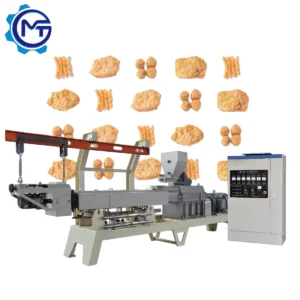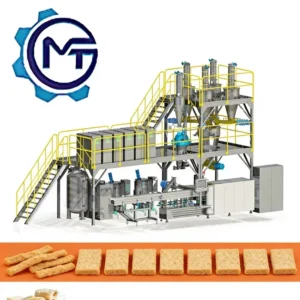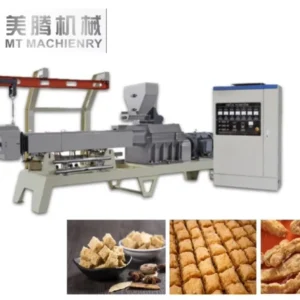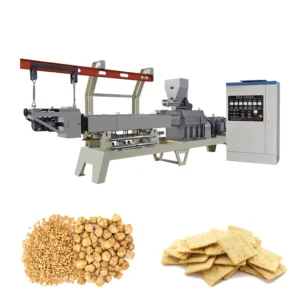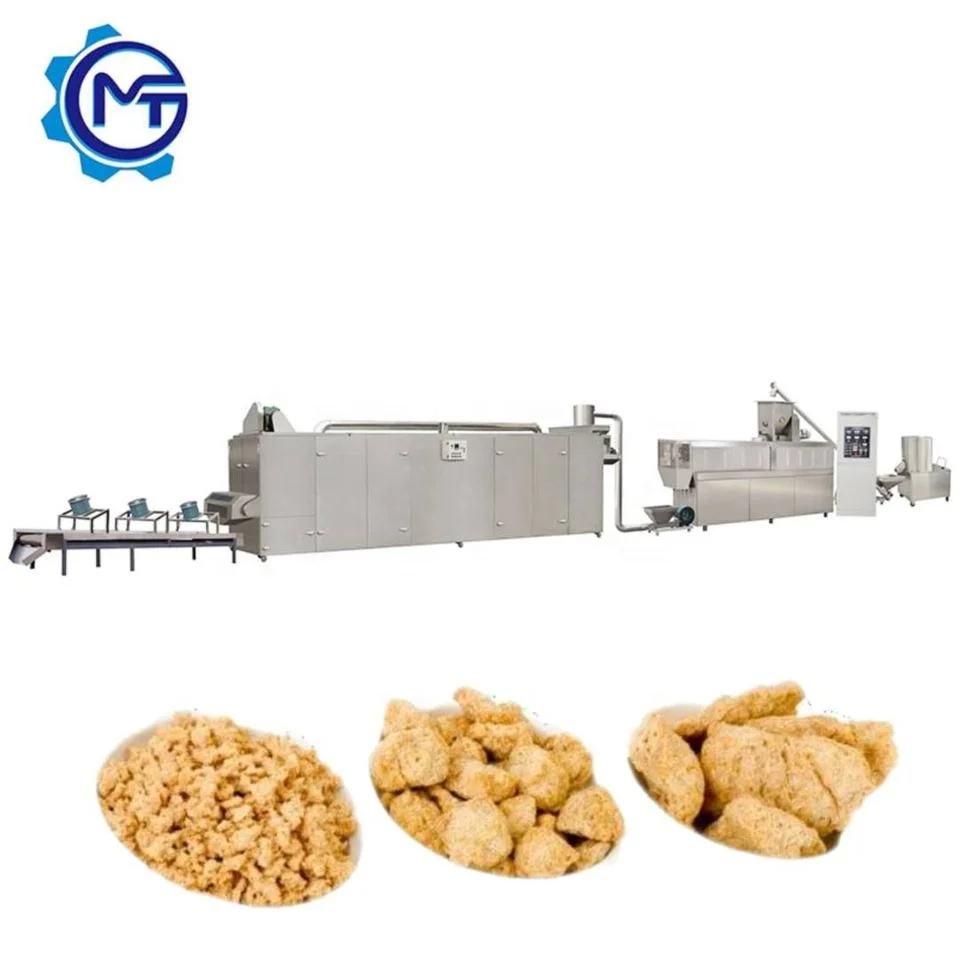
Matched Throughput Across Stations — every mixer, extruder, dryer and cooler on this texturized vegetable protein line is sized to the same output band, preventing the downstream choke that happens when vendors quote mismatched units.
Technical Specifications
| Parameter | Value |
|---|---|
| Product Type | Twin-Screw Texturized Vegetable Protein Extrusion Line |
| Available Models | MT65 / MT70 / MT85 |
| MT65 Installed Power | 85 kW |
| MT65 Real Power | 65 kW |
| MT65 Output Capacity | 150–200 kg/h (basis not stated in source — confirm raw material / moisture / protein type) |
| MT65 Overall Dimensions | 18000 × 1300 × 2300 mm |
| MT70 Installed Power | 120 kW |
| MT70 Real Power | 90 kW |
| MT70 Output Capacity | 200–300 kg/h (basis not stated in source — confirm raw material / moisture / protein type) |
| MT70 Overall Dimensions | 20000 × 1500 × 2400 mm |
| MT85 Installed Power | 195 kW |
| MT85 Real Power | 165 kW |
| MT85 Output Capacity | 600–800 kg/h (basis not stated in source — confirm raw material / moisture / protein type) |
| MT85 Overall Dimensions | 24000 × 3500 × 4300 mm |
| Extruder Screw Type | Twin-screw |
| Extruder Main Motor Power | 30 kW |
| Extruder Unit Installed Power | 45.87 kW |
| Extruder Unit Actual Power | 30–35 kW |
| Extruder Unit Dimensions | 2800 × 830 × 1875 mm |
| Extruder Unit Output | 200–250 kg/h (basis not stated in source — confirm raw material / moisture / protein type) |
| Mixer Type | Powder Mixer |
| Mixer Tank Volume | 150 kg |
| Mixer Rotary Speed | 385 rpm |
| Mixer Mixing Time | 10 min per batch |
| Mixer Power | 4 kW |
| Mixer Output | 300–600 kg/h |
| Dryer Type | High-temperature Belt Roaster (far infrared) |
| Dryer Belt Effective Length | 3.5 m |
| Dryer Heater Power | 3.9 kW × 24 |
| Dryer Belt Motor Power | 0.55 kW |
| Dryer Output | 300–400 kg/h |
| Dryer Dimensions | 4500 × 1500 × 1600 mm |
| Cooling Machine Capacity | 200–300 kg/h |
| Cooling Machine Temperature Range | 0–260 °C (source value — verify against manufacturer catalog) |
| Line Stations | Mixing → Conveying → Extrusion → Conveying → Drying → Cooling → Packing |
| Construction Material | Food-grade stainless steel |
| Certifications | CE, ISO |
| Warranty | 1 year complete; lifetime maintenance service |
Application Suitability
| Application | Material or Output |
|---|---|
| Texturized vegetable protein chunks | Low-temperature soybean meal |
| Plant-based meat strips and mince | Pea protein isolate or concentrate |
| Meat analogue fibre matrices | Peanut meal and blended plant proteins |
| Fortified nutrition programme ingredients | Blended plant protein with cereal extenders |
| Ham and sausage meat substitute bases | Soy-based TVP granules and fibres |
| Quick-frozen food and canned food fillers | Extruded and dried protein pieces |
Why "Nominal Capacity" Fails on Plant Protein Extrusion
Output must be verified on your actual raw material before the line ships.
A plant based meat processing line equipment specification sheet often lists a single capacity number derived from a standard test material. Pea protein, soybean meal and peanut meal each behave differently under shear and heat — varying in gelatinisation onset, melt viscosity and fibre alignment. When the raw material on site differs from the test basis, the twin-screw extruder can fall well below the quoted figure, and the downstream dryer and cooler sit idle waiting for product that never arrives [NEED_CITE: twin-screw extrusion behaviour on varying plant protein substrates]. I have watched lines stall at the extruder station because the buyer ordered on a brochure number that was never validated against their specific protein blend and moisture target.
Screw Configuration and the Fibre Structure You Actually Need
The twin-screw extruder is the point where raw protein powder becomes a fibrous, meat-like matrix. Screw element arrangement — kneading blocks, reverse-pitch flights and conveying sections — determines the shear profile and residence time inside the barrel. For a plant based meat processing line equipment setup, these parameters directly control whether the output is a dense chunk, a layered strip or a loose mince. A configuration copied from a generic starch application will not produce the aligned fibre structure that buyers expect from TVP.
Die Design and Moisture Management Across the Line
After extrusion, the protein mass exits through a die plate whose aperture shape and land length set the initial geometry and density. The high-temperature belt roaster then removes moisture across a 3.5 m effective belt length using far infrared heaters, stabilising the fibre matrix before cooling. If die selection and dryer capacity are not matched to the extruder throughput, the protein pieces either case-harden on the outside while staying wet inside, or the belt runs partially empty — both outcomes waste energy and compromise the final texture [NEED_CITE: moisture removal rates in far infrared belt drying of extruded protein].
What the Power and Dimension Figures Mean for Your Floor Plan
The MT85 at 195 kW installed power and 24 m overall length is a mid-volume commercial line, while the MT65 at 85 kW and 18 m length suits pilot or smaller batch production. The extruder main motor at 30 kW sets the torque available for high-protein, high-viscosity melts — plant protein doughs demand more torque per kilogram of throughput than puffed starch snacks. The powder mixer cycles a 150 kg batch every 10 minutes at 385 rpm, which keeps ingredient blending ahead of the extruder feed rate. Selecting the correct model tier means matching not only output expectations but also the electrical supply and floor space available at the installation site.
The Hidden Cost of Mismatched Line Stations
When a buyer sources the extruder from one vendor and the dryer from another, throughput figures rarely align. The extruder may push product faster than the dryer belt can carry it, causing pile-ups and uneven moisture removal. Alternatively, an oversized cooler sitting downstream of a smaller extruder represents capital locked in idle stainless steel. These mismatches compound over a production shift, creating rework, scrap and unplanned downtime that never appeared on any quotation [NEED_CITE: throughput imbalance consequences in multi-vendor food processing lines].
Why Procurement Here Differs
Every station from the powder mixer through the belt roaster to the cooler is configured under one supplier, so throughput is matched before the line ships. The screw configuration and die design are specified to the buyer’s raw material and target product rather than pulled from a generic catalogue. An in-house testing workshop runs trial extrusion on the customer’s actual protein blend before dispatch, producing a documented trial run report. The food-grade stainless steel construction across all stations meets the hygiene expectations of food safety audits. Pre-sales engineering covers line layout and capacity calculation, and on-site installation with commissioning and operator training is included in the scope.
Documentation & Verification
- Line layout drawing with throughput calculation across mixer, extruder, dryer and cooler
- Screw and die configuration record matched to your protein type and target fibre
- Trial run report on your raw material from the in-house testing workshop
- Electrical schematic with voltage and frequency confirmation for your market
- Factory test record and packing photographs before dispatch
- CE declaration of conformity and ISO certificate copies
Installation, Commissioning & Support
- Foundation plan accounts for the MT85 footprint at 24 m length and 4.3 m height
- Dedicated electrical circuit sized for 195 kW installed power on the largest model
- Line arrives in modular station groups for sequential assembly on site
- First-run parameter setting covers barrel temperature, screw speed and feed rate
- Operator training includes mixer batching sequence and dryer belt speed adjustment
- Wear parts list covers screws, die plates and barrel liner sections with supply terms
What to Include in Your Inquiry
Provide your protein source — soybean meal, pea protein, peanut meal or a blend — along with the target moisture content and the fibre structure you need (chunks, strips or mince). Confirm the daily or hourly output you intend to sustain, the voltage and frequency at your facility, and the control language your operators require. If you have existing upstream batching or downstream packing equipment, share the interface specifications so the line can be matched at both ends.
Frequently Asked Questions
Q: How is output capacity verified against my specific pea or soy protein raw material?
A: Before the line ships, your actual protein blend is run through the in-house testing workshop on the twin-screw extruder. Moisture content, barrel temperature profile and screw speed are adjusted until the target fibre structure and throughput are achieved, and a trial run report is issued for your review.
Q: What screw configuration and die design is specified for my target TVP fibre structure?
A: The screw element arrangement — kneading blocks, conveying sections and reverse flights — is selected based on your protein type and the desired chunk, strip or mince geometry. The die aperture shape and land length are then matched to set the initial density and alignment of the extruded fibre matrix.
Q: Is the dryer and cooler capacity matched to the extruder output?
A: Every station on the line is throughput-matched under a single supplier. The belt roaster effective length, heater array and cooler capacity are all calculated against the selected extruder model tier so that no station becomes a bottleneck during continuous production.
Q: What voltage, frequency and control language options are confirmed before commissioning?
A: These details are confirmed during the specification stage before production begins. The electrical schematic is drawn to match your facility supply, and the control interface language is set to your operator requirement so that no rework is needed when the line arrives on site.
Q: Which spare wear parts are included, and what is the replacement supply arrangement?
A: A wear parts list covering screws, die plates and barrel liner sections is provided with the line. Replacement supply terms are agreed before shipment so that the first changeover can be planned without emergency sourcing delays.