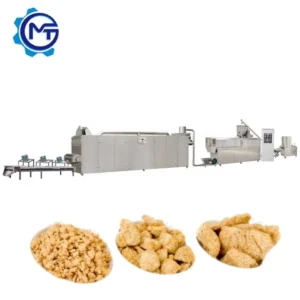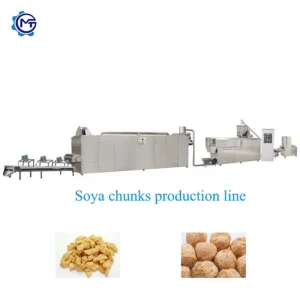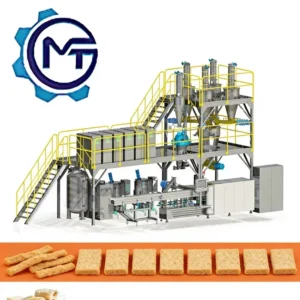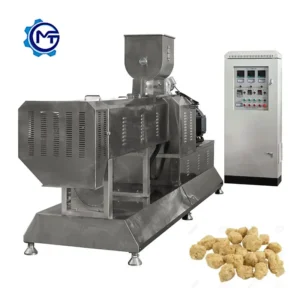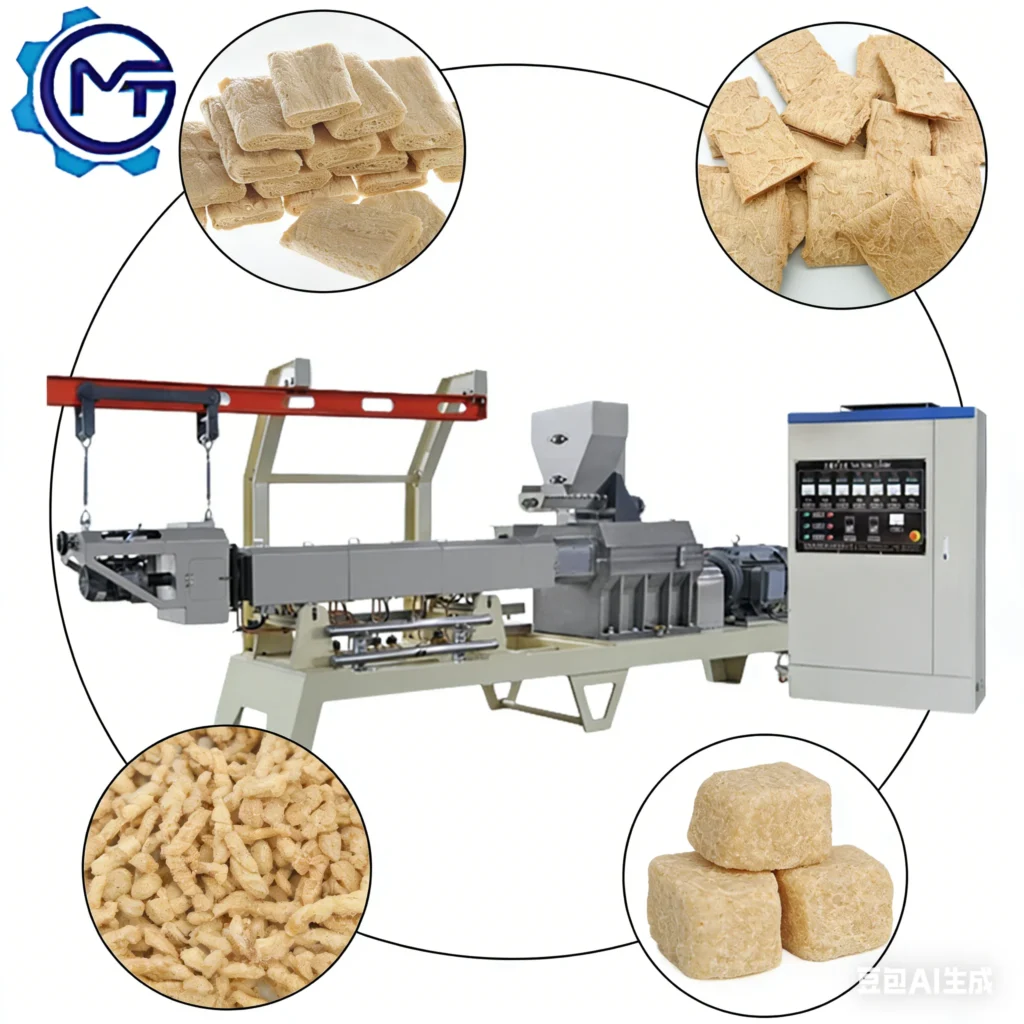
Balanced Throughput Across Every Station — This twin screw extruder line matches mixing, drying, and cooling capacity to the extruder output, preventing bottlenecks that occur when stations are sourced separately.
Technical Specifications
| Parameter | Value |
|---|---|
| Model | MT65 / MT70 / MT75 / MT85 |
| Product Type | Twin Screw Extruder Production Line for Texturized Vegetable Protein (TVP) |
| Screw Type | Twin Screw |
| Screw Length | 1050 mm / 1520 mm (varies by model) |
| Installed Power | 84 kW (MT65) / 160 kW (MT70) / 190 kW (MT75) / 210 kW (MT85) |
| Main Motor Power | 22 kW / 30 kW / 45 kW (varies by model) |
| Mixer Contact Material | Stainless Steel 304 |
| Dryer Type | Multi-layer dryer, double pitch roller chain drive |
| Dryer Heating Options | Fuel / Gas / Electricity (selectable) |
| Overall Dimensions (L×W×H) | 40000×1200×2200 mm (MT65) to 45000×1500×3500 mm (MT85) |
| Output Capacity | 100-300 kg/h (basis not stated in source — confirm raw material formulation and moisture content) |
| Standards | CE (certified since 2014), ISO |
Application Suitability
| Application | Material or Output |
|---|---|
| Texturized Vegetable Protein (TVP/TSP) | Defatted soya flour, low-temperature soya flakes |
| Soya Nuggets and Chunks | Soya flour blends for meat analogue substitution |
| Plant-Based Meat Analogues | High-protein formulations for fast food and frozen products |
| Fortified Plant Protein | Soybean dregs, peanut dregs for nutrition programmes |
The Problem with Generic Screw Configurations on Plant Protein
Output capacity on a brochure rarely matches what you get when you switch from soya flour to a pea-protein blend.
When sourcing a plant based meat processing equipment line, buyers often assume the extruder is configured for their specific formulation. In reality, many lines are shipped with a generic screw profile designed for standard starches. If your formulation includes pea protein, wheat gluten, or varying moisture levels, the wrong screw combination will fail to create the necessary fibrous structure, resulting in a product that lacks the bite and texture the market expects [NEED_CITE: impact of screw profile on TVP fibre alignment]. The extruder might run, but the texture will be wrong, and the line will become a bottleneck.
Matching the Screw Profile to the Protein Source
The twin screw extruder for TVP production line must be configured around the specific rheology of your raw material. We do not rely on a single build for all plant proteins; screw elements and die designs are selected based on the shear and heat requirements of your defatted soya flour or low-temperature soya flakes. This ensures that the protein molecules align correctly under pressure to form the fibrous, meat-like structure.
Dryer and Extruder Synchronization
A common failure in plant based meat processing equipment is a mismatch between extrusion output and drying capacity. Our multi-layer dryers are specified with adjustable temperature zones and a double pitch roller chain drive to handle the specific moisture load exiting the die. If the dryer cannot remove moisture at the same rate the extruder produces it, the entire line slows down, regardless of the main motor power or screw speed [NEED_CITE: thermal balance in extrusion drying systems].
Power and Shear Considerations
The mechanical energy input is critical for protein texturization. With main motor powers ranging from 22 kW to 45 kW across the MT65 through MT85 series, the system provides the torque necessary to maintain stable pressure within the barrel. The screw length, available in 1050 mm or 1520 mm, determines the residence time of the material, which directly influences the degree of protein denaturation and the final texture of the TVP.
The Cost of Unverified Raw Material Behaviour
Skipping a trial run on your specific raw material often leads to weeks of lost production. I have seen lines where the machine ran perfectly on soya during testing, but failed immediately upon arrival when the client introduced a local pea-protein variant. The screw parameters were entirely useless, and the fibre structure collapsed under tension. This requires an engineer to stay on-site to re-configure the screw elements, which is avoidable if the material is tested in the workshop before the machine is crated [NEED_CITE: risks of unverified raw material in extrusion].
Why Procurement Should Focus on the Whole Line
- Throughput Matching: Every station, from the 20-180 kg capacity mixer to the cooling machine, is calculated to prevent bottlenecks, ensuring the line runs at its rated potential.
- Pre-Shipment Validation: We conduct trial runs on your actual raw material in our testing workshop, providing a report that confirms the screw configuration and die design work before shipment.
- Utility Planning: Electrical schematics and voltage are confirmed against your site’s specific utility grid to prevent commissioning delays.
- Single Supplier Responsibility: Because the batching, extrusion, and drying systems come from one source, throughput is balanced across every station rather than assembled from separate vendors.
Documentation & Verification
- Line layout and capacity calculation showing balanced throughput for TVP and soya chunks.
- Screw and die configuration record specific to your soya flour or soya flake formulation.
- Trial run report on your raw material conducted in the testing workshop before dispatch.
- Electrical schematic and voltage confirmation matched to your target market’s utility standard.
- Factory test record and operation manual covering all line stations from mixer to cooler.
Installation, Commissioning & Support
- Foundation planning for the 40m to 45m line footprint and heavy extruder station.
- Dedicated circuit verification for the 84 kW to 210 kW installed power requirement.
- On-site assembly of the multi-layer dryer and double pitch roller chain drive.
- Parameter setting for barrel temperature and screw speed based on your protein formulation.
- Operator training on die changes and screw element maintenance for different TVP shapes.
- Wear parts supply including replacement screws, dies, and cutting blades for the extruder.
Requesting a Line Configuration
To receive a proposal that fits your facility, please provide your target raw material formulation (e.g., percentage of soya flour vs. pea protein), your required hourly output, and your local voltage and frequency standards. We also need to know if you require a specific heating source for the dryer, such as gas or electricity, and whether you need a trial run on your material prior to manufacturing.
Frequently Asked Questions
Q: How is the screw configuration determined for my specific plant-based meat formulation?
A: We require a sample of your raw material, such as defatted soya flour or a pea-protein blend, to run a trial in our testing workshop. The screw elements and die moulds are then selected and recorded to match the specific shear and heat requirements needed to achieve the correct fibre structure for your TVP.
Q: What happens if my local voltage differs from standard industrial supplies?
A: Before production begins, we confirm your site’s voltage and frequency. The electrical schematic and motor specifications for the extruder, mixer, and dryer are then adjusted to match your utility grid, preventing damage to the control systems and ensuring the heating elements operate at their rated efficiency.
Q: How does the multi-layer dryer prevent bottlenecks in a high-output TVP line?
A: The dryer is sized to handle the specific moisture load exiting the extruder. By using a double pitch roller chain drive and selectable heating sources like gas or electricity, the drying time and temperature are adjusted to match the extruder’s output, ensuring the product is cooled and dried without slowing down the line.
Q: Can the line produce different shapes and sizes of soya chunks?
A: Yes, the twin screw extruder uses interchangeable die moulds and a rotary cutting system to produce various shapes, including nuggets, chunks, and slices. The screw configuration can also be adjusted to change the density and fibre alignment of the final product to suit different food applications.
Q: What support is provided if the raw material source changes after installation?
A: If your raw material formulation changes, the original screw configuration may no longer be suitable. We provide ongoing support and can supply new screw elements and die designs based on a new trial run with your updated material to maintain the required texture and output capacity.