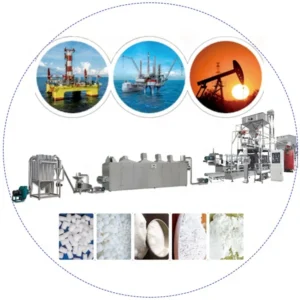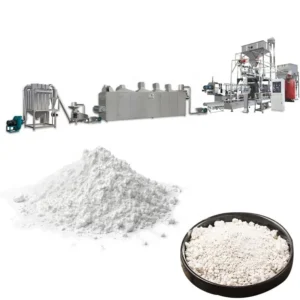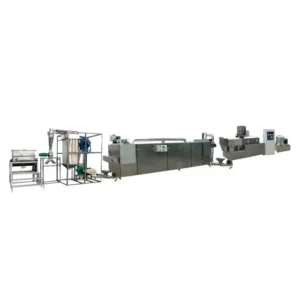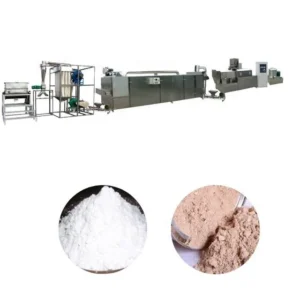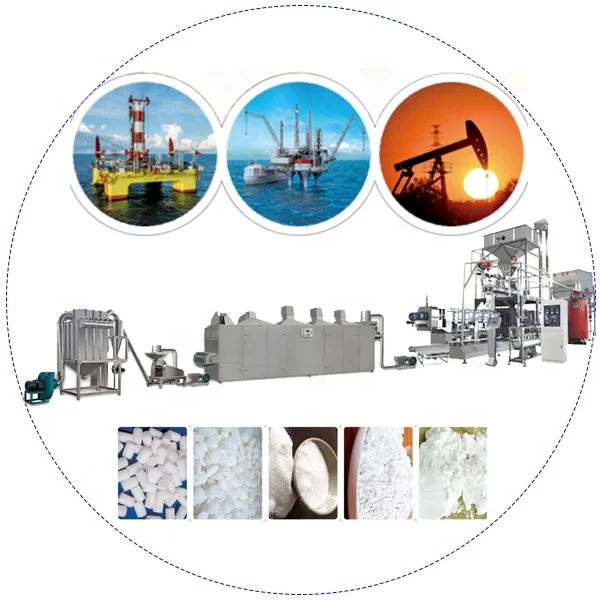
Throughput-matched stations — every station from batching through grinding is calculated against your actual raw material, not assembled from catalog defaults.
Technical Specifications
| Parameter | Value |
|---|---|
| Product Type | Modified Starch Processing Line |
| Raw Materials | Wheat flour, corn starch, potato starch |
| Output Capacity | 80–500 kg/h (basis not stated in source — confirm raw material type, moisture content, and specific modified starch variant) |
| Extruder Type | Twin-screw extruder |
| Contact Parts Material | Food-grade stainless steel 304 |
| Frame Material | Stainless steel 201 |
| Voltage & Frequency | Three-phase 380V/50Hz; Single-phase 220V/50Hz (customizable to buyer’s local voltage) |
| Rated Power | Approx. 100 kW (electric heating); approx. 50–60 kW (gas or diesel heating) (rated or peak not specified in source) |
| Energy Options | Electricity / Gas / Diesel / Steam |
| Motor Brand | Siemens (made in China) or China top brand; Delixi or Delta inverter |
| Mixer Motor | 4.0 kW |
| Mixer Dimensions | 1.2 × 0.9 × 1.4 m |
| Mixer Batch Output | 3.0–4.0 kg/time |
| Screw Conveyor Motor | 1.1 kW |
| Screw Conveyor Dimensions | 2.5 × 0.6 × 2.3 m |
| Screw Conveyor Output | 0–150 kg/h |
| Process Flow | Mixer → Screw Conveyor → Twin Screw Extruder → Shift → Air Conveyor → Dryer → Air Conveyor → Conditioning → Conveyor → Grinder |
| Die Configuration | Interchangeable dies for different product shapes |
| Assembly State | Complete line (batching through grinding) |
| Standards | CE, ISO |
Application Suitability
| Application | Material or Output |
|---|---|
| Pre-gelatinized starch for instant food and soup bases | Corn starch, potato starch |
| Modified starch for paper coating and sizing | Wheat flour, corn starch |
| Pregelatinized starch for pharmaceutical binders | Potato starch, corn starch |
| Expanded starch for industrial adhesives and drilling fluids | Corn starch, wheat flour |
| Textured starch additives for meat analogues and bakery | Wheat flour, potato starch |
Why "80–500 kg/h" Means Nothing Without Your Raw Material
Nominal capacity figures assume a reference material that is rarely what you actually feed into the hopper.
When a modified starch processing line full equipment range is quoted against standard corn starch, the numbers look solid on paper. Switch to potato starch or a waxy maize variant with a different amylose-to-amylopectin ratio, and the gelatinisation temperature, melt viscosity, and expansion behaviour shift entirely. I have seen pre-gelatinized starch trial runs where the same extruder settings produced fully expanded granules on one feedstock and half-cooked, gummy lumps on another — with no mechanical change, only a raw material swap. That is why throughput claims without a stated basis are a starting point, not a guarantee [NEED_CITE: starch gelatinisation temperature variation by botanical source].
What the Full Equipment Range Actually Covers
The modified starch processing line full equipment range links every station — mixing, screw conveying, twin-screw extrusion, air conveying, drying, conditioning, and grinding — into a continuous material path. Each station is specified so its throughput aligns with the adjacent unit, rather than pulling standalone machines from different catalogues and hoping they balance out at commissioning. This matters because a bottleneck at the dryer or grinder will cap your real output regardless of what the extruder is rated for.
Where Starch Processors Get Caught Between Stations
An extruder that can push 300 kg/h of gelatinized corn starch is useless if the downstream dryer only handles 180 kg/h at the residence time your product requires. I have walked into plants where operators were deliberately throttling the extruder to match a dryer that was never re-sized when the line was expanded. The screw conveyor output of 0–150 kg/h and mixer batch rate of 3.0–4.0 kg/time must be reconciled with the extruder barrel fill rate and the dryer belt loading — otherwise the modified starch processing line full equipment range becomes a collection of mismatched islands [NEED_CITE: continuous line throughput balancing in starch extrusion].
Decoding the Specs That Actually Govern Your Product
The twin-screw configuration is the core variable. Unlike a single-screw design that relies on drag flow, a co-rotating twin screw provides positive displacement and distributive mixing, which is critical when you need uniform shear and heat transfer across a starch melt that transitions from granular to fully gelatinized within a few barrel zones. The interchangeable die plates let you control exit pressure and strand geometry, which directly sets the expansion ratio and bulk density of the pre-gelatinized starch before it enters the dryer. Food-grade stainless steel 304 on all contact parts prevents iron catalysed oxidation during prolonged runs — a concern when processing wheat flour with higher protein and lipid fractions than pure corn starch. The multiple energy options (electricity, gas, diesel, steam) are not just a cost choice; steam or indirect gas heating gives you finer barrel temperature zoning, which matters when your target gelatinisation window is narrow, as it typically is for potato starch at lower onset temperatures compared to corn.
The Hidden Cost of a Line Assembled Station by Station
Buying an extruder from one vendor, a dryer from another, and a grinder from a third means no single party owns the throughput calculation. When your pre-gelatinized starch exits the dryer with higher residual moisture than the grinder can handle, each vendor points to the other’s equipment as the problem. The conditioning and grinding stages are where a lot of modified starch lines quietly lose product — fines generation, inconsistent particle size distribution, or screen blinding from starches that re-absorb moisture in humid plant environments. Without a unified line specification, these failures surface only after installation, when rework is expensive and downtime is measured in lost contracts [NEED_CITE: post-extrusion moisture control in starch grinding operations].
Why Source the Complete Range Here
Every station on this modified starch processing line full equipment range is specified against the same raw material and product target, so throughput, residence time, and energy input are calculated end-to-end rather than assumed. Screw configuration and die design are matched to your specific starch type and target degree of gelatinisation before the machine leaves the factory, not adjusted blindly on-site. An in-house testing workshop runs your actual material — whether it is cassava starch, waxy maize, or potato starch — so the trial run report confirms parameters before shipment rather than after installation. Electrical schematics and voltage are confirmed against your local supply standard before production begins, eliminating the commissioning delays that arise when a 380V/50Hz line arrives at a 440V/60Hz plant.
Documentation & Verification
- Line layout and capacity calculation showing throughput at every station
- Screw and die configuration record matched to your starch type
- Electrical schematic with voltage and frequency confirmation for your site
- Trial run report on your actual raw material before dispatch
- Factory test record with operating parameters logged
- Operation and maintenance manual with wear parts list
Installation, Commissioning & Support
- Foundation plan aligned to the 2.5 m screw conveyor footprint and extruder load
- Dedicated electrical circuit sized for the approx. 100 kW electric heating load
- Modular station delivery with on-site assembly and belt alignment
- First-run parameter setting using your raw material and target moisture content
- Operator training on die changeover and barrel temperature zone adjustment
- Wear parts list covering screw elements, die plates, and dryer belt sections
What to Include in Your Enquiry
Specify the botanical source and grade of your starch, the target modified starch variant, and your required output per shift so the line can be configured from the mixer batch rate through to the grinder screen size. Confirm your local voltage, frequency, and available energy source — electricity, gas, diesel, or steam — because the extruder heating and dryer configuration depend on it. If you have an existing upstream or downstream station you plan to keep, share its capacity and interface dimensions so the matching can be done before quotation.
Frequently Asked Questions
Q: How is output capacity verified across each station, and what raw material assumptions apply?
A: The quoted 80–500 kg/h range depends on the botanical starch source, moisture content, and the specific modification target. Each station — mixer, conveyor, extruder, dryer, grinder — is recalculated once your material and product spec are confirmed, and verified through a factory trial run before shipment.
Q: Which energy source is recommended for different plant utility setups?
A: Electric heating suits plants with stable grid capacity and simpler zoning control. Gas or diesel heating reduces peak electrical demand. Steam integration works where a boiler already serves other plant processes. The choice affects both the extruder barrel zones and dryer heat supply.
Q: How are the mixer batch rate, screw conveyor output, and extruder throughput matched?
A: The mixer delivers 3.0–4.0 kg per batch into the screw conveyor rated at 0–150 kg/h, which feeds the twin-screw extruder at a controlled rate. Dryer belt speed and grinder screen capacity are then set against the extruder’s confirmed output on your material to prevent upstream accumulation or downstream starvation.
Q: Can individual stations like the dryer or grinder be supplied to fit an existing line?
A: Yes, individual stations can be specified separately. We need your current extruder output rate, product moisture at the dryer infeed, and target particle size at the grinder outfeed so the replacement station is matched correctly to avoid creating a new bottleneck.
Q: What die and screw configurations are available for different modified starch specifications?
A: Interchangeable dies allow adjustment of strand diameter and exit pressure, influencing expansion ratio and bulk density. Screw element arrangements are configured for the shear and residence time your starch requires, whether you are targeting full gelatinisation or a partial modification with controlled viscosity.