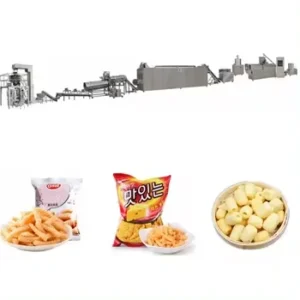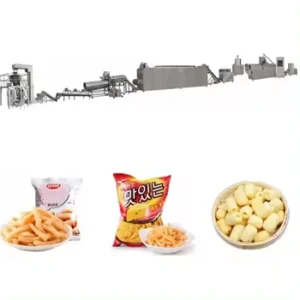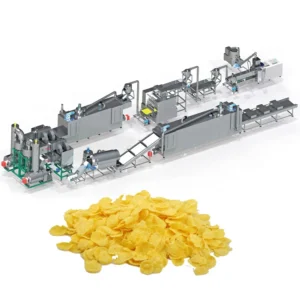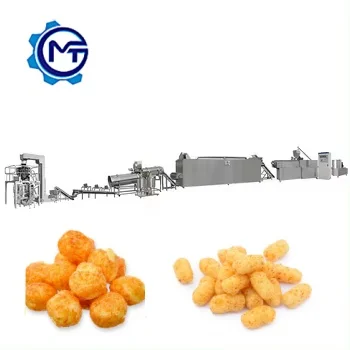
Throughput-Matched Line Configuration — Every station from batching through packing is sized to the extruder output, eliminating bottlenecks where downstream equipment cannot keep pace with upstream capacity.
Technical Specifications
| Parameter | Value |
|---|---|
| Model | MT65 |
| Product Type | Twin Screw Extruded Puff Snacks Food Production Line |
| Screw Type | Twin Screw |
| Available Models | MT65 / MT70 / MT85 / MT100 |
| Installed Power | 130 kW (MT65) / 180 kW (MT70) / 220 kW (MT85) / 240 kW (MT100) |
| Real Consumption | 95 kW (MT65) / 120 kW (MT70) / 130 kW (MT85) / 160 kW (MT100) |
| Capacity | 120–150 kg/h (MT65) / 200–300 kg/h (MT70) / 300–500 kg/h (MT85) / 600–800 kg/h (MT100) (basis not stated in source — confirm raw material type and moisture content) |
| Control System | Frequency speed controlling system |
| Line Stations | Materials preparation → Material batching → Extruding → Drying → Coating/Flavoring → Cooling → Packing → Stacking |
| Die Configuration | Interchangeable dies for cheese ball, ball, tube, stick, ring, fruit loop, star, wheel, flower, heart shapes |
| Core Filling Option | Available with additional core filling machine and cutting machine |
| Dryer Heating Source | Electric / Steam / Gas (configurable to customer local conditions) |
| Flavoring System | Double drum flavoring line with sugar melting and spraying nozzle |
| Packing Machine | Automatic weighing, sealing, marking, coding; vibration feeding with electronic pad weighing |
| Lubrication | Automatic lubricating and cooling system |
| Warranty | 1 year |
| Delivery Time | 20 working days (standard line); approximately 35 working days (with packing and stacking machine) |
| Standards | CE |
Application Suitability
| Application | Material or Output |
|---|---|
| Puffed snack production | Corn flour, rice flour, wheat flour, oat, barley flour and similar grain-based raw materials |
| Core-filled snack production | Grain-based shell with cream, chocolate or fruit paste center via optional core filling module |
| Shaped extruded snacks | Cheese ball, tube, stick, ring, fruit loop, star, wheel, flower, heart formats via interchangeable dies |
| Breakfast cereal formats | Ring shape cereals, natural corn flakes, sugar coated corn flakes |
What "Rated Capacity" Leaves Out on a Twin Screw Extruded Puff Snacks Production Line Full Equipment Range
Capacity only holds when the raw material matches the trial basis.
I once watched a buyer commission a puffed snack line quoted at a specific hourly output, only to discover the figure was established on refined corn grits at controlled moisture. Their actual feedstock was a blend of brown rice and mixed grains with different starch gelatinisation behaviour, and the extruder could not hold the stated throughput without compromising expansion. The entire parameter set had to be reworked on site [NEED_CITE: raw material moisture and starch composition effects on twin screw extrusion throughput]. This is why the Twin Screw Extruded Puff Snacks Production Line full equipment range is configured only after confirming your exact raw material specification, because a line that cannot sustain its rated output on your actual feedstock is not the line you bought.
Surveying Every Station Before Specifying Your Line
The Twin Screw Extruded Puff Snacks Production Line full equipment range covers eight sequential stations, from material batching through stacking. Each station has its own throughput envelope, and the purpose of this catalogue view is to let buyers and process engineers match capacity at every point before a single machine is built. An undersized dryer will force the extruder to idle; an undersized flavoring drum will leave product waiting in buffer conveyors.
Matching Dryer and Flavoring Throughput to Extruder Output
When the MT85 or MT100 extruder runs at higher output, the downstream dryer must remove moisture from a proportionally larger volume of expanded product within the same residence time. The dryer heating source is configurable between electric, steam and gas to align with local utility infrastructure, but thermal capacity must still match the upstream mass flow [NEED_CITE: industrial dryer thermal sizing for extruded snack moisture removal]. The double drum flavoring line with sugar melting and spraying nozzle is sized to coat the full extruder discharge without product hold-up.
Reading the Power and Capacity Data Correctly
The installed power figures — 130 kW for the MT65 up to 240 kW for the MT100 — represent peak motor and heater draw, while real consumption values reflect typical running load. The gap between the two tells a process engineer how much headroom exists during start-up and feedstock transitions. The frequency speed controlling system allows screw speed adjustment across the barrel zones, which directly influences shear, residence time and therefore expansion ratio. Die selection then determines final product geometry; the interchangeable die system supports ten standard shapes on a single extruder platform, so a change from fruit loops to stars requires only a die swap and minor screw profile adjustment rather than a full reconfiguration.
The Cost of Mismatched Station Capacity
When a dryer is specified for a smaller extruder model but paired with a larger one, moisture content at the coating stage rises above the threshold where seasoning adhesion fails. Product that should be crisp arrives at the flavoring drum still soft, and the sugar or spice coating clumps instead of distributing evenly. The line does not stop — it simply produces off-spec output that the market rejects [NEED_CITE: moisture content thresholds for seasoning adhesion on extruded snacks]. This mismatch is invisible in a quotation that lists each machine individually without a unified throughput calculation.
Why Buyers Source the Full Equipment Range Here
Screw configuration and die design are specified to the buyer’s raw material and target product shape rather than copied from a generic build. An in-house testing workshop allows trial runs on the customer’s actual feedstock before the line ships, catching expansion and density issues at the factory instead of on the buyer’s floor. Every station from batching to packing is supplied under one responsibility, so throughput is matched across the entire flow rather than assembled from separate vendors who each warrant only their own machine. The Twin Screw Extruded Puff Snacks Production Line full equipment range is documented with a line layout and capacity calculation that shows the mass balance at each station. Pre-sales consultation through engineer design, on-site installation, commissioning and ongoing maintenance support are included as part of the project scope.
Documentation & Verification
- Line layout and capacity calculation showing throughput at each station from batching to packing
- Machine specification sheet confirming selected extruder model, installed power and real consumption
- Screw and die configuration record matched to your raw material and target snack shape
- Electrical schematic with voltage and frequency confirmed for your installation site
- Trial run report on your actual raw material conducted in the testing workshop before dispatch
- CE declaration of conformity covering the complete line assembly
Installation, Commissioning & Support
- Foundation and floor space planning based on the eight-station line layout for your selected extruder model
- Dedicated electrical circuit sized to the real consumption of your chosen MT65 through MT100 configuration
- Dryer heating source installed and tested against your local electric, steam or gas supply specifications
- Frequency speed controlling system calibrated and operator language confirmed during on-site commissioning
- Die changeover procedure and screw profile adjustment training conducted with your production team
- Wear parts list covering screws, dies and flavoring nozzles with recommended replacement intervals
What We Need to Configure Your Line
To build an accurate line layout and quotation, share your raw material type, typical moisture content, and target snack shape from the available die range. Specify your local voltage, frequency and preferred dryer heating source so the electrical schematic and utility connections are correct before fabrication. If you are expanding an existing line, provide the throughput of your current upstream and downstream equipment so the new stations integrate without creating a bottleneck.
Frequently Asked Questions
Q: How do I verify the stated capacity range against my raw material?
A: The capacity figures shown for each extruder model are reference values that depend on raw material type, moisture content and target product density. We conduct a trial run on your actual feedstock in the testing workshop before shipment, measuring real throughput and expansion to confirm the line meets your output requirement.
Q: How is dryer and flavoring station capacity matched to the extruder?
A: Each downstream station is selected based on the mass flow from your chosen extruder model. The line layout document shows throughput at every station so you can verify the dryer residence time and flavoring drum volume handle the full extruder discharge without buffering or bottlenecks.
Q: What voltage and frequency options are available?
A: The electrical system is configured to your site supply before production begins. Provide your local voltage, frequency and phase specification during inquiry, and the electrical schematic will reflect these values. Control panel language is confirmed at the same stage.
Q: Which die shapes are available and can I request custom profiles?
A: Ten standard die shapes are available including cheese ball, tube, ring, fruit loop, star and heart. Custom profiles can be developed; the die configuration record documents the geometry and corresponding screw profile so results are repeatable across production runs.
Q: What is included versus optional in the complete line?
A: The standard line covers batching, extruding, drying, double drum flavoring, cooling and packing. Core filling requires an additional module with its own cutting machine. Stacking equipment extends delivery lead time. Each option is listed separately in the quotation.