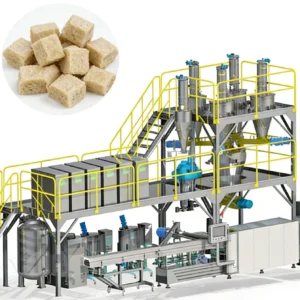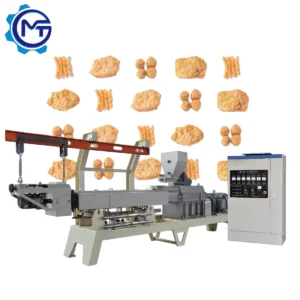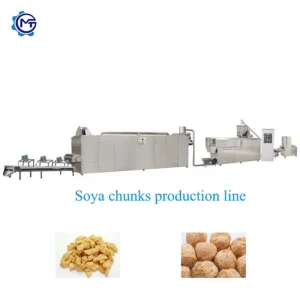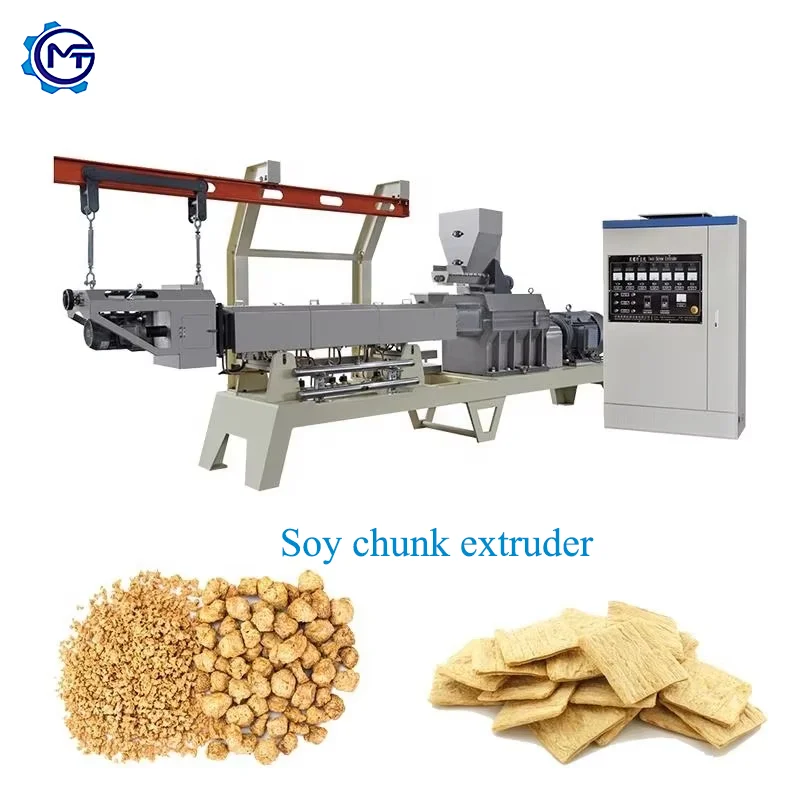
Throughput-matched stations across every stage — this textured vegetable protein production line full equipment range specifies output, power and footprint for each machine from mixer to cooler, so no single station becomes the bottleneck.
Technical Specifications
| Parameter | Value |
|---|---|
| Product Type | Textured Vegetable Protein (TVP) Extrusion Production Line |
| Model | MT65 / MT70 / MT85 |
| Screw Type | Twin-screw |
| Installed Power | MT65 — 85 kW; MT70 — 120 kW; MT85 — 195 kW |
| Actual Power Consumption | MT65 — 65 kW; MT70 — 90 kW; MT85 — 165 kW |
| Output Capacity | MT65 — 150–200 kg/h; MT70 — 200–300 kg/h; MT85 — 600–800 kg/h (basis to be confirmed — dependent on raw material formulation, moisture content and target TVP format) |
| Overall Dimensions (L × W × H) | MT65 — 18000 × 1300 × 2300 mm; MT70 — 20000 × 1500 × 2400 mm; MT85 — 24000 × 3500 × 4300 mm |
| Construction Material | Stainless steel (food-grade contact surfaces) |
| Main Motor Power (Extruder) | 30 kW |
| Extruder Installed Power | 45.87 kW |
| Extruder Actual Power | 30–35 kW |
| Extruder Output (standalone unit) | 200–250 kg/h (basis to be confirmed) |
| Extruder Dimensions | 2800 × 830 × 1875 mm |
| Powder Mixer Output | 300–600 kg/h |
| Powder Mixer Tank Volume | 150 kg |
| Powder Mixer Rotary Speed | 385 rpm |
| Powder Mixer Power | 4 kW |
| Powder Mixer Dimensions | 1000 × 630 × 1100 mm |
| High-Temperature Roaster Output | 300–400 kg/h |
| Roaster Effective Belt Length | 3.5 m |
| Roaster Heating | Far infrared 3.9 kW × 24; gas-assisted, 6.8 m³ consumption (gas type and heating value to be confirmed) |
| Roaster Belt Motor Power | 0.55 kW |
| Roaster Dimensions | 4500 × 1500 × 1600 mm |
| Cooling Machine Capacity | 200–300 kg/h (source value — verify against manufacturer catalog) |
| Line Process Flow | Raw material preparation → Mixing → Conveying → Extrusion → Conveying → Drying → Cooling → Packing |
| Warranty | 1 year complete; lifetime maintenance service |
| Standards | CE; ISO |
Application Suitability
| Application | Material or Output |
|---|---|
| Plant-based meat alternative production | Low-temperature soybean meal, peanut meal |
| Textured soybean protein for sausage and ham formulations | Defatted soybean meal with varying protein content |
| Vegetarian meat substitutes for canned and quick-frozen food | Soy and legume-based protein blends |
| Institutional nutrition programme supply | High-protein meal formulations for fortified feeding |
| Snack food and fast-food ingredient processing | Blended plant protein with starch and fibre additives |
What Happens When the Mixer, Extruder and Dryer Are Not Speaking the Same Language
Matching throughput across every station is the real engineering challenge behind any textured vegetable protein production line full equipment range.
I spent years on assembly floors watching lines that looked perfect on paper fall apart the moment real material hit the hopper. One plant in the Pearl River Delta ran a Textured Soybean Protein Extruder on our standard defatted meal during trials, and the fibrous pull-apart texture was exactly what the buyer wanted. Then the buyer switched to their own local soybean meal with a noticeably lower protein content. On-site, the output came out as fine powder rather than structured fibre. The screw combination had to be completely reconfigured, costing weeks of downtime [NEED_CITE: raw material protein content influence on TVP extrusion texture]. When one station is rated for a certain throughput but the upstream mixer or downstream roaster cannot keep pace, the entire line stalls at its weakest link. The full station lineup on this page exists to prevent exactly that mismatch.
How High-Temperature, High-Shear Extrusion Builds the Fibrous Structure
The twin-screw extruder in this textured vegetable protein production line full equipment range subjects raw material to high temperature, high pressure and intense shear inside the barrel. Spherical protein molecules are forced open and rearranged into elongated chain structures as the material passes through the die. This structural transformation is what gives TVP its meat-like, pull-apart texture. The screw configuration and die geometry are specified to the buyer’s particular raw material blend, which means the internal profile of the extruder is never a generic off-the-shelf build.
Capacity Tiers That Let You Scale Without Overbuilding
Three extruder models — MT65, MT70 and MT85 — span output ranges from smaller pilot-scale runs up to high-volume production, always contingent on the buyer’s confirmed raw material formulation and moisture level. Rather than forcing every buyer into one oversized machine, the lineup allows a snack manufacturer testing a new plant-based format to start with the MT65, then move to the MT85 when demand justifies the floor space and utility draw. Each tier carries its own installed and actual power figures, so electrical planning stays honest from the first drawing [NEED_CITE: industrial electrical load planning for extrusion facilities].
Reading the Specs That Actually Matter on the Floor
The powder mixer operates at 385 rpm with a 150 kg tank volume, which determines how much pre-blended material is available per batch cycle before the extruder runs dry. If the mixer batch cycle is longer than the extruder consumption rate, the screw will starve and product density will drift. The high-temperature roaster uses 24 far infrared heater elements at 3.9 kW each, combined with gas-assisted heating over a 3.5 m effective belt length. That belt length sets the residence time — too short and the TVP retains excess moisture, inviting spoilage during storage; too long and surface scorching degrades colour and flavour. The cooling machine downstream must then bring the dried product to ambient temperature before packing, because bagging warm TVP traps condensation inside the package.
The Hidden Cost of Skipping the Trial Run
Buyers who approve a line configuration without testing their own raw material in the extruder barrel often discover problems only after the machines are bolted to the factory floor. A screw combination that produces perfect fibre on standard soybean meal may yield crumbly, under-textured output on a local meal with different protein-to-starch ratios. Reconfiguring the screw elements on-site means halting production, sourcing replacement segments and running multiple test batches — all while the downstream roaster, cooler and packing line sit idle. That kind of delay is measured in weeks, not hours [NEED_CITE: extrusion screw reconfiguration lead time and production loss].
Why Sourcing the Full Range from One Supplier Changes the Conversation
Every station in this lineup — mixer, extruder, roaster, cooler, conveyors — is specified so that throughput aligns rather than conflicts. Screw configuration and die design are matched to the buyer’s raw material, not copied from a generic template. An in-house testing workshop allows trial runs on the buyer’s actual soybean or peanut meal before shipment, catching formulation problems early. Twin-screw expertise spans plant protein applications alongside pet food, aquatic feed and breakfast cereal lines, so cross-application knowledge informs every build. Pre-sales engineering covers line layout and utility planning, while on-site commissioning and operator training ensure the first production run meets specification.
Documentation & Verification
- Line layout and capacity calculation showing throughput matching across mixer, extruder, roaster and cooler
- Machine specification sheet for each station with motor power, dimensions and utility draw
- Screw and die configuration record matched to your soybean or peanut meal formulation
- Electrical schematic with voltage and frequency confirmed for your facility before production begins
- Trial run report on your raw material conducted in the testing workshop before dispatch
- CE declaration of conformity and ISO certificate included with shipment documentation
Installation, Commissioning & Support
- Floor space planning based on the MT65, MT70 or MT85 overall line dimensions up to 24 m length
- Dedicated electrical circuit sized for the selected model’s installed power up to 195 kW
- Station-by-station assembly sequence with conveyor alignment between extruder discharge and roaster infeed
- First-run parameter setting including barrel temperature profile and die gap for your specific meal blend
- Operator training covering screw element inspection intervals and die cleaning procedures
- Wear parts list identifying screws, dies and roaster belt segments for initial spare stock
What to Include in Your First Inquiry
To move from a general inquiry to a specific line proposal, the most useful information you can provide starts with your raw material type, its protein content and moisture level at the point of mixing. Next, share your target output per shift and the format of the finished TVP — whether granules, chunks or slices. Finally, confirm your facility voltage, frequency and the control language your operators will need on the HMI screen. If you have existing upstream or downstream equipment that the new line must integrate with, include those machine specs so the layout can account for them.
Frequently Asked Questions
Q: How do I match each station’s capacity to avoid bottlenecks across the full TVP line?
A: Start with the extruder output for your confirmed raw material, then verify that the mixer batch cycle replenishes material faster than the extruder consumes it. The roaster belt speed and length must allow sufficient drying residence time at that throughput, and the cooling machine must handle the same hourly volume before packing. Each station’s rated capacity should exceed the extruder output slightly to absorb normal variation.
Q: What supporting equipment is needed alongside the extruder for a balanced line?
A: A powder mixer for uniform raw material blending, screw conveyors to feed the extruder hopper consistently, a high-temperature roaster for moisture removal, a cooling machine to stabilise product temperature, and belt or bucket conveyors linking each station. Packing equipment at the line end must match the cooled output rate to prevent backlog.
Q: What are the footprint and utility requirements for each machine model?
A: The MT65 line occupies roughly 18 m in length, the MT70 extends to 20 m and the MT85 reaches 24 m with a wider profile. Electrical supply must cover the installed power of the selected model, and the roaster requires a gas connection for its assisted heating system. Confirm ceiling height against the maximum station height before finalising the layout.
Q: Can individual stations be sourced separately or only as a complete line?
A: Individual stations such as the powder mixer, extruder, roaster or cooling machine can be specified on their own for integration into an existing line. When sourcing single stations, provide the throughput and interface dimensions of your current equipment so the new machine can be matched correctly.