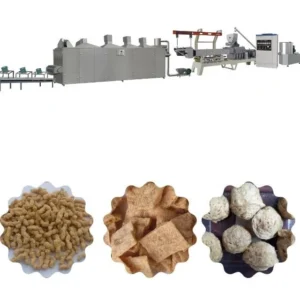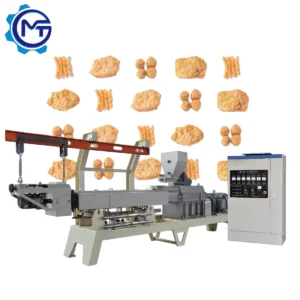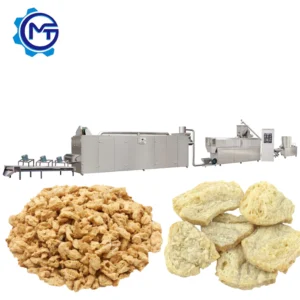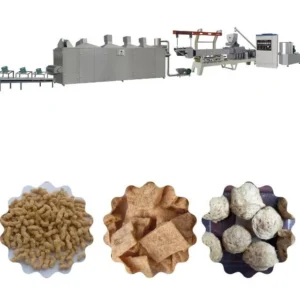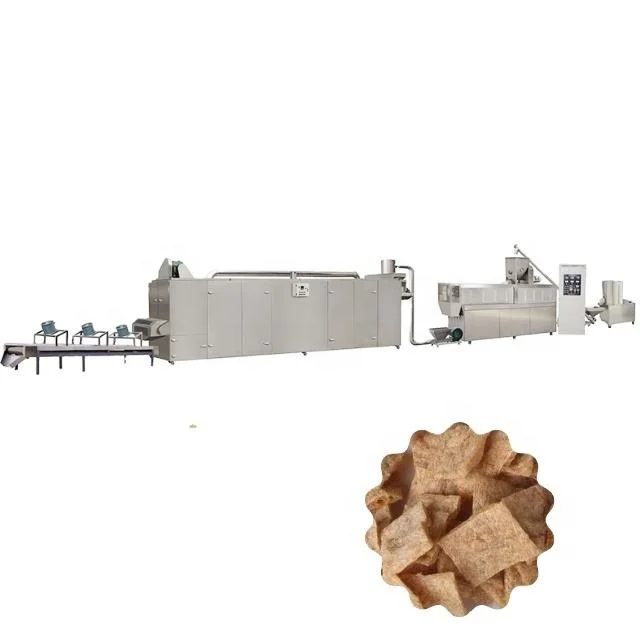
Integrated station lineup — throughput from the powder mixer through the MT65, MT70 or MT85 extruder to the roaster and cooling machine is specified together, so no single unit throttles the plant based meat processing line equipment range you are building.
Technical Specifications
| Parameter | Value |
|---|---|
| Product Type | Textured Vegetable Protein (TVP) / Soybean Meat Extrusion Production Line |
| Process Flow | Raw material preparation → mixing → conveying → extrusion → conveying → drying → cooling → packing |
| Extruder Models Available | MT65, MT70, MT85 (Twin-screw) |
| MT65 Installed / Real Power | 85 kW / 65 kW |
| MT65 Output | 150–200 kg/h (basis not stated in source — confirm raw material formulation and moisture content) |
| MT65 Overall Dimensions | 18000 × 1300 × 2300 mm |
| MT70 Installed / Real Power | 120 kW / 90 kW |
| MT70 Output | 200–300 kg/h (basis not stated in source — confirm raw material formulation and moisture content) |
| MT70 Overall Dimensions | 20000 × 1500 × 2400 mm |
| MT85 Installed / Real Power | 195 kW / 165 kW |
| MT85 Output | 600–800 kg/h (basis not stated in source — confirm raw material formulation and moisture content) |
| MT85 Overall Dimensions | 24000 × 3500 × 4300 mm |
| Powder Mixer Capacity | 300–600 kg/h, 150 kg tank volume, 385 rpm, 4 kW |
| High-temperature Roaster Capacity | 300–400 kg/h, effective belt length 3.5 m |
| Roaster Heating | Far infrared 3.9 kW × 24, gas consumption 6.8 m³/h |
| Cooling Machine | 200–300 kg/h, temperature range 0–60 °C (verify against final spec) |
| Control System | Automated PLC and MCC control |
| Construction Material | Stainless steel food-grade contact surfaces |
| Standards | CE (certified since 2014), ISO |
| Warranty | 1 year complete warranty |
Application Suitability
| Application | Material or Output |
|---|---|
| Textured vegetable protein for ham and sausage filling | Low-temperature soybean meal, soy protein concentrate |
| Soybean meat chunks for canned and quick-frozen meals | Defatted soybean meal, peanut meal |
| Plant-based meat ingredient supply for fast-food chains | Blended soy and pea protein formulations |
| High-moisture meat analogue base for slicing and shredding | Concentrated soy protein with starch modifiers |
Why a Mismatched Station Breaks the Whole Line
Every station must pass the same tonnage, or the slowest unit decides your real output.
A plant based meat processing line equipment range is only as productive as its bottleneck. I have watched a twin-screw extruder push material faster than the downstream roaster could handle, leaving trays of hot, wet protein sitting in a staging area losing moisture unevenly. The extruder then had to be dialed back, which shifted the shear profile inside the barrel and changed the fiber texture the buyer had already shown to their customer. [NEED_CITE: throughput balancing across extrusion, drying and cooling stations] The lesson was simple: capacity figures for each station must be read together, not in isolation, before any purchase order is signed.
Station-to-Station Throughput Matching
The powder mixer cycles at a batch rate that feeds the extruder continuously, while the roaster belt speed and the cooling machine conveyor are set to receive the extrudate without accumulation. When you survey a plant based meat processing line equipment range, compare the roaster effective belt length and the cooling machine capacity against the extruder output you intend to run. A mismatch of even one station forces the entire line to idle or surge, and protein fiber structure suffers when residence time in the dryer varies from batch to batch.
Screw Configuration and Die Selection for Protein Fibers
Twin-screw extrusion of low-temperature soybean meal requires a screw profile that builds shear gradually, aligning protein molecules into layered fibers before the die opens them into chunks. The die aperture and land length together control the expansion ratio; open them too wide and the chunks collapse into crumbs, restrict them too much and the motor load climbs without improving texture. [NEED_CITE: screw configuration impact on texturized vegetable protein fiber formation] Every raw material blend behaves differently, so the screw and die record must be documented against the buyer’s actual formulation before the machine leaves the factory.
Reading Installed Power Versus Real Power
The MT65, MT70 and MT85 each list an installed power figure that covers the main motor, feeder, cutter and auxiliary drives, while the real power reflects typical continuous draw during steady extrusion. Sizing your transformer and cable run on the installed number avoids nuisance trips during start-up, yet operating cost calculations should use the real power value. For the MT85, installed power is 195 kW with a real draw around 165 kW, so electrical infrastructure should plan for the higher figure while energy budgeting can rely on the lower one. Mixing these two numbers leads to either under-sized breakers or inflated utility projections.
The Hidden Cost of Skipping a Trial Run
Running the extruder on a generic soy formulation at the factory and then switching to the buyer’s actual low-temperature soybean meal on site often means two weeks of screw adjustments, temperature re-tuning and die swaps before fiber structure meets market expectations. Downtime during that period still consumes labor, utilities and raw material, and the buyer’s first shipment to their own customer is delayed. [NEED_CITE: trial run practices for textured protein extrusion lines] A pre-shipment trial on the buyer’s exact blend removes most of that variable, locking in the screw configuration and barrel temperature profile before the crates are sealed.
Why Source the Full Lineup Here
Complete station coverage from mixing through packing means throughput is calculated across every conveyor and dryer, not patched together from separate vendors. Screw configuration and die design are matched to the buyer’s raw material and target fiber structure, not copied from a generic build. An in-house testing workshop allows trial runs on the customer’s actual soybean meal or peanut meal before shipment. Twin-screw expertise spans TVP, pet food, aquatic feed and snack applications, so process knowledge transfers across product formats. Pre-sales consultation covers line layout, utility planning and voltage confirmation, continuing through on-site installation and operator training.
Documentation & Verification
- Line layout and capacity calculation matching every station to the chosen extruder model
- Machine specification sheet for MT65, MT70 or MT85 with individual power and dimension data
- Screw and die configuration record tied to the buyer’s raw material blend
- Electrical schematic with voltage and frequency confirmed for the destination market
- Factory test record on customer-supplied soybean meal or peanut meal before dispatch
- CE declaration of conformity and ISO certificate included with shipping documents
Installation, Commissioning & Support
- Foundation pad sized to the MT85 footprint of 24000 × 3500 mm with leveling anchors
- Dedicated circuit rated for 195 kW installed power on the MT85 extruder station
- Roaster gas supply line sized for 6.8 m³/h consumption plus far-infrared heater circuits
- PLC and MCC control language set to operator preference before commissioning begins
- Spare screw elements and die plates listed in the wear parts schedule for first replacement cycle
- Cooling machine temperature range verified against local ambient conditions during start-up
Preparing Your Inquiry
Share the protein source you plan to run, whether low-temperature soybean meal, soy concentrate or a blended formulation, along with the target chunk size and moisture level. Confirm the daily output you need so the correct extruder model and matching roaster capacity can be proposed. State the voltage, frequency and control language required at your facility, and indicate whether a trial run on your raw material is needed before dispatch.
Frequently Asked Questions
Q: What stations are included in a complete TVP production line and where does each fit?
A: The line starts with a powder mixer for blending soybean meal and additives, feeds a twin-screw extruder for protein texturization, passes extrudate through a high-temperature roaster for moisture reduction, then a cooling machine before packing. Each station’s capacity is matched to the extruder model selected.
Q: How is throughput matched between the extruder, roaster, and cooling machine?
A: The roaster belt length and heater output are chosen so residence time dries the extrudate to the target moisture without backlog. The cooling machine capacity is then aligned to the roaster discharge rate, preventing accumulation that would cause uneven texture or fiber collapse.
Q: What is the difference between installed power and real power on these extruders?
A: Installed power covers all motors and heaters at peak demand, while real power reflects continuous draw during steady-state extrusion. Electrical infrastructure should be sized for installed power, whereas energy cost estimates can use real power figures.
Q: Which extruder model fits a mid-range production target and limited factory space?
A: The MT70 delivers an output range of 200–300 kg/h with a footprint of 20000 × 1500 mm, fitting most mid-volume TVP operations. Confirm the exact capacity basis against your raw material formulation before final selection.
Q: Are voltage, frequency, and control language confirmed before shipment?
A: Yes. The electrical schematic, PLC configuration and MCC labeling are set to the buyer’s destination market requirements during the specification confirmation stage, preventing commissioning delays caused by mismatched power supply or unreadable interface text.