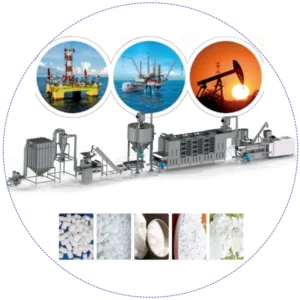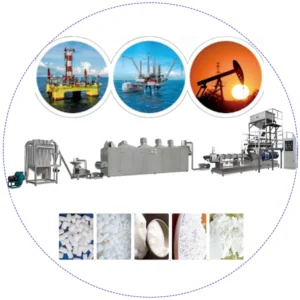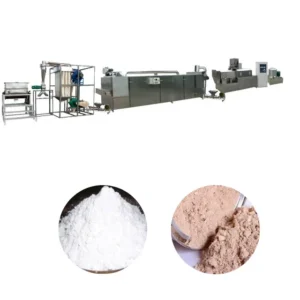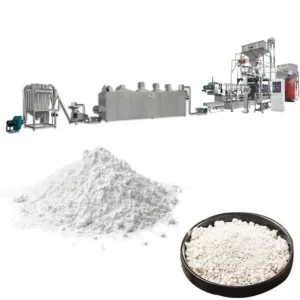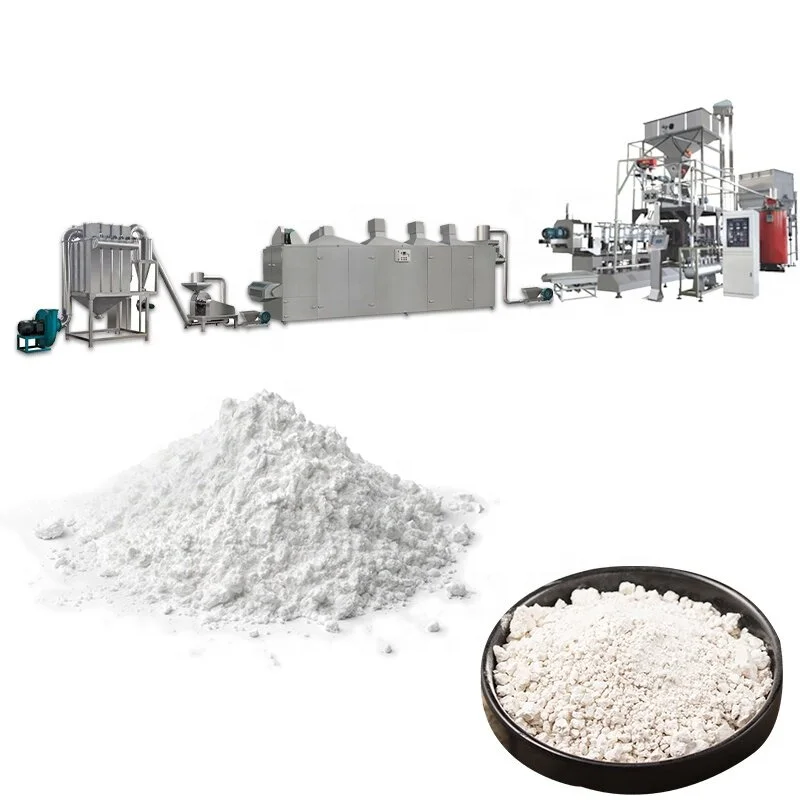
Throughput-Matched Stations — every mixer, extruder, dryer, and grinder is specified as a set so no single unit chokes the modified starch line you are building.
Technical Specifications
| Parameter | Value |
|---|---|
| Product Type | Twin Screw Extruder for Modified Starch and Pre-Gelatinized Starch Production Line |
| Model Options | MT65 / MT70 / MT70C / MT75 |
| Installed Power | 84 kW (MT65) / 160 kW (MT70) / 190 kW (MT70C) / 200 kW (MT75) |
| Power Consumption | 59 kW (MT65) / 120 kW (MT70) / 140 kW (MT70C) / 145 kW (MT75) |
| Output Capacity | 100–150 kg/h (MT65) / 150–200 kg/h (MT70) / 200–250 kg/h (MT70C) / 250–300 kg/h (MT75) (basis to be confirmed) |
| Overall Dimensions (L×W×H) | 41000×1500×2200 mm (MT65/MT70) / 41000×1500×3200 mm (MT70C) / 45000×1500×3500 mm (MT75) |
| Screw Type | Twin screw |
| Screw Material | 38CrMoAl (molybdenum aluminum alloy steel) |
| Barrel Material | 45# steel |
| Screw Length Options | 1050 mm / 1520 mm / 1699 mm |
| Main Motor Options | 22 kW / 30 kW / 45 kW |
| Shelf Material | Carbon steel |
| Outer Sealing Plate | Stainless steel 201 or 304 |
| Control System | Cabinet with feeding and spindle frequency conversion |
| Mixer Power | 4 kW / 7.5 kW / 15 kW |
| Mixer Batch Capacity | 20–30 kg / 70–80 kg / 170–180 kg per batch |
| Dryer Type | Multi-layer oven (electric / fuel oil / gas heating options) |
| Dryer Temperature Range | 0–200 °C, adjustable |
| Dryer Configurations | 3-layer 5 m / 5-layer 5 m / 5-layer 7 m / 7-layer 10 m / 5-layer 12 m |
| Dryer Mesh Belt | Stainless steel double-layer mesh |
| Grinder Type | Pulse grinder with cyclone discharge and dust collector |
| Line Stations | Mixer → Twin-screw extruder → Multi-layer dryer → Pulse grinder → Packing |
| Certification | CE, ISO |
Application Suitability
| Application | Material or Output |
|---|---|
| Modified starch for food industry | Native corn, wheat, potato, or tapioca starch with adjusted gelatinization and viscosity |
| Pre-gelatinized starch for instant foods | Starch processed for cold-water solubility in instant soups, desserts, and bakery mixes |
| Industrial modified starch | Starch for paper sizing, textile warp, and construction adhesive applications |
| Nutritional ingredient blending | Starch-based carriers and excipients for vitamin and mineral premixes |
What "300 kg/h Output" Leaves Out About Starch Extrusion
The raw material defines the real capacity, not the nameplate. A modified starch extruder full equipment range only reaches its rated throughput when the starch source, moisture content, and target modification degree all match the screw configuration in the barrel.
I once watched a line that was quoted for standard corn starch switch to a heavy tapioca blend without changing the screw profile. The gelatinization dropped, the extrudate came out dense, and the downstream grinder could not keep up with the off-spec material. The throughput numbers on paper meant nothing because the material behaviour had shifted entirely [NEED_CITE: starch gelatinization behaviour across corn, tapioca, and potato sources]. This is why every capacity figure above carries a "basis to be confirmed" note — the actual number depends on what you feed into the hopper.
Matching the Extruder to Your Starch Chemistry
The twin screw extruder for modified starch production line must account for how different starch sources respond to shear and heat. Corn starch gelatinizes at a different temperature window than tapioca or potato starch, so barrel zone temperatures and screw pitch have to be set accordingly. The 38CrMoAl screw elements resist the abrasive wear that native starches produce over long production runs, maintaining consistent shear across the barrel length.
Dryer and Grinder Capacity Must Track Extruder Output
A common mistake is sizing the dryer only for the extruder’s nominal output without considering the moisture load. Starch extrudate leaves the die at elevated moisture, and if the multi-layer oven cannot remove water fast enough, material backs up on the belt. The five dryer configurations — from 3-layer 5 m to 5-layer 12 m — exist because different starch modification targets produce extrudate at different moisture levels [NEED_CITE: moisture removal requirements for pre-gelatinized versus chemically modified starch].
Screw Length and Motor Sizing for Residence Time
Longer screw barrels increase residence time inside the extruder, which matters when you need deeper starch modification. The available screw lengths of 1050 mm, 1520 mm, and 1699 mm let you select a configuration that gives the material enough time under heat and shear to reach the required gelatinization degree. Pairing the right screw length with the correct main motor — 22 kW, 30 kW, or 45 kW — prevents overloading the drive when running high-viscosity starch formulations.
Control System Precision Across Batches
The control cabinet with feeding and spindle frequency conversion lets operators adjust material feed rate and screw speed independently. This matters because a slight change in feed rate alters the fill level inside the barrel, which directly affects shear intensity and final starch properties. Consistent batch-to-batch output depends on holding these variables steady rather than adjusting by feel.
The Hidden Cost of Mismatched Station Capacity
When the mixer batch capacity does not align with extruder throughput, operators either wait between batches or overfill the feeder, causing uneven material flow into the barrel. When the pulse grinder is undersized relative to dryer output, dried extrudate piles up and absorbs ambient moisture, degrading the particle size distribution. These are not problems you see during a factory demonstration — they appear three weeks into production when the line is running at full schedule [NEED_CITE: throughput bottleneck patterns in starch processing lines].
Why Source the Full Range from One Supplier
The complete line from mixer through grinder is configured under one supplier, so each station’s capacity is calculated against the others rather than assembled from separate vendors who each quote their own nominal numbers. Screw and barrel specifications are recorded against your target starch type before production begins. The in-house testing workshop allows trial runs on your actual raw material — corn, tapioca, potato, or a blend — so the screw profile and temperature curve are validated before the line ships. Electrical schematics and voltage are confirmed for your destination market, and the documentation package includes the trial run report so you have a baseline to measure against during commissioning.
Documentation & Verification
- Line layout and capacity calculation showing throughput balance across mixer, extruder, dryer, and grinder
- Screw configuration record matched to your specific starch source and modification target
- Electrical schematic with voltage and frequency confirmed for destination market
- Trial run report on customer-supplied raw starch material before shipment
- Factory test record documenting all stations running together under load
Installation, Commissioning & Support
- Foundation must support the longest configuration at 45 m length with level tolerance for dryer belt tracking
- Dedicated three-phase circuit required matching confirmed voltage and frequency at destination
- Line ships in modular sections; extruder, dryer, and grinder assembled and aligned on site
- First production run supervised to set barrel temperatures, screw speed, and feed rate for your starch
- Operator training covers frequency conversion adjustment and pulse grinder classifier tuning
- Wear parts list includes 38CrMoAl screw elements, barrel liners, grinder rotor blades, and mesh belt sections
Before You Request a Quote
To size the twin screw extruder for modified starch production line correctly, share your starch source and any blending ratios, your target gelatinization or viscosity specification, the daily output you need to hit, and the voltage and frequency standard at your facility. If you plan to run multiple starch types on the same line, list each one so the screw configuration can be planned for changeovers.
Frequently Asked Questions
Q: How do I choose between MT65 and MT75 for my modified starch output target?
A: The choice depends on your confirmed raw material and daily production requirement. We calculate actual throughput on your specific starch source during a trial run before recommending a model, since tapioca and corn starch behave differently in the barrel and yield different real-world capacities from the same machine.
Q: Which dryer heating method should I select for my facility?
A: That depends on your local energy infrastructure. Electric heating offers precise temperature control for sensitive starch modifications. Gas or fuel oil options reduce operating cost where those fuels are readily available. We confirm your energy supply and required moisture removal rate before specifying the dryer configuration.
Q: How do you prevent bottlenecks between the extruder, dryer, and grinder?
A: Each station is sized against the others using your confirmed material and output target. The mixer batch capacity, extruder throughput, dryer belt length and layer count, and grinder classifier speed are all calculated together so no single machine limits the line below your production requirement.
Q: What voltage and control options are available for my market?
A: The standard mixer configuration is 380 V, 50 Hz, three-phase, but the extruder and all motorized stations are confirmed against your destination market’s electrical standard before production. Control cabinet labeling and interface language are specified during the quotation stage.
Q: Can I run both modified starch and pre-gelatinized starch on the same line?
A: Yes, if the line is configured for both from the start. The screw profile, barrel temperature zones, and dryer settings differ between the two products, so we plan the changeover procedure and document both configurations in the operation manual during commissioning.