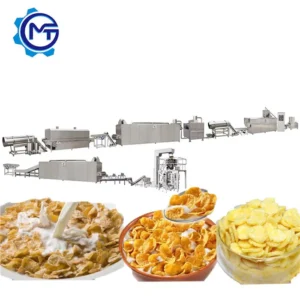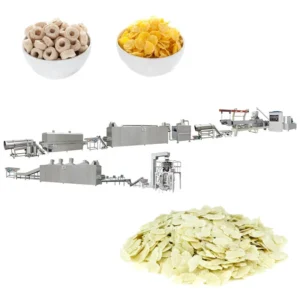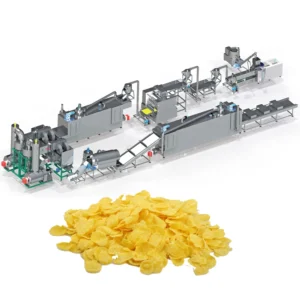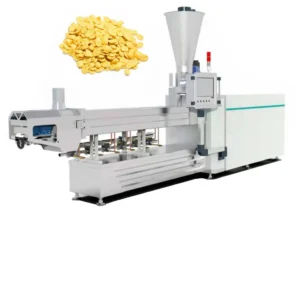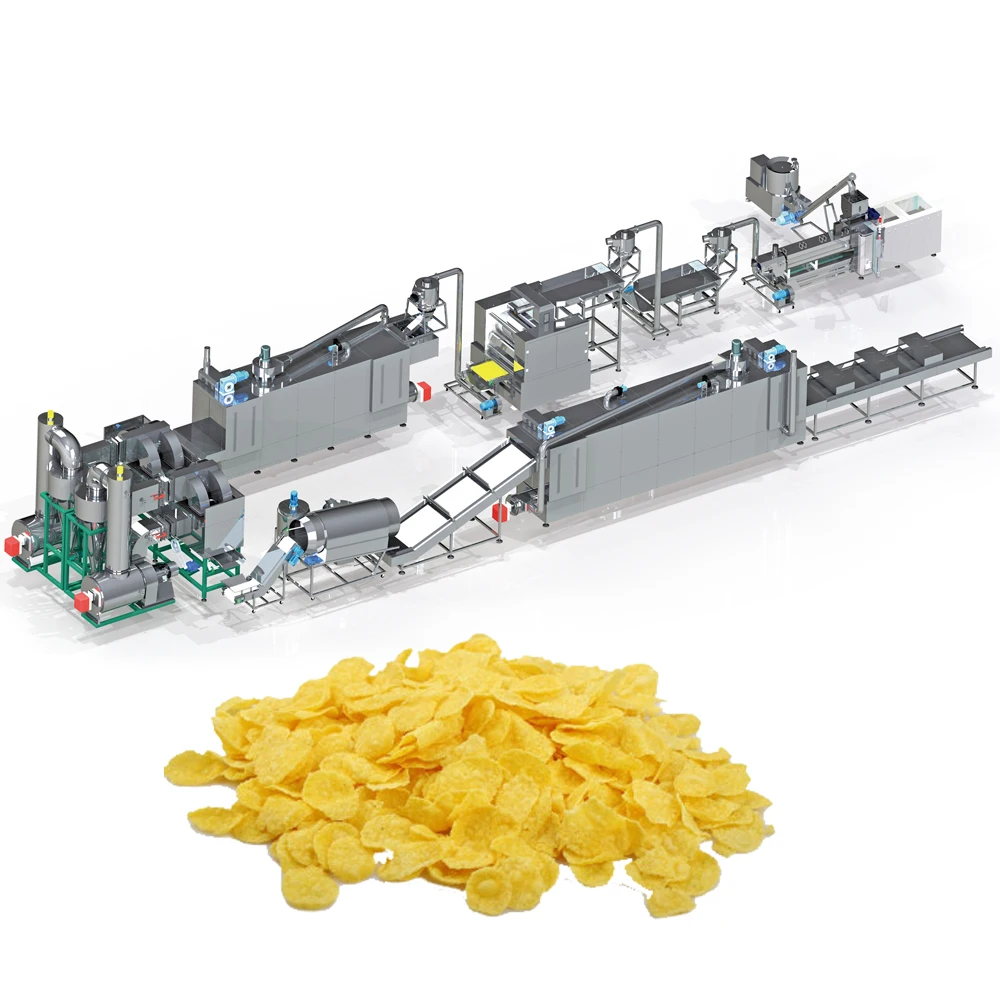
Integrated Line Capacity Matching — every station from batching to packing is engineered to balance throughput so the extruder output never piles up at the flaking mill or dryer entrance.
Technical Specifications
| Parameter | Value |
|---|---|
| Product Type | Twin Screw Corn Flakes Extrusion Line |
| Available Models | MT70 / MT75 / MT85 |
| Screw Configuration | Twin-screw, wear-resistant alloy, automatic lubricating and cooling |
| Installed Power | 160 kW (MT70) / 210 kW (MT75) / 190 kW (MT85) |
| Power Consumption | 120 kW (MT70) / 150 kW (MT75) / 140 kW (MT85) |
| Output Capacity | 150–200 kg/h (MT70, basis not stated in source) / 300–500 kg/h (MT75, basis not stated in source) / 300–400 kg/h (MT85, basis not stated in source) |
| Overall Dimensions (L×W×H) | 41 × 1.5 × 2.2 m (MT70) / 45 × 1.5 × 3.5 m (MT75) / 43 × 1.5 × 3.2 m (MT85) |
| Extruder Control | MCC and PLC control |
| Flaking Drive | Double motors for independent roller driving; hydraulic system for roller pressure |
| Flaking Temperature Control | Infrared sensor for even temperature pipe regulation |
| Dryer Heating Source | Gas or Electric (configurable) |
| Roasting Oven | Hot air roasting with conciliation burner, dual circulating fans, cyclone dust removal |
| Coating System | Double tumble sugar melter, elevator, coating drum, spraying nozzle |
| Line Sequence | Mixing → Extruding → Flaking → Drying → Hot Air Roasting → Sugar Spraying & Coating → Drying → Cooling → Packing |
| Raw Material Compatibility | Corn, rice, wheat, oat, barley and other cereal powders |
| Standards | CE certified, ISO certified |
Application Suitability
| Application | Material or Output |
|---|---|
| Natural corn flakes production | Corn grits and corn flour, toasted without sugar coating |
| Sugar-coated breakfast cereals | Corn, rice or wheat base with sugar or honey glaze applied in coating drum |
| Multi-grain flaked cereals | Blends of oat, barley, wheat and rice powders processed through twin-screw extrusion |
| Shaped cereal pieces | Ball, tube, stick, ring, fruit loop, star, wheel and heart forms via die exchange on the extruder |
| Fortified breakfast cereal lines | Cereal powder blends with added vitamin and mineral premix, extruded and flaked |
What a Nominal Capacity Figure Leaves Out About Your Corn Flakes Line
A line rated at 300–500 kg/h means nothing if the dryer cannot remove moisture at the same rate the extruder produces it.
When I visited a plant in the Pearl River Delta that had purchased a twin-screw extruder as a standalone unit, corn flakes were stacking up on the conveyor before the dryer entrance because the dryer’s evaporation rate lagged behind the extruder output. The buyer had compared machines on extruder capacity alone without verifying downstream station throughput. That bottleneck forced them to run the extruder at reduced speed, negating the investment in the larger model. A corn flakes machine full equipment range manufacturer approach means every station — flaking, drying, roasting, coating — is sized against the extruder’s actual discharge rate so material flows continuously without queuing at any point [NEED_CITE: line throughput matching principles in food extrusion plants].
Matching Extruder Output to Flaking Mill Intake
The flaking station determines whether the extruded pellet becomes a uniform, thin flake or an inconsistent sheet that breaks during drying. On this line, the flaking machinery uses a hydraulic dual-roller system with independent double-motor drives, meaning each roller can be adjusted for pressure and gap independently. The infrared temperature sensor monitors the roller surface to maintain consistent material plasticity, which directly affects flake thickness uniformity. When sourcing from a corn flakes machine full equipment range manufacturer, verifying that the flaking mill’s throughput matches the extruder’s discharge rate prevents material pile-up between the two stations.
Dryer and Roasting Oven Capacity Alignment
After flaking, the flakes carry significant surface moisture that must be removed before they reach the roasting oven. The dryer on this line supports both gas and electric heating sources, configurable to match local utility availability. The roasting oven uses hot air circulation driven by two separate fans and a conciliation burner, with a cyclone dust removal device to manage fine particulates generated during toasting. If the dryer cannot reduce moisture content to the level the roasting oven expects, the final product emerges under-toasted or with uneven blistering — a common complaint in lines where stations were sourced from separate vendors without throughput verification [NEED_CITE: moisture content targets for corn flake drying and roasting stages].
How Screw and Die Configuration Shapes the Final Flake
The twin-screw extruder range covers three models — MT70, MT75, and MT85 — each with a distinct installed power rating and dimensional footprint. The screw elements feature automatic lubrication and internal cooling channels, which maintain barrel temperature consistency during continuous operation. Wear-resistant screw treatment extends service intervals between replacements, a factor that matters on abrasive cereal formulations with high mineral content. Die selection determines the initial pellet shape before flaking: a round die produces pellets that flatten into classic round flakes, while a slit die creates elongated forms. The screw configuration and die combination must be matched to the specific cereal powder blend — corn behaves differently from oat or barley under shear and heat, and a configuration tuned for corn may not gelatinize an oat-heavy formula correctly.
The Hidden Cost of Mismatched Coating and Cooling Stations
When the coating drum cannot process flakes at the rate they exit the second dryer, the cooling conveyor receives an irregular feed pattern that causes uneven temperature reduction before packing. The sugar coating system on this line includes a double tumble melter, an elevator, a rotating coating drum, and precision spraying nozzles — all specified to handle the line’s maximum throughput. I have reviewed installations where the coating drum was undersized, forcing operators to batch-feed flakes and creating inconsistent sugar coverage from one batch to the next [NEED_CITE: coating uniformity issues in undersized cereal finishing lines]. Cooling must then handle variable thermal loads, leading to condensation in packing bags if flakes enter the sealer above the target temperature.
Why Buyers Specify the Full Equipment Range Here
Each station is manufactured and assembled under one production control, so the extruder discharge conveyor physically aligns with the flaking mill infeed height — not just on paper but on the factory floor before shipment. Screw and die configurations are documented and matched to the buyer’s specific cereal formulation, not copied from a generic build. The in-house testing workshop runs the buyer’s actual raw material through the complete line sequence before dispatch, generating a trial run report that confirms output rate and product quality at each station. PLC control programming across extrusion and flaking stations uses a common communication protocol, so operators manage the entire sequence from one interface rather than juggling separate vendor HMIs. The electrical schematic and voltage specification are confirmed against the buyer’s target market before production begins, eliminating commissioning delays caused by incorrect frequency or motor ratings.
Documentation & Verification
- Line layout and capacity calculation showing throughput balance across every station for your target output
- Machine specification sheet for each unit with installed power, dimensions and utility requirements
- Screw and die configuration record matched to your cereal powder blend and target flake shape
- Electrical schematic with voltage and frequency confirmation for your local power supply standard
- Trial run report produced on your raw material in the testing workshop before shipment
- Operation and maintenance manual covering each station with wear parts list and replacement intervals
Installation, Commissioning & Support
- Foundation preparation for the 45-meter maximum line length with level tolerance requirements per station
- Power supply circuit sizing for up to 210 kW installed extruder load plus dryer and roasting oven draw
- Delivery in modular sections for site assembly, with flaking mill and roasting oven requiring overhead clearance
- First-run commissioning with screw speed, barrel temperature and flaking roller gap calibrated to your formulation
- Operator training covering PLC interface navigation across extrusion, flaking and coating station sequences
- Wear parts inventory for screws, dies and roller surfaces with recommended first replacement ordering timeline
What to Share When Requesting a Line Quotation
To configure a balanced corn flakes line, the useful starting information includes your primary cereal raw materials and whether you plan to run multi-grain blends, your target hourly output in kilograms, and your available workshop dimensions including ceiling height for the roasting oven and dryer exhaust routing. Specify your local voltage and frequency standard along with the preferred control language for the PLC interface. If you are integrating this line with existing upstream batching or downstream packing equipment, share the connection interface details so the conveyor heights and signal protocols can be matched before production.
Frequently Asked Questions
Q: How do I choose between the MT70, MT75 and MT85 extruder models for my corn flakes output target?
A: Selection depends on your confirmed raw material formulation and moisture content, since the published capacity ranges are measured under conditions that may differ from your process. Share your target output and primary cereal type, and the extruder model is matched based on actual trial runs using your material in the testing workshop rather than nominal figures alone.
Q: Can I order the flaking machinery or coating system separately to add to an existing cereal line?
A: Each station is available as an individual unit. The flaking machinery with hydraulic dual-roller drive and infrared temperature control, and the coating system with double tumble melter and spray drum, can be specified to match your existing extruder output. Capacity and conveyor interface details must be confirmed to ensure integration without throughput gaps.
Q: Which cereal raw materials are compatible and how does the die configuration change per product?
A: The line processes corn, rice, wheat, oat, barley and blended cereal powders. Die selection changes the pellet shape before flaking — round dies for classic flakes, slit dies for elongated forms. Screw configuration is adjusted to match each material’s gelatinization behavior, and the setup is documented so you can replicate results across production runs.
Q: What documentation accompanies each station in the line?
A: Each unit ships with a specification sheet listing installed power and dimensions, an electrical schematic with confirmed voltage and frequency, a screw and die configuration record for extrusion stations, an operation and maintenance manual, and a wear parts list. A trial run report on your raw material is generated from the pre-shipment testing workshop session.