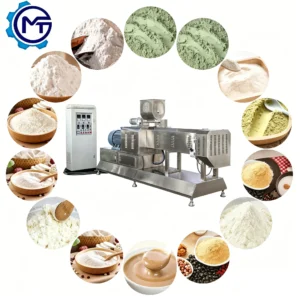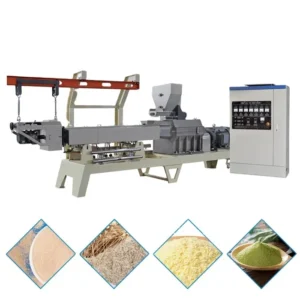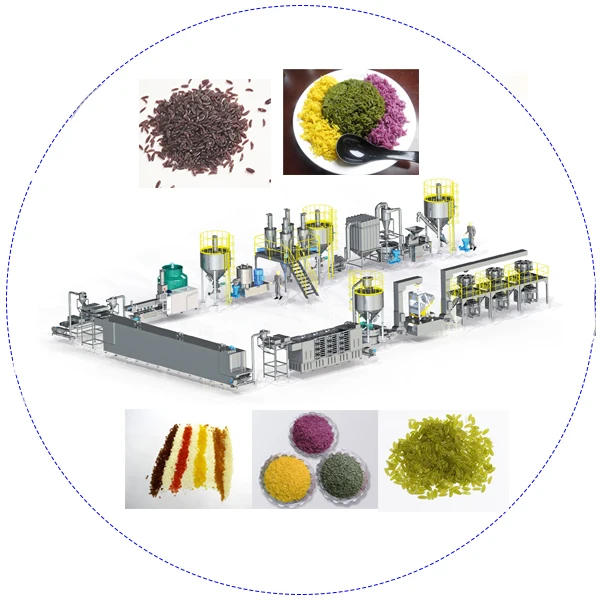
Matched Throughput Across Every Station — every artificial fortified rice processing line is configured so that mixing, extruding, drying, and packing capacities align to your specific grain formulation rather than assembled from mismatched standalone units.
Technical Specifications
| Parameter | Value |
|---|---|
| Product Type | Artificial Fortified Rice Processing Line |
| Model Options | MT65 / MT70 / MT85 / MT75 / MT95 |
| Screw Type | Twin-screw |
| Installed Power Range | 85 kW (MT65) to 260 kW (MT95) |
| Power Consumption Range | 60 kW (MT65) to 195 kW (MT95) |
| Output Capacity | 80–1000 kg/hr depending on model (basis to be confirmed against raw material formulation and moisture content) |
| Overall Dimensions (L×W×H) | 28×1.2×2.2 m (MT65) to 36×3.5×4.3 m (MT95) |
| Control System | Frequency speed controlling with high automation |
| Feeding System | Single or double screw feeding, selectable by material |
| Screw Material | Special wear-resistant treatment |
| Line Stations | Mixing → Extruding → Vibrating → Low Temperature Drying → Cooling → High Temperature Roasting → Cooling → Packing |
| Dryer Heating Source | Electric or gas |
| Dryer Feature | Circulation drying with frequency motor-controlled mesh belt speed |
| Lubrication | Automatic lubricating and cooling system |
| Voltage & Frequency | Customized to local requirements |
| Standards | CE, ISO |
Application Suitability
| Application | Material or Output |
|---|---|
| Fortified rice kernel production | Broken rice, rice bran, corn, millet, wheat, oats, buckwheat, beans, starch-based blends with added vitamins and minerals |
| Nutritional rice enrichment | Pre-extrusion blending of micronutrients into grain matrices for solidification |
| Broken rice recovery | Reconstitution of fragmented rice and bran into uniform, high-value artificial kernels |
| Institutional nutrition programmes | Vitamin- and mineral-fortified rice for government or NGO food supply chains |
| Retail-ready grain products | Extruded rice kernels with controlled nutritional profiles for consumer packaging |
Why Nominal Capacity Figures Can Mislead Your Line Design
Output numbers mean nothing without the raw material recipe attached to them.
I remember a Southeast Asian buyer who ordered an artificial fortified rice processing line equipment for sale based on a brochure capacity figure. The trial used plain rice flour, but their actual recipe included coarse millet and a mineral premix that changed the dough viscosity entirely. The extruder choked, expansion was uneven, and we spent days on-site adjusting screw speed and barrel temperatures to stabilise output. That is why every capacity figure in the table above carries a note: the real throughput depends on your exact ingredient blend and moisture level, and it must be verified before the line ships [NEED_CITE: extrusion throughput variability with grain formulation changes].
How Screw Configuration Shapes the Kernel
The twin-screw design in these models allows operators to adjust screw element sequencing — conveying, kneading, and reverse elements — to match the starch gelatinisation behaviour of each grain blend. A formulation heavy in buckwheat or oat flour requires a different shear profile than one based primarily on broken rice. The screw configuration record is specified to your ingredient list, not pulled from a generic template, which directly affects kernel density and surface texture.
Drying and Roasting Sequence for Kernel Integrity
The line routes extruded kernels through low-temperature drying first, then cooling, followed by high-temperature roasting and a second cooling stage. This multi-stage thermal path prevents case hardening — where the outer shell dries too fast and traps moisture inside — which causes cracking during storage. The circulation dryer uses a frequency-controlled mesh belt, so residence time adjusts to the kernel size and initial moisture content leaving the extruder die [NEED_CITE: multi-stage drying principles for extruded grain products].
Reading the Power and Dimension Data
Installed power spans from 85 kW on the MT65 to 260 kW on the MT95, but actual consumption runs roughly 70–75% of that figure under normal load. The dimensional spread — from a 28-metre footprint on the smallest model to 36 metres on the largest — reflects added drying and cooling length at higher throughputs. Frequency-controlled feeding means the single or double screw feeder can be matched to how freely your premix flows; mineral-fortified blends with fine powders often need the double screw option to prevent bridging in the hopper. The automatic lubricating and cooling system reduces manual greasing intervals, which matters on continuous runs where stopping the extruder for maintenance breaks the thermal equilibrium of the barrel.
The Cost of Skipping Configuration Verification
When a line arrives with a generic screw setup and the buyer’s actual grain blend behaves differently under shear, the consequences compound. The extruder may run, but kernel shape drifts outside specification, the dryer cannot keep up with excess moisture, and packing speed drops because the cooling stage delivers product still too warm for bagging. These mismatches do not show up as a single failure point — they appear as chronic underperformance across the entire line, and tracing each bottleneck back to the original configuration gap takes weeks of on-site troubleshooting [NEED_CITE: production line throughput matching between extrusion and downstream stations].
Why Buyers Source This Line Here
Complete lines from batching through packing come under one supplier, so throughput at each station is calculated against the others rather than left to the buyer to reconcile. The in-house testing workshop runs your actual raw material before the line ships, producing a trial report that documents screw speed, barrel temperature profile, and kernel output on your specific formulation. Screw configuration and die design are recorded per project, meaning replacement wear parts match the original build. Voltage, frequency, and control language are confirmed before production begins, avoiding commissioning delays at the destination. Pre-sales consultation covers line layout and utility planning, with on-site installation, operator training, and ongoing maintenance support included in the project scope.
Documentation & Verification
- Line layout drawing with station-by-station capacity calculation for your grain formulation
- Screw and die configuration record matched to your fortified rice ingredient blend
- Trial run report documenting output on your raw material before dispatch
- Electrical schematic with confirmed voltage, frequency, and control language
- CE declaration of conformity and ISO certificate for customs clearance
- Wear parts list with specification codes for screws, dies, and mesh belt segments
Installation, Commissioning & Support
- Foundation plan based on the selected model’s overall dimensions and weight distribution across the 28–36 m line length
- Dedicated electrical circuit sized to the model’s installed power, from 85 kW to 260 kW, with confirmed voltage and frequency
- Modular station delivery with on-site assembly and alignment of extruder, dryer, and cooling conveyors
- First-run commissioning including barrel temperature profiling and screw speed calibration on your grain blend
- Operator training covering frequency drive adjustment, feeder selection, and dryer belt speed control
- Spare screw elements and die plates supplied with part codes matching the configuration record
What to Include in Your Inquiry
Send your raw material formulation — including the grain base, any added vitamin or mineral premix, and typical moisture content — along with your target daily output and available workshop floor space. Specify the local voltage and frequency at your facility, the preferred control panel language, and whether you want to send a sample batch for a trial run before the artificial fortified rice processing line equipment for sale is shipped.
Frequently Asked Questions
Q: How is output capacity verified against my specific raw material formulation?
A: We run your actual grain blend — including any vitamin or mineral premix — through the extruder in our in-house testing workshop before shipment. The trial records screw speed, barrel temperatures, moisture content, and kernel output rate, and you receive a written report documenting the verified throughput for your recipe.
Q: What voltage, frequency, and control language options are available?
A: Voltage and frequency are configured to match your local electrical grid standards, and the control panel language is set to your operator preference. These specifications are confirmed during the design stage, before production begins, so the line arrives ready for connection without on-site electrical modifications.
Q: How are screw and die configurations matched to fortified rice ingredients?
A: Each screw element sequence and die opening is selected based on your ingredient blend’s starch content, fibre level, and mineral additive particle size. The configuration is documented in a project-specific record, ensuring replacement wear parts match the original setup and maintain consistent kernel density and shape over time.
Q: What upstream and downstream equipment is included in the line?
A: The line covers mixing, extruding, vibrating, low-temperature drying, cooling, high-temperature roasting, a second cooling stage, and packing. Each station’s capacity is calculated to match the others based on your formulation, preventing bottlenecks where one section runs faster or slower than the rest.
Q: Is a trial run performed before shipment, and what documentation is provided?
A: Yes. Your raw material is processed through the configured line in our testing workshop, and you receive a trial run report along with the line layout, electrical schematic, screw and die record, wear parts list, operation manual, and CE documentation before the equipment leaves the factory.