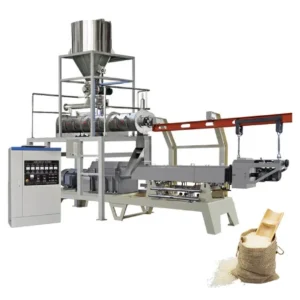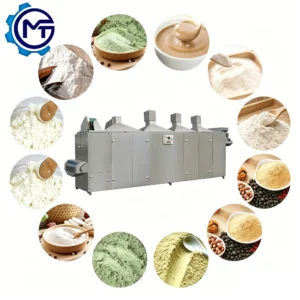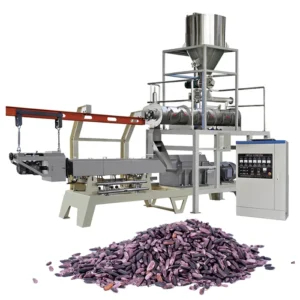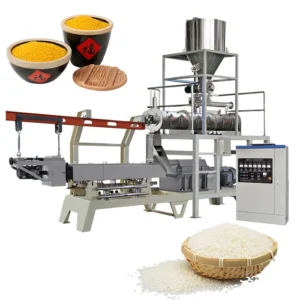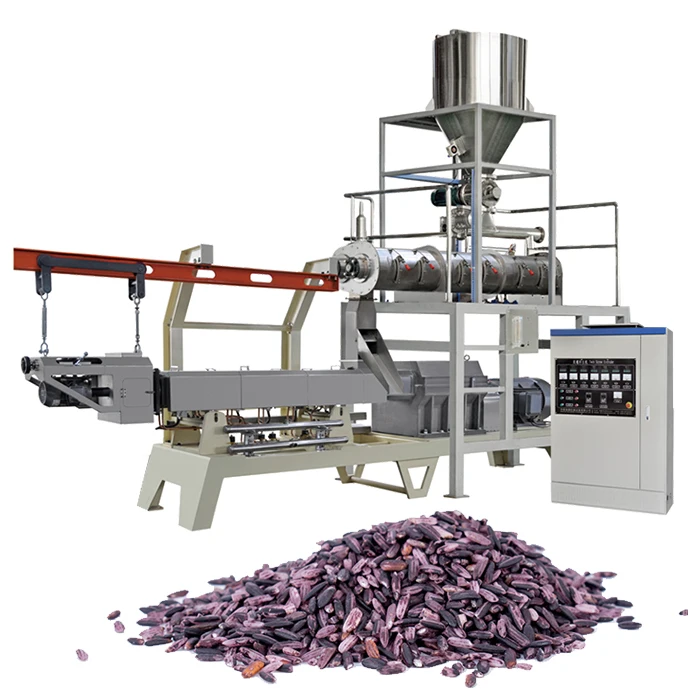
Integrated Line Capacity Matching — Every station from batching to packing is throughput-balanced against the extruder output to prevent downstream bottlenecks on your fortified artificial rice line.
Technical Specifications
| Parameter | Value |
|---|---|
| Model | MT65 / MT70 / MT85 / MT75 / MT95 |
| Product Type | Fortified Artificial Rice Production Line |
| Screw Type | Twin-screw extrusion (single or double screw feeding system available based on material) |
| Installed Power | MT65: 85 kW / MT70: 120 kW / MT85: 235 kW / MT75: 180 kW / MT95: 260 kW |
| Power Consumption | MT65: 60 kW / MT70: 85 kW / MT85: 165 kW / MT75: 135 kW / MT95: 195 kW |
| Output Capacity | MT65: 80–100 kg/hr / MT70: 100–120 kg/hr / MT85: 200–300 kg/hr / MT75: 300–500 kg/hr / MT95: 800–1000 kg/hr (basis not stated in source — confirm raw material formulation and moisture content) |
| Overall Dimensions | MT65: 28 × 1.2 × 2.2 m / MT70: 30 × 1.5 × 2.2 m / MT85: 34 × 3.5 × 4.3 m / MT75: 32 × 3.5 × 4.3 m / MT95: 36 × 3.5 × 4.3 m |
| Speed Control | Frequency speed controlling |
| Lubrication System | Automatic lubricating and cooling |
| Dryer Heating Source | Electric or gas |
| Dryer Type | Circulation drying with mesh belt, frequency motor speed control |
| Line Stations | Mixing → Extruding → Vibrating → Low temperature drying → Cooling → High temperature roasting → Cooling → Packing |
| Raw Material Compatibility | Broken rice, rice, corn, millet, wheat, oats, buckwheat, bean, starch as main ingredient; vitamin and mineral as partial ingredient |
| Assembly State | Complete production line |
| Standards | CE, ISO |
Application Suitability
| Application | Material or Output |
|---|---|
| Fortified rice kernel production | Broken rice blended with vitamin and mineral premix |
| Artificial rice manufacturing | Rice flour, corn, millet, wheat, or buckwheat base |
| Nutritional rice enrichment | Rice bran incorporated with micro-nutrient additives |
| Instant rice processing | Starch-rich grain blends requiring rapid rehydration properties |
| Micro-nutrient solidification | Vitamin and mineral integration into extruded rice kernels |
What "Nominal Output" Means When Your Formula Changes
Capacity figures only hold when the raw material matches the test conditions — a different grain blend or moisture level reshapes the entire production rate.
Many buyers compare machines on stated kg/hr numbers and place orders before confirming whether those numbers were measured on their actual fortified formula. A line rated at a given throughput on standard rice flour may behave differently once vitamin premix, mineral salts, or fibre are added, because those ingredients alter starch gelatinisation behaviour inside the barrel. The extruder might still turn, but the downstream dryer or cooler can suddenly become the constraint. [NEED_CITE: starch gelatinisation behaviour under varying ingredient compositions]
Mapping the Station Sequence for Nutritional Rice Kernels
A fortified artificial rice production line follows a specific sequence: mixing, twin-screw extrusion, vibrating distribution, low temperature drying, cooling, high temperature roasting, a second cooling stage, and finally packing. Each station must be sized against the extruder output, otherwise moisture removal lags behind and kernels crack or deform. The vibrating feeder spreads the extrudate evenly onto the dryer belt so that kernel density across the belt remains consistent.
How Drying Profile Affects Final Kernel Integrity
The circulation drying oven uses a frequency-controlled mesh belt to adjust residence time, which directly determines how much moisture leaves each kernel before the roasting stage. Low temperature drying removes bulk moisture gently; the subsequent high temperature roasting locks in the grain structure and develops surface firmness. If the belt speed is fixed and the operator cannot match it to the actual moisture load, surface cracking or internal voids appear. [NEED_CITE: drying temperature profiles for extruded rice-based products]
Reading the Screw, Power, and Dimension Data
The five extruder models span installed power from 85 kW on the MT65 to 260 kW on the MT95, reflecting the increasing barrel volume and screw torque required for higher throughput targets. Twin-screw extrusion provides intermeshing self-wiping action, which is critical when mineral premixes or fibre additives tend to stick in dead zones of single-screw designs. Frequency speed controlling across the line lets operators fine-tune screw RPM and belt speed together, keeping kernel geometry consistent even when the formulation shifts slightly between batches. Overall line length grows from roughly 28 metres for the MT65 configuration to 36 metres for the MT95, so floor space planning must account for the full station sequence plus maintenance access corridors.
When Unmatched Stations Cost You Weeks of Commissioning
A dryer that cannot keep pace with extruder output forces the operator to reduce screw speed, meaning the stated capacity is never actually achieved. A cooler undersized for the roaster discharge temperature sends warm kernels into the packing station, where condensation inside the bag leads to mould complaints within days. Voltage and control language mismatches surface only after the electrical cabinet is energised on site, adding days of rewiring before commissioning can even begin. [NEED_CITE: common commissioning delays in food extrusion line installations]
Why Sourcing the Full Equipment Range Here Makes Sense
Screw configuration and die design are specified against your grain blend and fortification formula, not copied from a generic template. An in-house testing workshop runs trial production on your actual raw material before the line ships, so gelatinisation and expansion behaviour are confirmed in advance rather than discovered during on-site commissioning. Every supporting station — mixer, dryer, roaster, cooler, packing — is selected to match extruder throughput, preventing the bottleneck problem that arises when stations are sourced from separate vendors. Electrical schematics and voltage are confirmed against your facility supply before production starts, avoiding rewiring delays. Documentation including line layout, capacity calculation, and trial run reports ships with the equipment so your local engineering team has verified reference material from day one.
Documentation & Verification
- Line layout and capacity calculation showing throughput balance across all stations
- Machine specification sheet with screw and die configuration matched to your formula
- Electrical schematic and voltage confirmation matching your facility power supply
- Trial run report on your actual raw material from in-house testing workshop
- CE declaration of conformity and ISO certificate for regulatory compliance
- Operation and maintenance manual with wear parts list included
Installation, Commissioning & Support
- Floor space planning accounts for full line length from 28 m (MT65) to 36 m (MT95) plus access corridors
- Power supply verification against installed load up to 260 kW before electrical connection
- Frequency speed controlling system calibrated during commissioning for screw and belt synchronisation
- Automatic lubricating and cooling system checked and filled before first production run
- Operator training covers formulation changeover procedure on twin-screw extruder
- Wear parts list provided with recommended first replacement schedule for screws and dies
What to Include in Your Inquiry
Share your target formula including the base grain, fortification ingredients, and expected moisture content so we can size the extruder and dryer correctly. Specify your local voltage, frequency, and preferred control language to ensure the electrical cabinet matches your facility on arrival. Provide workshop dimensions and ceiling height so the line layout can be drafted to fit your available space without station compression.
Frequently Asked Questions
Q: How is output capacity verified, and what formulation is the stated kg/hr based on?
A: Published output ranges are measured under specific raw material and moisture conditions that may differ from your fortified formula. We run a trial production in our testing workshop using your actual grain blend and premix to confirm real throughput before the quotation is finalised. The trial report documents measured output, kernel density, and expansion behaviour under your exact conditions.
Q: Which supporting stations are included, and how is throughput matched across the line?
A: The complete line includes mixer, twin-screw extruder, vibrating feeder, low temperature dryer, cooler, high temperature roaster, second cooler, and packing station. Each station is sized so its processing rate equals or exceeds extruder discharge, preventing material backlog. Capacity calculations are documented in the line layout submitted before production.
Q: Can screw configuration and die design be matched to my specific grain blend?
A: Yes. Screw element arrangement and die geometry are selected based on your raw material composition, including any vitamin, mineral, or fibre additives. The configuration is recorded in the machine specification sheet and validated during the in-house trial run on your formula before the extruder ships.
Q: What voltage, frequency, and control language options are available?
A: Electrical cabinets are built to match your local voltage and frequency, confirmed via electrical schematic review before production. Control panel language is specified during the order stage. This prevents rewiring or reprogramming work during on-site commissioning.
Q: What wear parts are supplied, and when should the first replacement occur?
A: A wear parts list is included with shipment, identifying screws, dies, and other consumable components. The recommended first replacement schedule depends on your formulation abrasiveness and daily run hours, and is discussed during operator training at commissioning.