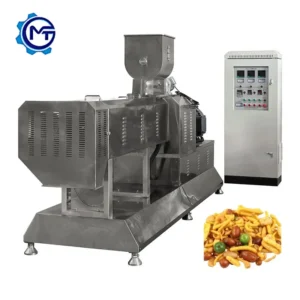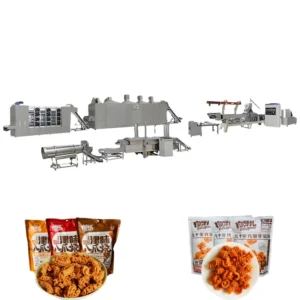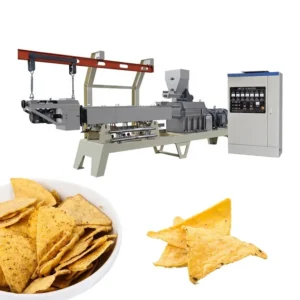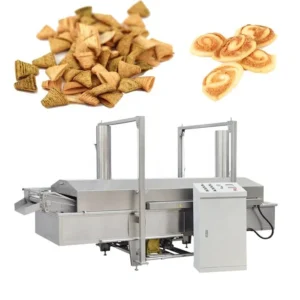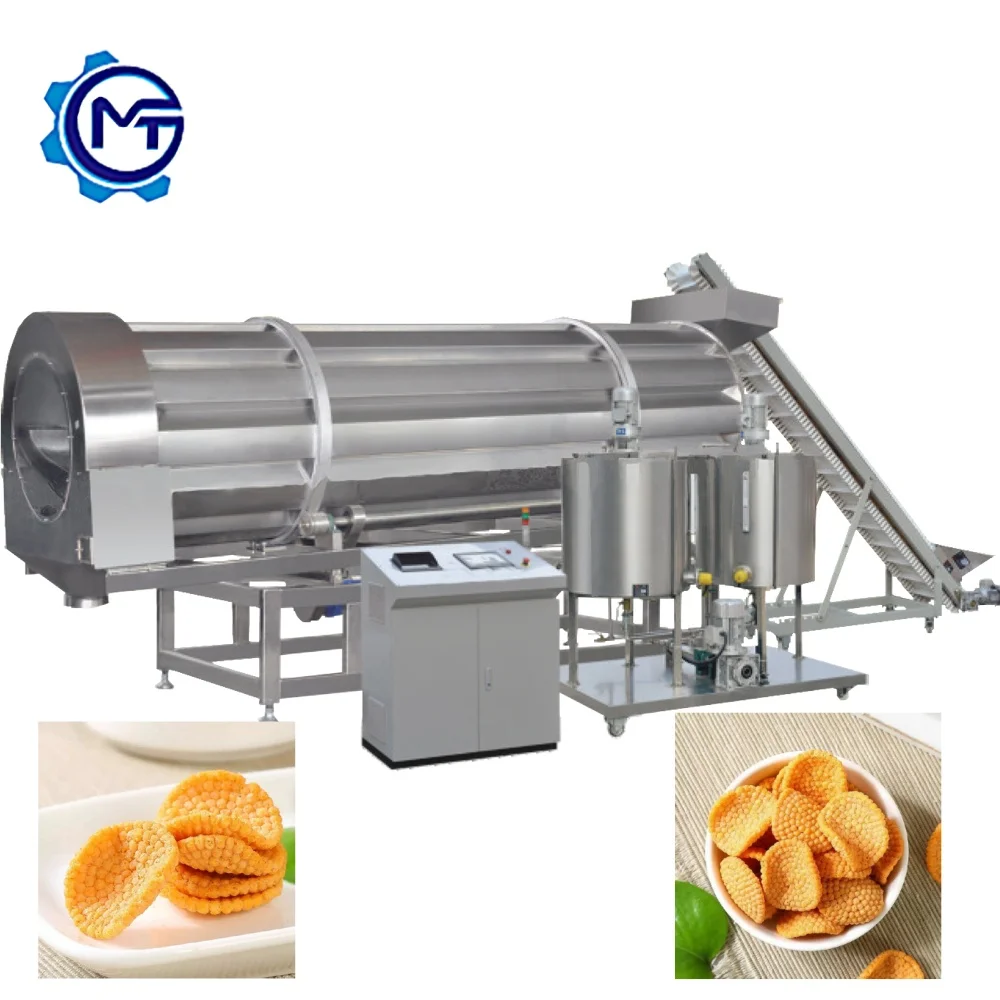
Frying Station Integration — Every continuous frying machine leaves our workshop with a line capacity calculation confirming its oil volume, belt speed, and thermal recovery match the upstream extruder and downstream de-oiling drum.
Technical Specifications
| Parameter | Value |
|---|---|
| Product Type | Continuous Frying Machine for Snack Food Processing Line |
| Power Source | Electric or Gas (configurable) |
| Voltage & Frequency | 380V / 50Hz (configurable to site standard) |
| Control System | PLC |
| Heating Method | Electricity Heating or Gas Heating |
| Drive Power | 2.6 kW |
| Oil Capacity | 320 L |
| Overall Dimensions (L×W×H) | 6700 × 2200 × 1200 mm |
| Net Weight | 2000 kg |
| Output Capacity | 100–1000 kg/h (basis not stated in source — confirm product format, moisture, oil temperature) |
| Material | Food-grade 304 Stainless Steel |
| Belt Type | Upper and lower double-layer mesh belt |
| Speed Control | Frequency conversion stepless speed regulation |
| Oil Filtration | Automatic oil circulation filtration system |
| Slag Discharge | Bottom slag discharge system |
| Lifting System | Automatic lifting for upper hood and mesh belt |
| Warranty | 1 Year (core components included) |
| Machinery Test Report | Provided |
| Video Outgoing-inspection | Provided |
Application Suitability
| Application | Material or Output |
|---|---|
| Rice crust chip frying | Extruded or sheeted rice dough, pre-dried to target moisture before entering the fryer |
| Bugle and corn tube frying | Twin-screw extruded corn-based tubes, cut and conditioned prior to frying |
| Pizza roll and filled snack frying | Formed or extruded dough pockets with savoury filling, surface-dried to prevent oil splatter |
| Puffed pellet chip frying | 2D or 3D pellets expanded through hot oil immersion for final texture development |
Why the Moisture Handoff Between Extruder and Fryer Decides Your Yield
A fryer can only hold its thermal profile if the product entering it arrives at a consistent, pre-agreed moisture level.
I once watched a rice crust line in the Pearl River Delta shut down for an entire shift because the extruded sheets entered the fryer at a moisture content several points higher than the oil temperature could flash off. The result was scorched edges, uneven colour, and a full batch written off before the operator could adjust the belt speed. The fryer itself was correctly sized; the problem was that nobody had mapped the dryer exit moisture against the oil recovery rate. That is the gap a continuous frying machine for snack production line must close — not in isolation, but as a thermally matched station within a sequence that starts at the mixer and ends at the packing scale. When the upstream dryer and the fryer are specified by separate vendors with no shared responsibility for the moisture handoff, the buyer absorbs the cost of every misalignment [NEED_CITE: thermal recovery calculations for continuous industrial fryers].
Matching Frying Time to Product Density
Every snack format that passes through a continuous frying machine for snack production line carries its own target residence time. Rice crust chips, which are thin and low in moisture after pre-drying, need a short, high-temperature pass. Bugles and pizza rolls, thicker and sometimes filled, require a longer dwell at a slightly moderated temperature to avoid surface scorching before the core is fully cooked. The frequency conversion stepless speed regulation on the mesh belt lets the operator dial in the exact belt travel speed without stopping the line, so a changeover from one SKU to the next is a parameter adjustment rather than a mechanical reconfiguration.
Oil Quality as a Process Variable
The automatic oil circulation filtration system continuously draws oil from the bath, passes it through a filter media to capture fine particulate and polymerised residue, and returns it to the fryer. This is not simply a hygiene measure — it directly controls the free fatty acid level in the bath, which governs both the smoke point and the flavour profile of the finished snack. When residue accumulates unchecked, the acid value climbs, the oil smokes at lower temperatures, and the product picks up off-notes that no amount of downstream seasoning can mask. The bottom slag discharge system complements this by evacuating heavier debris that settles below the belt, keeping the heating surfaces clear and maintaining consistent thermal transfer [NEED_CITE: oil degradation rates in continuous snack frying operations].
Reading the Specification Sheet Against Your Line Layout
The 320-litre oil capacity and 6700-millimetre tank length define the thermal mass and the maximum product curtain width the fryer can handle. A wider curtain means more product per linear metre of belt, which raises the thermal load on the heating elements; the 60 kW heating tube rating (electric mode) must therefore be cross-checked against the actual product load and the oil temperature drop that occurs when cold product enters the bath. The 2.6 kW drive power governs the belt motor, and its pairing with the frequency inverter is what enables the stepless speed range. The 2000 kg net weight reflects the stainless steel construction and the volume of oil the frame must support at operating temperature, which in turn affects floor loading requirements at the installation site. The upper and lower double-layer mesh belt clamps the product during submersion, preventing buoyant items like puffed rice crusts from floating to the surface and frying unevenly.
The Hidden Cost of an Undersized Frying Station
When the fryer is specified on nominal capacity alone, without accounting for the specific product format, the line may run at nameplate speed for lightweight, low-moisture items and then stall the moment a denser or wetter SKU is introduced. The oil temperature drops, recovery time lengthens, and the belt has to slow down to compensate — creating a bottleneck that backs up into the extruder and dryer. I have seen lines where the extruder was running well below its rated output simply because the fryer could not absorb what the upstream stations were producing [NEED_CITE: throughput bottlenecks caused by mismatched frying stations in snack lines]. The downtime is not limited to lost production; every minute the oil sits at suboptimal temperature accelerates polymerisation, shortening oil service life and raising consumable costs.
Why Source the Fryer from the Same Line Builder
Specifying the continuous frying machine for snack production line from the same supplier that provides the extruder, dryer, and seasoning drum removes the interface risk that arises when stations are assembled from separate vendors. The line layout and capacity calculation document confirms that the fryer’s belt speed range, oil volume, and thermal recovery rate are scaled to the exact upstream output and downstream de-oiling capacity. Screw configuration on the upstream extruder is matched to the moisture and density targets that the fryer is designed to receive, so the handoff between stations is engineered rather than assumed. The PLC control architecture is common across stations, meaning a single operator interface can manage belt speed, oil temperature, and filtration cycles in coordinated sequence. Factory trial runs are conducted on the buyer’s actual raw material before shipment, so the frying parameters are validated in advance rather than discovered during commissioning on the factory floor.
Documentation & Verification
- Line layout showing fryer station positioned between dryer and de-oiling conveyor with matched throughput
- Machine specification sheet confirming voltage, frequency, heating method, and control language for your market
- Screw and die configuration record linking upstream extruder output to fryer inlet moisture target
- Factory trial run report on your raw material and product format before dispatch
- CE declaration of conformity and ISO certificate included with shipping documentation
- Wear parts list covering mesh belt sections, heating elements, and oil filter media with lead times
Installation, Commissioning & Support
- Floor must support the 2000 kg static load plus 320 L of oil at operating temperature across the 6700 mm footprint
- Dedicated electrical circuit required for the 380V / 50Hz supply and the 60 kW heating load in electric mode
- Automatic lifting system for the hood and mesh belt allows the unit to arrive partially assembled and be opened for inspection on site
- First-run commissioning includes oil temperature profiling and belt speed calibration against your specific snack format
- Operator training covers PLC parameter adjustment for SKU changeovers and daily filter media replacement procedures
- Spare mesh belt sections and heating elements identified on the wear parts list with stocking recommendations for year one
Preparing Your Frying Station Inquiry
To size the fryer correctly within your line, share the product format you intend to fry, the moisture content at the dryer exit, and the target hourly throughput on that specific SKU. Confirm the available voltage and frequency at your facility, along with the preferred heating method and the control language your operators will use. If you already have upstream extrusion or downstream seasoning equipment in place, provide the model and current output rate so the fryer can be matched to the existing station capacities.
Frequently Asked Questions
Q: How is frying capacity verified against the specific snack format and moisture content entering the fryer?
A: Capacity is confirmed through a trial run on your actual raw material in the testing workshop. We measure the oil temperature drop when your product enters the bath at its post-dryer moisture level, then adjust belt speed and heating input until the target colour, texture, and residual oil content are achieved. The results are documented in a trial run report shared before shipment.
Q: What voltage, frequency, and control language options are confirmed before shipment?
A: The standard configuration is 380V at 50Hz, but the electrical system can be built to match your site supply. The PLC interface language is set to your preference — English, Spanish, or other agreed language — and the electrical schematic confirms all settings before the machine leaves the factory.
Q: How does the fryer station throughput match with upstream extruders and downstream de-oiling or flavouring drums?
A: The line layout and capacity calculation document specifies the output of every station. The fryer’s belt speed range and oil volume are scaled so that the product curtain entering from the dryer does not exceed the thermal recovery rate, and the exit rate does not overwhelm the downstream de-oiling conveyor or flavouring drum.
Q: What is included in the on-site installation, commissioning, and operator training package?
A: Our engineer supervises placement, utility connection, and first oil fill. Commissioning covers temperature profiling and belt speed calibration on your product. Training includes PLC parameter adjustment for SKU changeovers, daily filtration procedures, and the lifting system operation for cleaning access.
Q: Which spare wear parts are recommended for the first year, and what are their lead times?
A: The wear parts list identifies mesh belt sections, heating elements, and oil filter media as the primary consumables. Typical multi-week lead times apply, so we recommend stocking first-replacement sets at the time of initial order to avoid unplanned line stoppages.