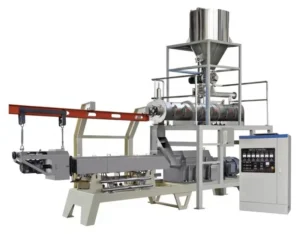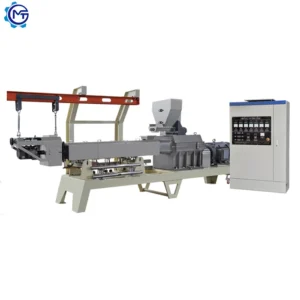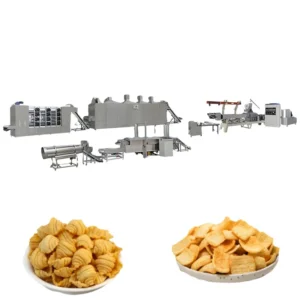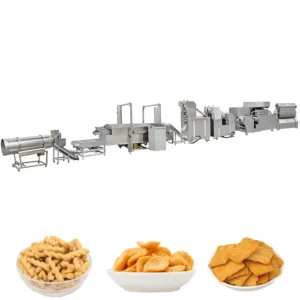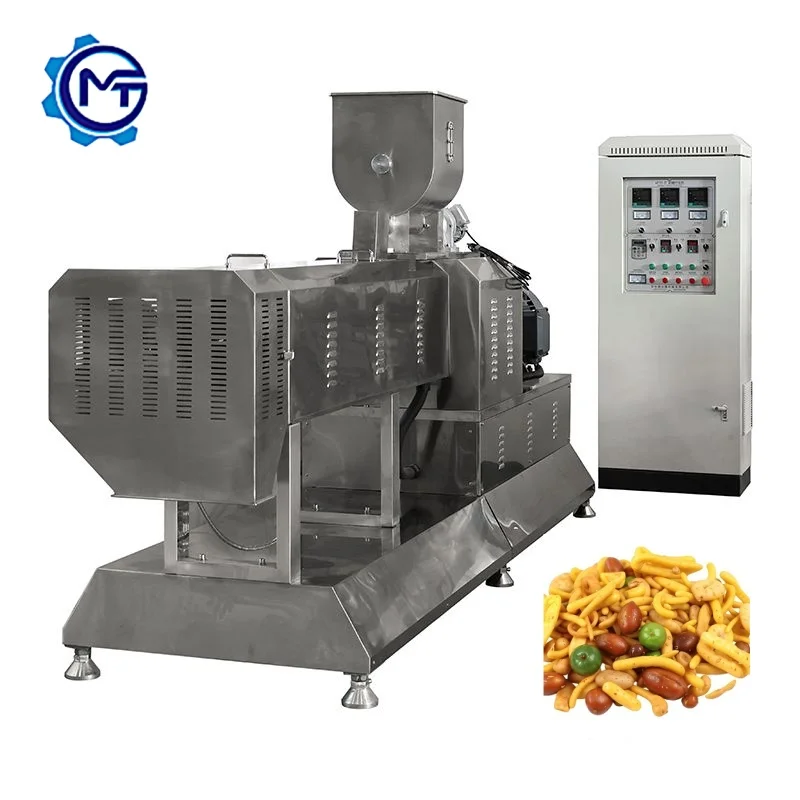
Integrated Frying Line Planning — Continuous deep fryers with oil filtration and mesh belt control matched to upstream extruder throughput, specified from a single equipment catalogue rather than sourced from separate vendors.
Technical Specifications
| Parameter | Value |
|---|---|
| Product Type | Continuous Deep Frying Machine for Snack Processing Line |
| Rated Power | 2.6 kW (control system) + 60 kW heating tube |
| Voltage & Frequency | 380V / 50Hz |
| Control System | PLC |
| Overall Dimensions (L×W×H) | 6700 × 2200 × 1200 mm |
| Net Weight | 2000 kg |
| Capacity Range | 100–1000 kg/h (basis not stated in source — confirm raw material, moisture content, product format) |
| Oil Capacity | 320 L |
| Heating Method | Electric heating / Gas heating (dual option) |
| Mesh Belt Type | Upper and lower double-layer mesh belt with frequency conversion stepless speed regulation |
| Oil Filtration | Continuous oil circulation filtration system |
| Slag Discharge | Bottom-mounted automatic slag discharge system |
| Lifting System | Automatic lifting system for upper hood and mesh belt |
| Construction Material | Food-grade 304 stainless steel |
| Warranty | 1 Year (core components: 1 Year) |
Application Suitability
| Application | Material or Output |
|---|---|
| Fried extruded snack pellets | Corn, potato, or wheat-based pellet dough from upstream extruder |
| Nimko and fried chips | Formed or cut snack pieces requiring uniform deep frying |
| Puffed snack post-processing | Pre-dried extrudates needing oil treatment for texture and flavor |
| Continuous snack line integration | Inline station between extrusion/drying and seasoning/coating |
Why the Fryer Capacity Must Match the Extruder Before the Order Is Placed
A frying chips making machine full equipment range approach prevents the bottleneck that forms when a fryer cannot absorb upstream extruder output or when downstream cooling cannot keep pace with fryer discharge.
When a snack line is assembled from separate vendors, the extruder supplier quotes nominal throughput, the fryer supplier quotes a different metric, and the coating drum runs half-empty or overfed. I have walked into Southeast Asian snack plants where the fryer oil temperature dropped every time the extruder ramped up, because the heating capacity was never calculated against actual feed rate. The frying chips making machine full equipment range concept forces all three stations into a single capacity calculation before metal is cut [NEED_CITE: line throughput matching methodology for snack processing].
Oil Filtration and Product Consistency Across a Full Shift
Continuous oil circulation filtration removes particulate and free fatty acids that accumulate as snack pieces shed surface starch and moisture. In a snack processing line running mixed-legume or high-fat raw materials, oil degradation accelerates, and without inline filtration the acid value climbs within the first few hours of production. The filtration loop on this unit runs in parallel with the frying chamber, so oil quality at hour eight is comparable to hour one, reducing the need for full oil changeouts between shifts.
Double-Layer Mesh Belt Control and Residence Time
The upper and lower double-layer mesh belt holds product submerged at a fixed depth while frequency conversion stepless speed regulation adjusts belt travel from the PLC panel. For low-density extruded pellets that tend to float, the upper belt forces submersion; for dense nimko pieces that sink naturally, belt speed alone governs residence time. This two-axis control means frying time is adjusted without changing oil temperature, preserving oil life while hitting target moisture and color [NEED_CITE: frying residence time and oil absorption relationship].
Reading the Specifications That Matter on a Continuous Deep Fryer
The 60 kW heating tube power paired with a 320 L oil bath determines recovery rate after cold product enters the fryer. A larger oil volume buffers temperature swing, but also means longer heat-up at shift start, so the dual electric/gas heating option lets plants choose based on local energy cost and availability. The 6700 mm overall length includes the infeed and discharge zones, which must align with upstream conveyor height and downstream cooling belt entry. Food-grade 304 stainless steel construction meets hygiene requirements, but also affects weld quality and cleanability of the bottom-mounted automatic slag discharge system, which must be accessed during daily sanitation.
What Happens When the Frying Station Is Underspecified
An undersized fryer forces the extruder to idle or the line to run in batches, negating the advantage of continuous processing. Excess oil absorption from prolonged residence time produces a greasy mouthfeel and shortens shelf life. When voltage and frequency are confirmed after shipment rather than before, heating elements may underperform or trip breakers on arrival, delaying commissioning by weeks while replacement parts are sourced internationally [NEED_CITE: voltage mismatch impact on industrial heating elements].
Why Buyers Source the Full Equipment Range Here
Line layout and capacity calculation document throughput matching between fryer, extruder, and coating stations before purchase. Screw and die configuration on the upstream extruder is specified to the buyer’s raw material, so the product entering the fryer has known density and moisture. The in-house testing workshop runs trial batches on customer-supplied raw material, confirming oil absorption and color before the fryer ships. PLC programming is confirmed for site voltage, frequency, and operator language. Pre-sales consultation extends through installation, commissioning, and wear parts planning, so the frying station is never an orphaned purchase.
Documentation & Verification
- Line layout and capacity calculation matching fryer throughput to extruder output
- Machine specification sheet confirming 380V/50Hz and dual heating method
- Factory test record on customer raw material before dispatch
- Machinery test report and video outgoing-inspection provided
- CE declaration of conformity and ISO certificate on file
Installation, Commissioning & Support
- Floor space for 6700 × 2200 mm footprint plus maintenance clearance on both sides
- Dedicated 380V three-phase circuit with breaker rated above 62.6 kW total draw
- Fully assembled unit arrives with upper hood and mesh belt in lowered position for transport
- First-run parameter setting covers oil temperature, belt speed, and filtration cycle timing
- Operator training on PLC interface, slag discharge, and daily oil sampling protocol
- Wear parts list covering mesh belt sections, heating tubes, and filtration media
Requesting a Line Configuration Proposal
To size the frying chips making machine full equipment range correctly, specify your extruded product format, raw material composition, and target hourly output. Confirm site voltage, frequency, and whether electric or gas heating aligns with your utility structure. Indicate whether the fryer will integrate into an existing line with defined upstream and downstream equipment, or whether the full frying-to-packing range is being specified from one source.
Frequently Asked Questions
Q: How do I confirm the fryer throughput matches my extruder output?
A: Request a line layout and capacity calculation that documents feed rate from the extruder, residence time in the fryer at your target oil temperature, and discharge rate into the cooler. These three figures must align on a single sheet before the order proceeds, preventing bottleneck scenarios where one station idles while another overflows.
Q: Should I choose electric or gas heating for this continuous deep fryer?
A: Electric heating with 60 kW tubes offers precise temperature control via the PLC, while gas heating reduces per-unit energy cost in markets where gas tariffs are favorable. Confirm your site utility capacity and local energy pricing structure before specifying, as the choice affects both the control panel configuration and the plant’s monthly operating expense.
Q: What voltage and PLC language options are available?
A: The standard configuration is 380V / 50Hz, but voltage and frequency must be confirmed against your site supply before production. PLC HMI language is configurable to match your operator team. Specify these parameters during the quotation stage to avoid commissioning delays caused by incompatible electrical or control interfaces.
Q: How does continuous oil filtration affect oil consumption?
A: The inline filtration loop removes particulate and slows acid value buildup, extending oil service life across a full production shift compared to static baths. Actual consumption depends on raw material composition and product surface characteristics. Request a trial run on your raw material to observe oil degradation rate under your specific production conditions.
Q: What downstream stations complete the frying line?
A: The full equipment range includes flavouring drums, coating and seasoning lines, cooling conveyors, and packing stations, all matched to fryer discharge rate. Sourcing from one supplier ensures throughput alignment and a single point of responsibility for line layout, commissioning, and ongoing maintenance support across every station.