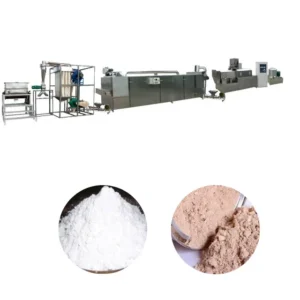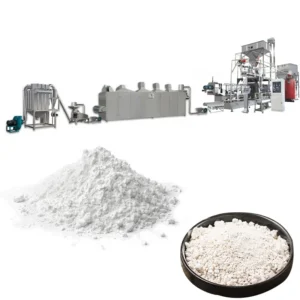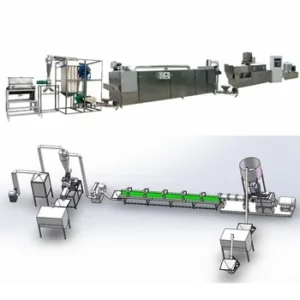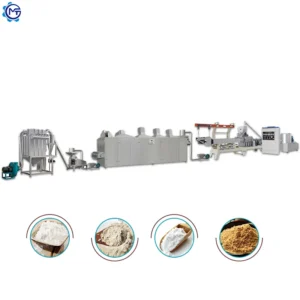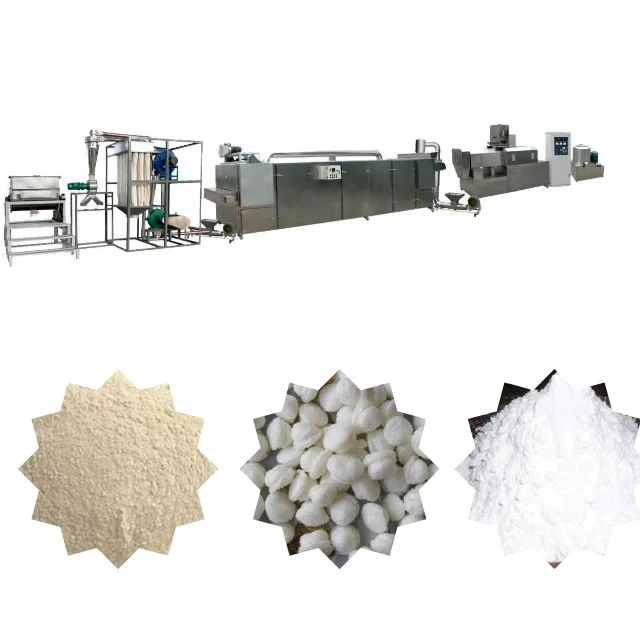
Precision-Matched Starch Extrusion — Every station on the MT-65 line is throughput-calibrated against your specific starch source, eliminating the mid-line bottlenecks that occur when mixing, extruding, and baking equipment are sourced independently.
Technical Specifications
| Parameter | Value |
|---|---|
| Model | MT-65 |
| Product Type | Modified Starch Production Line |
| Screw Type | Twin-screw (double screw extruder) |
| Screw Configuration | 3-phase design (conveying → smelting → inflated) |
| Motor Power | 45 kW |
| Power Source | Electricity |
| Voltage Options | 380V / 220V / 430V (frequency to be confirmed) |
| Screw Material | Carbon steel |
| Barrel Material | Carbon steel |
| Raw Materials | Potato starch, maize starch, cassava starch |
| Process Type | Cooking extrusion with thermochemical treatment |
| Production Line Stages | Mixing process → Extruding process → Baking process |
| Dimensions (L×W×H) | 2×3×5 m |
| Delivery Time | 40-45 days for large scale equipment |
| Installation Time | 2-3 weeks including training and machinery test |
| Warranty | 1 year for auger and cylinder |
Application Suitability
| Application | Material or Output |
|---|---|
| Modified maize starch production | Native corn starch with controlled gelatinisation for food thickeners |
| Pregelatinised potato starch processing | Potato starch for instant food blends and industrial adhesives |
| Modified cassava starch extrusion | Tapioca starch thermochemical treatment for textile and paper sizing |
| Pre-cooked starch for nutritional formulations | Partially gelatinised starch blends for infant formula and dietary products |
Why Nominal Capacity Claims Fail on Real Starch Feedstock
A starch line is only as fast as its weakest matched station, and nominal ratings rarely reflect actual raw material behaviour.
When procurement teams evaluate a Modified Starch Production Line complete equipment package, the quoted output figure often assumes ideal moisture content and a specific amylose ratio. In practice, maize sourced in tropical regions carries different residual moisture than temperate-zone grain, and cassava starch granule size varies by harvest season. The extruder may physically run at its nameplate speed, but if the downstream baking station cannot handle the actual throughput of partially gelatinised material, the entire line stalls. I have watched buyers discover this mismatch only after their equipment is bolted to the factory floor [NEED_CITE: throughput matching principles in multi-stage food processing lines].
How the Twin-Screw Profile Controls Starch Gelatinisation
The 3-phase screw configuration on this extruder moves material through distinct mechanical zones. The conveying phase meters raw starch into the barrel at a controlled feed rate, the smelting phase applies shear and thermal energy to rupture starch granules, and the inflated phase manages expansion as moisture flashes off at the die. For modified starch processing, the residence time in each phase determines the degree of gelatinisation achieved. Adjusting the screw element spacing changes how long maize or potato starch is exposed to peak barrel temperature, which directly influences the functional properties of the finished powder.
Thermochemical Treatment and Barrel Temperature Profiling
Starch modification through cooking extrusion depends on precise thermal input at each barrel zone. The carbon steel barrel construction conducts heat uniformly across the smelting phase, where temperatures must stay within a narrow window to achieve partial or full gelatinisation without degrading polymer chains. When a processor switches from maize to cassava starch, the barrel temperature profile requires recalibration because cassava granules swell at lower onset temperatures. The Modified Starch Production Line complete equipment setup allows operators to adjust zone heaters independently, maintaining consistent product specification across different feedstock batches [NEED_CITE: gelatinisation temperature ranges for maize, potato, and cassava starch].
Reading the Specs That Actually Matter for Starch Lines
The motor power rating of 45 kW on the MT-65 indicates the mechanical energy available for shear-driven gelatinisation. Higher motor capacity allows the screws to maintain torque when processing high-viscosity starch melts that resist conveyance. The twin-screw design generates intermeshing wipe action that keeps barrel walls clean, preventing scorched buildup that would contaminate subsequent batches. Carbon steel screw and barrel materials provide adequate wear resistance for pure starch feedstocks, which are less abrasive than mineral-filled compounds. The 2×3×5 m footprint defines the floor space needed for the extruder section alone, and buyers should allocate additional length for the upstream mixer and downstream baking oven when planning workshop layouts.
The Hidden Cost of Unmatched Line Stations
Purchasing an extruder without verifying that the mixer output and baking conveyor can sustain identical mass flow creates a permanent production constraint. The extruder idles while waiting for the oven to clear, or partially processed starch accumulates between stations and degrades. I have seen processors attempt to compensate by increasing extruder speed, which pushes ungelatinised material into the baking stage and produces off-spec product that must be scrapped. Electrical frequency mismatches between the extruder motor and local grid supply compound these problems, causing thermal protection trips during continuous operation [NEED_CITE: voltage and frequency standards by export market].
Why Sourcing the Full Line from One Supplier Changes Outcomes
Every station on this Modified Starch Production Line complete equipment package is specified together, so the mixing output rate, extruder throughput, and baking conveyor speed are calculated as a single system rather than independent purchases. The screw configuration and die design are matched to the buyer’s declared starch source and target modification degree before the machine is built. An in-house testing workshop allows trial runs on customer-supplied raw material, producing a physical sample and process parameter record before the line ships. Electrical schematics confirm voltage and control language requirements for the destination market, preventing commissioning delays. Documentation includes a trial run report, machine specification sheet, and wear parts list specific to the configuration delivered.
Documentation & Verification
- Line layout drawing showing throughput-matched station positions for your workshop dimensions
- Screw and die configuration record matched to your declared starch type and moisture level
- Trial run report produced on your supplied raw material before factory dispatch
- Electrical schematic with confirmed voltage and frequency for your local grid supply
- Machine specification sheet stating capacity against defined starch source and moisture conditions
Installation, Commissioning & Support
- Foundation plan calibrated to the 2×3×5 m extruder footprint and dynamic load from the 45 kW motor
- Dedicated circuit specification for 380V or 430V supply with confirmed frequency for continuous extruder operation
- Barrel zone heater calibration and screw element verification during initial power-on sequence
- Operator training on screw configuration adjustments when switching between maize, potato, and cassava starch
- Carbon steel screw and barrel wear inspection schedule with replacement auger availability under the one-year warranty
What We Need to Configure Your Line
Share the specific starch source you plan to process, including typical moisture content at intake and your target gelatinisation degree. Provide your workshop ceiling height and available floor length so the mixing, extruding, and baking stations can be arranged without material handling gaps. Confirm your local voltage and frequency, along with the preferred control panel language, so electrical components are specified correctly before production begins.
Frequently Asked Questions
Q: How is line capacity verified against my specific starch type?
A: Capacity is determined through a trial run using your supplied raw material in the testing workshop. The extruder processes your actual starch at production-relevant feed rates, and the resulting output is measured against your target moisture and gelatinisation specification. A written report documents the achieved throughput so you can evaluate line performance before the equipment leaves the factory.
Q: What screw configuration works best for different starch sources?
A: Maize, potato, and cassava starch each require different residence times in the smelting phase due to varying granule swelling temperatures. The conveying and inflated phase element spacing is adjusted to control shear intensity and expansion at the die. The configuration record is matched to your declared feedstock and provided as part of the documentation package.
Q: How do you prevent bottlenecks between the extruder and baking station?
A: Every station is specified as part of a single system calculation. The mixer batch cycle time, extruder mass flow rate, and baking conveyor speed are matched so material moves continuously without accumulation or starvation between stages. The line layout document shows the throughput balance across all equipment positions.
Q: Is a trial production run conducted before the line ships?
A: Yes. The in-house testing workshop runs your raw material through the configured extruder to verify that the screw profile, barrel temperature settings, and die design produce starch that meets your functional property requirements. The trial run report is included in the dispatch documentation and serves as the baseline for on-site commissioning parameters.
Q: What electrical configurations are available for different markets?
A: The extruder motor and control systems can be specified for 380V, 220V, or 430V supply, with frequency confirmed during the quotation stage. Electrical schematics are prepared with your local grid standard so that circuit breakers, contactors, and heater elements match available power without requiring on-site transformers or rewiring during installation [NEED_CITE: industrial voltage standards for food processing equipment exports].