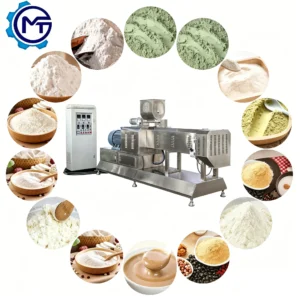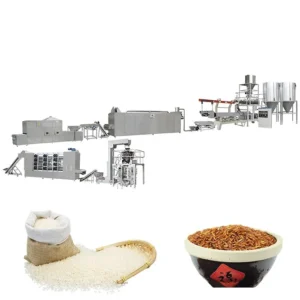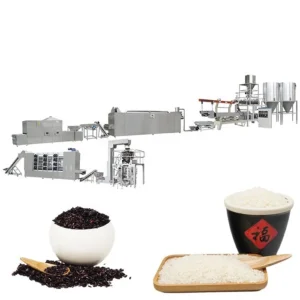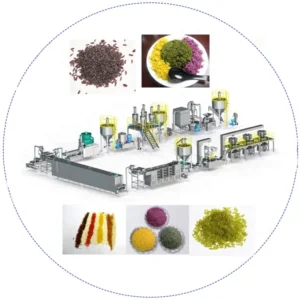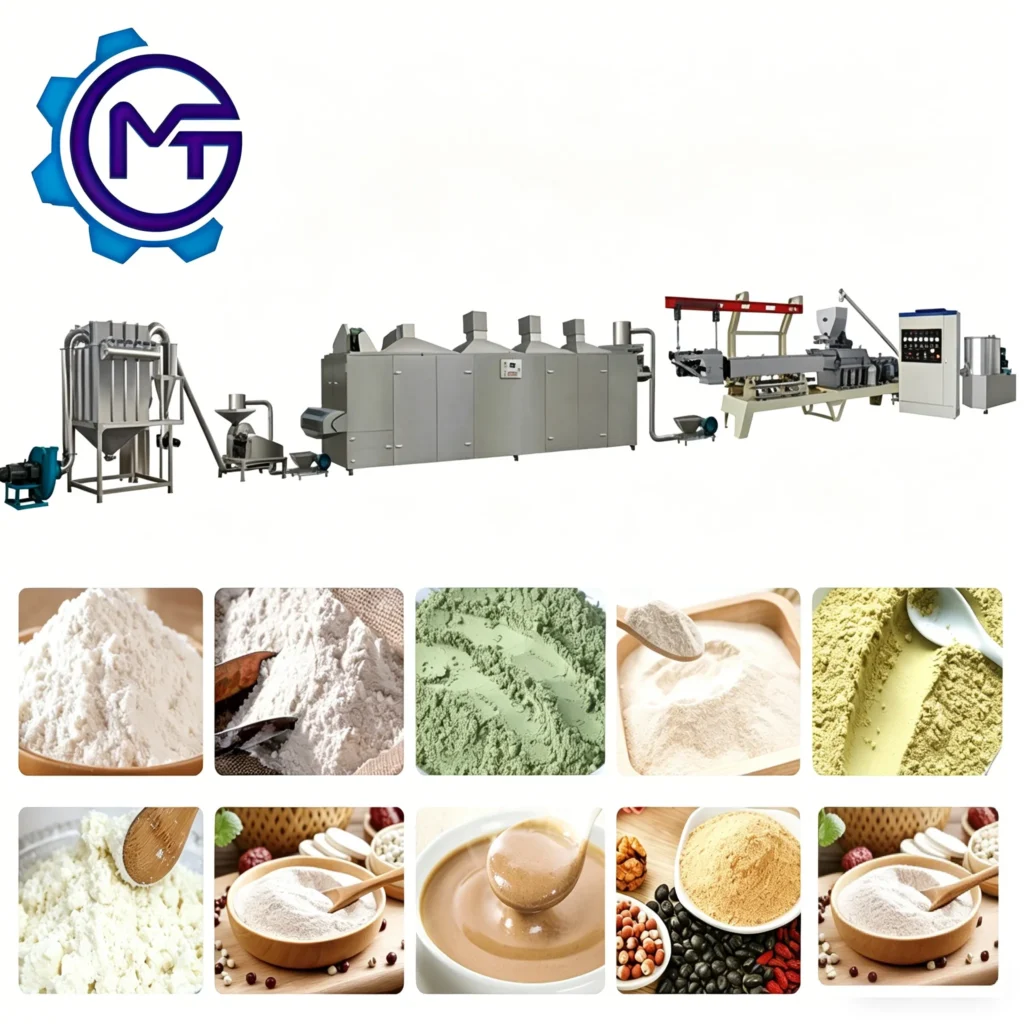
Throughput matching across every station — Each mixer, extruder, dryer and cooler in the nutrition powder processing line is sized against the same raw material formulation, preventing the common trap where one under-capacity unit throttles the entire output.
Technical Specifications
| Parameter | Value |
|---|---|
| Product Type | Nutrition Powder Processing Line |
| Output Capacity | 200–500 kg/h (basis not stated in source — confirm raw material, moisture content, formulation) |
| Control System | PLC with touch control panel and digital system |
| Construction Material | Food-grade 304 stainless steel |
| Heat Source Options | Electric / Gas / Steam |
| Automation Level | Fully automatic |
| Line Stations | Mixers, extruder, drying/baking ovens (full station list to be confirmed) |
| Energy Profile | Low energy consumption design |
| Warranty | 1 year |
| After-Sales Service | Overseas engineer service available |
| Certification | CE; ISO |
Application Suitability
| Application | Material or Output |
|---|---|
| Baby cereal and infant nutrition powder | Rice, corn, oats and blended grain formulations |
| Fortified nutritional powder | Grain bases blended with vitamin and mineral premixes |
| Porridge and instant drink powder | Multi-grain recipes including beans and legumes |
| Dietary and weaning food powder | Pre-cooked and gelatinised starch-based blends |
What "500 kg/h on Paper" Really Means for Nutrition Powder
The only capacity figure that matters is the one measured on your exact grain blend at your target moisture.
I once worked with an infant cereal producer who specified a line rated at a certain throughput on standard white rice flour. Their actual recipe relied heavily on brown rice and oat ratios, which behave differently during gelatinisation. The starch structure never reached full expansion inside the barrel, and real output fell well short of expectations. The gap was not a machine fault — it was a specification that never accounted for the raw material [NEED_CITE: raw material behaviour in twin-screw extrusion]. That is why every nutrition powder processing line full equipment range we configure starts with a trial run on the buyer’s own grain samples.
Every Station Visible Before You Commit
When buyers survey equipment for baby cereal or fortified powder production, they typically focus on the extruder. Yet the drying oven, the cooling conveyor and the flavouring station each impose their own throughput ceiling. This catalogue lays out the full nutrition powder processing line full equipment range so that every station’s capacity is visible side by side. A line where the extruder pushes 500 kg/h but the dryer can only handle 300 kg/h is effectively a 300 kg/h line — and that mismatch is far easier to spot when all stations are documented in one layout.
Matching Heat Source to Your Facility
The drying and baking stations accept electric, gas or steam heat sources, which matters more than it first appears. A facility with existing steam boiler infrastructure will see lower operating cost per kilogram of moisture removed compared with electric resistance heating. Gas-fired dryers suit regions where electricity tariffs are high but natural gas or LPG is affordable. Specifying the heat source early in the project avoids redesigning the dryer section after the rest of the nutrition powder processing line full equipment range has already been laid out [NEED_CITE: industrial dryer heat source selection criteria].
Reading the Specs That Actually Affect Output
Food-grade 304 stainless steel across all product-contact stations is not merely a hygiene checkbox — it resists the mild acidity released by certain grain formulations during extrusion, preventing surface pitting that could harbour residue between batches. The PLC touch control panel centralises temperature zones, screw speed and feed rate into one interface, which directly supports batch-to-batch consistency when operators switch between a rice-heavy infant formula and a multi-bean porridge recipe. Fully automatic operation reduces manual intervention at each transfer point, limiting moisture loss or contamination risk between the extruder discharge and the dryer infeed. The low energy consumption design philosophy targets heat recovery within the drying section, where the largest share of total line energy is consumed.
When the Dryer Becomes the Bottleneck
A common consequence of sourcing the extruder and dryer from different vendors is that nobody takes responsibility for the transfer moisture content. The extruder discharges product at a moisture level the dryer was never specified to handle, leading to extended residence times or incomplete drying. In nutritional powder applications, residual moisture above the target range shortens shelf life and invites microbial growth — a failure that surfaces only weeks after packaging [NEED_CITE: moisture content and shelf stability in infant cereal products]. Matching dryer capacity to extruder output on the same formulation data eliminates this gap.
Why Buyers Specify the Full Range Here
Line layout and capacity calculations are prepared against the buyer’s specific grain formulation, not a generic benchmark. Screw configuration and die design are selected after reviewing the target particle size and gelatinisation degree required for infant-safe or fortified powder applications. The in-house testing workshop allows trial runs on customer-supplied raw material before shipment, catching throughput or texture issues before the line leaves Jinan. Documentation packages include electrical schematics confirmed to the destination market’s voltage and frequency. Every station from batching to packing comes from a single supplier, so accountability for throughput matching sits in one place.
Documentation & Verification
- Line layout showing throughput match between mixer, extruder, dryer and packing stations
- Screw and die configuration record matched to your grain formulation
- Electrical schematic with voltage and frequency confirmed for your facility
- Factory trial run report using your raw material before shipment
- CE declaration of conformity and ISO certificate for the complete line
- Operation and maintenance manual covering every station in the line
Installation, Commissioning & Support
- Foundation plan sized to the extruder and dryer footprint for your layout
- Dedicated power circuit specification based on confirmed voltage and frequency
- Modular station delivery allowing phased assembly in facilities with limited access
- First-run parameter setting on your grain recipe during on-site commissioning
- Operator training covering PLC interface navigation and recipe changeover procedures
- Wear parts list identifying screws, dies and seals with replacement intervals
- Routine maintenance schedule aligned to the fully automatic control system diagnostics
Before You Request a Quote
To configure the right nutrition powder processing line full equipment range for your project, share your grain formulation with ratios, the target moisture content in the finished powder, and your required hourly or daily throughput. Include your facility’s available voltage, frequency and preferred control language, along with any existing upstream milling or downstream packing equipment the line must integrate with. If you can send a representative raw material sample, a trial run in the testing workshop will produce real data on gelatinisation behaviour and achievable output before the quotation is finalised.
Frequently Asked Questions
Q: How do I verify the line’s actual output on my grain formulation?
A: Send a representative sample of your raw material blend to the testing workshop. A trial run is conducted using your exact grain ratios and target moisture, and a report documents the measured throughput, gelatinisation degree and powder particle characteristics. This data replaces nominal capacity estimates with figures grounded in your actual recipe.
Q: Which stations are included, and how is throughput matched across them?
A: The line covers mixing, extrusion, drying, cooling and packing. Each station is sized against the same formulation data so that no single unit limits overall output. A line layout document shows the capacity of every station side by side, making bottlenecks visible before equipment is manufactured.
Q: What voltage, frequency and control language options are available?
A: The electrical system is configured to your facility’s supply before production begins. Voltage, frequency and PLC interface language are confirmed during the specification stage. An electrical schematic is included in the documentation package so your local electrician can verify compliance with regional standards.
Q: How are screw type and die configuration selected for different grains?
A: Screw elements and die geometry are chosen based on the starch, protein and fibre composition of your grain blend, along with the target powder particle size. The configuration record is documented and retained, allowing consistent replication across future production runs and simplifying spare parts ordering.
Q: What supporting equipment prevents downstream bottlenecks?
A: Dryers, coolers and packing stations are specified to handle the extruder’s discharge rate at the confirmed moisture level. Heat source options include electric, gas and steam, selected to match your facility’s utility infrastructure and avoid capacity mismatches that would otherwise constrain the entire line.