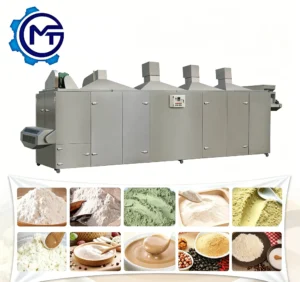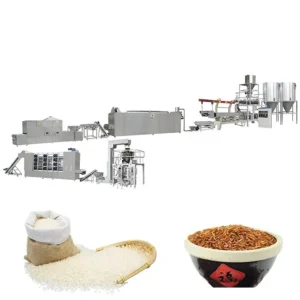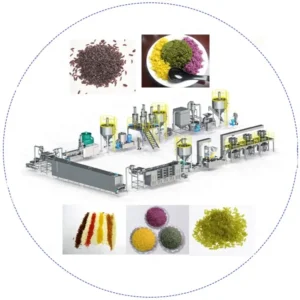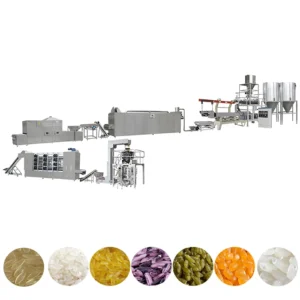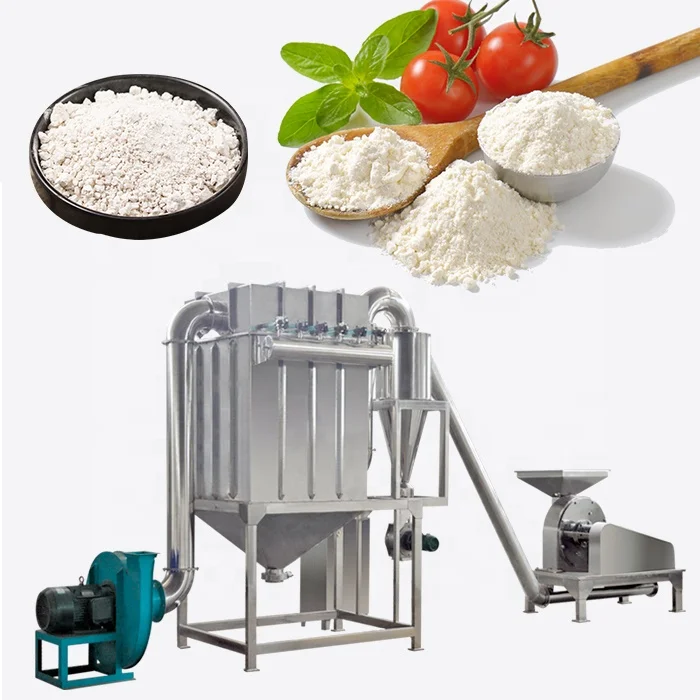
Integrated extrusion technology — Every component from the powder mixer to the high-temperature roaster is engineered as a single coordinated system, ensuring matched throughput across all stations.
Technical Specifications
| Parameter | Value |
|---|---|
| Product Type | Nutritional Powder Production Line |
| Model | MT65 / MT70 / MT85 |
| Extruder Type | Twin-screw |
| Installed Power (MT65) | 85 kW |
| Real Power (MT65) | 65 kW |
| Installed Power (MT70) | 120 kW |
| Real Power (MT70) | 90 kW |
| Installed Power (MT85) | 195 kW |
| Real Power (MT85) | 165 kW |
| Output Capacity (MT65) | 150–200 kg/h (basis to be confirmed) |
| Output Capacity (MT70) | 200–300 kg/h (basis to be confirmed) |
| Output Capacity (MT85) | 600–800 kg/h (basis to be confirmed) |
| Overall Dimensions (MT65) | 18000×1300×2300 mm |
| Overall Dimensions (MT70) | 20000×1500×2400 mm |
| Overall Dimensions (MT85) | 24000×3500×4300 mm |
| Control System | PLC and MCC |
| Contact Material | Food-grade stainless steel |
| Roaster Belt Effective Length | 3.5 m |
| Roaster Far Infrared Heater | 3.9 kW × 24 |
| Powder Mixer Tank Volume | 150 kg |
| Powder Mixer Rotary Speed | 385 rpm |
| Powder Mixer Power | 4 kW |
| Standards | CE, ISO |
Application Suitability
| Application | Material or Output |
|---|---|
| Baby rice powder production | Rice flour with controlled gelatinisation |
| Infant formula powder blending | Grain base with whey protein and micronutrients |
| Soybean powder for nutritional supplements | Whole soybean or defatted soy meal |
| Sesame paste powder processing | Roasted sesame with oil content management |
| Modified starch for industrial use | Corn, cassava or potato starch with adjusted barrel configuration |
| Fortified cereal powder for nutrition programmes | Multi-grain blends with vitamin and mineral premix |
Why Nominal Capacity Figures Can Mislead Your Purchase
A nutritional powder processing line full equipment range must be validated against your actual formula, not a generic test material.
I have watched buyers receive lines that performed well during factory acceptance on standard rice flour, only to discover their real production formula containing whey protein isolate and trace minerals behaves entirely differently under heat and shear. The gelatinisation temperature shifts, expansion characteristics change, and the extruder cannot maintain the quoted throughput. [NEED_CITE: starch gelatinisation behaviour under varying protein concentrations] This is why every nutritional powder processing line full equipment range we build starts with your specific raw material running through our testing workshop before shipment.
Extruder Configuration That Adapts to Your Formula
The twin-screw design allows operators to adjust screw elements and barrel sections based on raw material characteristics. When processing baby rice powder, the screw profile prioritises gentle starch gelatinisation at controlled moisture levels. For infant formula blends containing dairy proteins and heat-sensitive vitamins, the configuration shifts to minimise residence time while maintaining adequate cooking. This flexibility means a single nutritional powder processing line full equipment range can handle multiple product formulations without requiring hardware replacement.
Roaster Design for Consistent Moisture Removal
The high-temperature roaster uses a far infrared heating array distributed across the 3.5-meter belt length. This arrangement provides uniform thermal exposure to extruded material as it travels through the chamber. The belt speed adjusts independently from extruder output, allowing operators to fine-tune final moisture content. [NEED_CITE: far infrared drying efficiency in food powder processing] For nutritional powder applications where over-drying can damage heat-sensitive nutrients, this controlled approach prevents scorching while achieving target shelf-stable moisture levels.
Reading the Specifications That Matter
The installed power versus real power distinction reveals actual energy consumption during operation. The MT65 draws 85 kW at peak but typically operates at 65 kW during steady-state extrusion. The powder mixer operates at 385 rpm with a 150 kg tank volume, completing batches in approximately 10 minutes depending on material density and cohesion. This mixing time determines upstream batch frequency and must align with extruder throughput to prevent material starvation or surge. The roaster’s 24 far infrared heaters at 3.9 kW each provide substantial thermal capacity, but gas consumption figures require confirmation based on your target moisture reduction and ambient conditions. Control system architecture using PLC and MCC enables recipe storage for repeatable batch-to-batch consistency across different nutritional powder formulations.
The Cost of Mismatched Station Capacity
When the mixer cannot keep pace with extruder demand, operators face constant stoppages waiting for the next batch. When the roaster belt cannot handle extruder output, material accumulates and degrades before entering the drying chamber. [NEED_CITE: production line bottleneck analysis in food extrusion] These imbalances rarely appear during brief factory demonstrations but emerge immediately during continuous production. A nutritional powder processing line full equipment range assembled from separate vendors often suffers from these throughput mismatches because each supplier sizes their equipment independently without visibility into the complete system.
What You Get from a Single-Source Line
The line layout and capacity calculation shows throughput matching between powder mixer, air conveyor, twin-screw extruder, and roaster based on your specific material characteristics. Screw and die configuration records document the exact setup proven during testing with your raw material. The in-house testing workshop validates performance before the line ships, preventing the scenario where product development begins only after installation. Food-grade stainless steel contact surfaces across all stations meet hygiene requirements for infant formula and baby food applications. Multiple extruder models covering different capacity ranges allow selection based on your actual production targets rather than forcing you into oversized or undersized equipment.
Documentation & Verification
- Line layout showing station spacing and utility connection points for your facility
- Screw configuration record matched to your specific powder formulation and target density
- Electrical schematic with confirmed voltage and frequency for your local power supply
- Trial run report documenting performance on your actual raw material before dispatch
- CE declaration of conformity for equipment entering regulated markets
- Wear parts list identifying screws, dies and seals requiring periodic replacement
Installation, Commissioning & Support
- Foundation requirements based on the 18–24 meter line length depending on model selection
- Dedicated electrical circuit sized for 85–195 kW installed power with voltage confirmation before production
- Modular station design allowing phased installation as facility preparation completes
- First-run parameter setting using screw configuration record from testing workshop trials
- Operator training covering recipe changes between different nutritional powder formulations
- Spare screw and die inventory recommendations based on your production volume and material abrasiveness
- Preventive maintenance schedule aligned with mixer bearing, extruder gearbox and roaster belt inspection intervals
Before You Request a Quotation
Share your raw material specifications including grain type, protein content, moisture level and any added micronutrients or functional ingredients. Provide your target daily output and available workshop dimensions including ceiling height for the air conveyor routing. Specify your local voltage and frequency standards along with preferred control language for the PLC interface. Indicate whether you need a trial run on your actual material before shipment or if standard test documentation is acceptable for your procurement process.
Frequently Asked Questions
Q: How is output capacity verified against my specific raw material and formula?
A: We run your actual raw material through the extruder in our testing workshop before finalising the quotation. This trial documents real throughput, product quality and energy consumption under your specific conditions rather than relying on generic capacity figures. The results determine which extruder model and screw configuration matches your requirements.
Q: What screw and die configuration is specified for my target powder product?
A: The screw profile and die geometry are selected based on your raw material composition, target powder density and desired gelatinisation degree. We document the exact configuration during testing and provide this record with your shipment, enabling consistent reproduction across production runs.
Q: Which supporting stations are included and how is throughput matched across the line?
A: The complete line includes powder mixer, air conveyor, twin-screw extruder and high-temperature roaster. Each station is sized based on your confirmed extruder output to prevent bottlenecks. The capacity calculation shows material flow rates between stations accounting for moisture loss during roasting.
Q: What documentation is provided with the nutritional powder processing line full equipment range?
A: You receive machine specification sheets, electrical schematics with your confirmed voltage, screw configuration records, trial run reports on your material, CE declaration, operation manuals and wear parts lists. All documentation supports your local regulatory compliance and maintenance planning.
Q: How does the line accommodate different extruder models for varying production scales?
A: The MT65, MT70 and MT85 models share the same station architecture but differ in extruder capacity, power requirements and overall footprint. Selection depends on your target output range, available facility space and electrical infrastructure capacity.