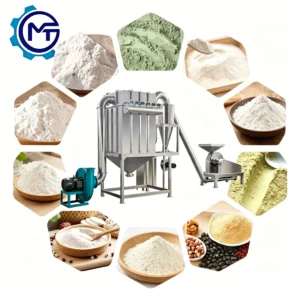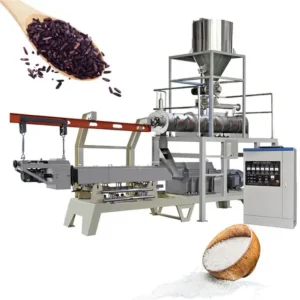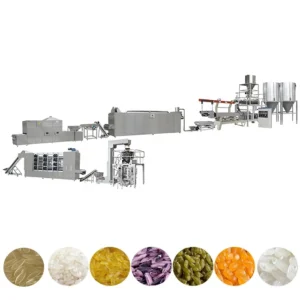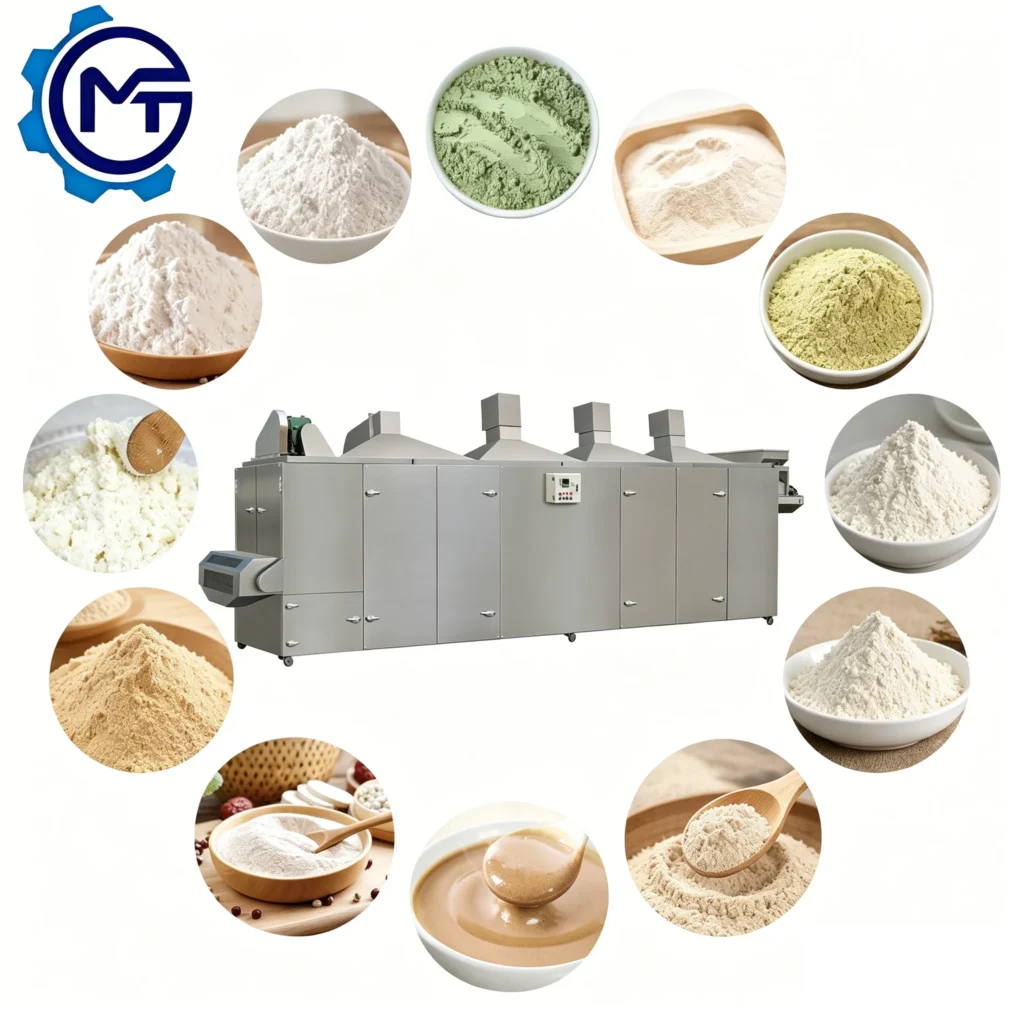
Integrated Line Engineering — Every station from mixing through milling is throughput-matched under one supplier, eliminating the bottleneck gaps that form when extruders, dryers, and grinders are sourced separately for baby food nutrition powder production line equipment.
Technical Specifications
| Parameter | Value |
|---|---|
| Product Type | Baby Food Nutrition Powder Production Line |
| Output Capacity | 200–500 kg/h (basis not stated in source — confirm raw material formulation, moisture content, and target particle size) |
| Control System | PLC with touch control panel and digital interface |
| Construction Material | Food-grade 304 stainless steel (contact parts) |
| Heat Source Options | Electric / Gas / Steam |
| Automation Level | Fully automatic |
| Line Stations | Mixing, baking oven, milling/grinding |
| Warranty | 1 year |
| After-Sales Service | Overseas engineer service available |
| Voltage & Frequency | Configurable to target market (confirm before order) |
| Control Language | Configurable (confirm before order) |
| Standards | CE conformity (line-level declaration to confirm) |
Application Suitability
| Application | Material or Output |
|---|---|
| Infant nutrition powder | Rice flour blended with乳清蛋白, vitamins, and mineral premix |
| Fortified porridge powder | Corn, millet, sorghum, and mixed grain formulations |
| Dietary supplement base | Soy, bean, and pulse-based nutritional powder |
| Baby rice cereal | Single-grain and multi-grain rice flour with micronutrient dosing |
| Instant drink powder | Pre-cooked grain flour for reconstitution |
Why Voltage and Frequency Confirmation Must Precede Every Other Decision
Specifying the correct electrical configuration before production begins prevents commissioning delays that can stretch into weeks once the baby food nutrition powder production line equipment arrives on site.
I have watched a nutrition powder line sit idle in a Southeast Asian factory because the motor windings were set for 380V/50Hz while the local supply ran at 440V/60Hz. The PLC panel displayed error codes the operator could not read, and the HMI language defaulted to a script the maintenance team did not recognize. By the time replacement contactors and a reprogrammed drive arrived, the buyer had missed two shipping windows for a contracted retail order [NEED_CITE: voltage and frequency standards by export market]. These are not rare edge cases — they surface on any line crossing borders, and they are entirely preventable when the electrical discussion happens at the inquiry stage rather than during installation.
Matching the Heat Source to Your Factory Utility Layout
The baking oven on this line accepts electric, gas, or steam heating, and the choice carries consequences well beyond the oven itself. Electric heating offers precise zone control but demands a dedicated high-amperage circuit; gas firing reduces electrical load but requires combustion air intake and exhaust routing that must satisfy local safety codes. Steam integration works when the facility already runs a boiler for other process lines, though steam pressure stability directly affects baking uniformity across the tray surface. Selecting the heat source early ensures the baby food nutrition powder production line equipment fits the existing utility envelope rather than forcing an unplanned infrastructure build-out after delivery.
Why Stainless Steel Contact Surfaces Matter Beyond Compliance
Food-grade 304 stainless steel on every product-contact surface is not simply a regulatory checkbox. Infant powder formulations often contain added fats from milk powder or oil-based vitamin carriers, and these residues oxidize on porous carbon steel, creating off-flavors that carry through to the next batch. The polished finish on 304 stainless also reduces adhesion during the milling stage, where fine powder tends to pack into surface scratches and contaminate subsequent runs [NEED_CITE: food contact material regulations for infant formula processing]. When a buyer switches from a plain rice flour run to a formulation containing fish-oil-based DHA, the cleaning cycle on 304 stainless is noticeably shorter and leaves fewer detectable residues, protecting batch-to-batch integrity.
How PLC Touch Control Reduces Operator Dependency
A digital PLC interface with touch control replaces the manual dial-and-guess approach that still appears on older nutrition powder lines. The operator sets barrel temperature zones, conveyor speed, and milling gap from one screen, and the system holds those values across shifts. This matters because infant powder particle size must stay within a narrow range to pass dissolution tests — a milling gap that drifts even slightly produces oversized granules that fail reconstitution specifications. The control panel logs process parameters for each batch, giving quality teams traceable data rather than handwritten shift notes.
The Hidden Cost of Skipping a Raw Material Trial Run
I once set up a baby food powder line using standard rice flour for the factory test, and everything ran clean — consistent output, even baking, uniform particle size. Two weeks later the buyer’s actual formulation arrived at the site: rice flour blended with whey protein isolate, calcium carbonate, and a fat-based vitamin premix. The added protein raised the dough viscosity inside the baking stage, the calcium carbonate altered heat transfer, and the fat content changed how the powder behaved through the mill. Parameters had to be rebuilt from scratch, and commissioning stretched well beyond the planned window. A trial run on the buyer’s exact formulation before shipment would have caught all three variables while the line was still on the test floor, where adjustments cost days instead of weeks. Buying matched stations from one supplier means nothing if the process recipe has not been validated on the real material [NEED_CITE: importance of raw material trial runs in food extrusion projects].
What Sets This Procurement Path Apart
Every station on this line — mixing, baking, milling, cooling — is engineered under one roof, so throughput is calculated across the entire chain rather than guessed at each individual machine. Screw and die configurations, where applicable, are specified to the buyer’s raw material profile rather than copied from a generic build sheet. The in-house testing workshop allows trial runs on the customer’s actual formulation before the line ships, meaning process parameters travel with the equipment instead of being discovered during on-site commissioning. Documentation covers the full chain from line layout through electrical schematics, so the installation team has a single reference rather than juggling manuals from four different vendors.
Documentation & Verification
- Line layout and capacity calculation matched to your grain formulation and target output
- Machine specification sheet with voltage, frequency, and HMI language confirmed for your market
- Trial run report generated on your actual raw material blend before dispatch
- Electrical schematic and control logic diagram for local panel integration
- Operation and maintenance manual with illustrated wear parts replacement guide
- CE declaration of conformity covering the complete line assembly
Installation, Commissioning & Support
- Foundation plan and floor load data provided based on the PLC cabinet and oven weight distribution
- Dedicated circuit sizing sheet aligned to your selected heat source option
- Overseas engineer available for first-start parameter tuning on your specific grain formulation
- Operator training covers HMI navigation, milling gap adjustment, and cleaning protocols for 304 stainless surfaces
- Wear parts list with reorder lead times for milling screens and oven tray components
- Scheduled maintenance intervals documented for bearings, drive belts, and thermal elements
What We Need to Move Forward
To configure this baby food nutrition powder production line equipment accurately, share the full ingredient list including any protein isolates, fat-based additives, and mineral premixes, along with the target particle size range and daily output requirement. Specify the available voltage, phase, and frequency at your facility, and note the preferred control language for the HMI. If your workshop has ceiling height or floor space constraints, a dimensioned sketch helps us adjust the layout before production begins.
Frequently Asked Questions
Q: How is the 200–500 kg/h output capacity verified, and on which raw material formulation?
A: The stated range is a general reference and must be confirmed against your specific formulation — including grain type, protein content, fat percentage, and moisture level. We run your actual raw material blend in our testing workshop to establish the verified throughput before the quotation is finalized, so the capacity figure you receive reflects your recipe, not a generic benchmark.
Q: Which voltage, frequency, and control language configurations are available?
A: The line is configurable for standard industrial voltages and frequencies used across export markets. The PLC touch panel supports multiple language options for the HMI. We confirm all three parameters — voltage, frequency, and display language — during the specification stage before production begins, ensuring the electrical package matches your facility on arrival.
Q: How is throughput balanced between mixing, baking, and milling to avoid bottlenecks?
A: Each station is sized based on the same capacity calculation, so the mixer batch cycle, oven residence time, and milling feed rate are aligned from the design stage. The line layout document shows the matched throughput at every station, preventing the common problem where one segment runs faster than the next and forces unplanned buffer storage.
Q: What does the overseas engineer installation and operator training service include?
A: The engineer supervises mechanical assembly, electrical connection verification, and first-run parameter tuning on your formulation. Training covers PLC operation, milling gap calibration, cleaning procedures for 304 stainless contact parts, and routine maintenance schedules. Wear parts replacement procedures are demonstrated on-site using the actual components installed on your line.
Q: What screw, die, and milling configurations are matched to specific grain types?
A: Milling screen aperture, hammer type, and classifier settings are selected based on your target particle size distribution and the grain blend you process. For formulations containing high-fat or high-protein additions, the milling configuration is adjusted to prevent clogging and ensure uniform output. The configuration record is documented and included in your shipment file.