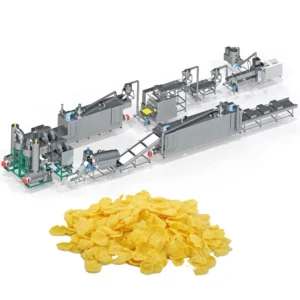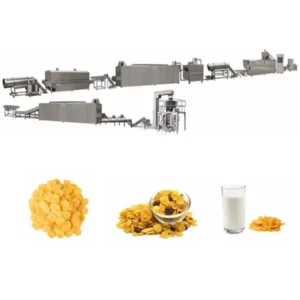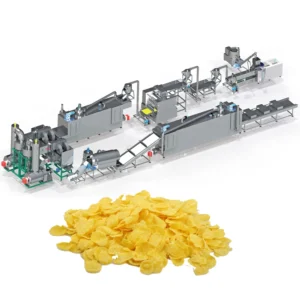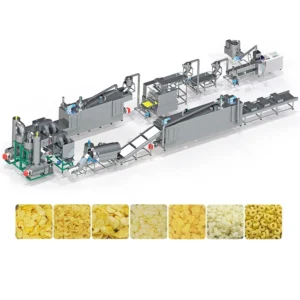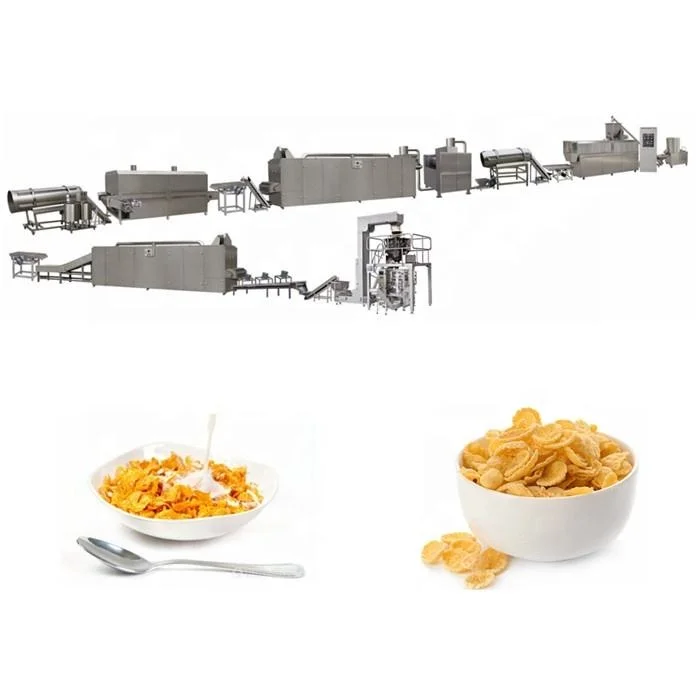
Full Line Equipment Survey — Every station from mixing through packing is specified with matched throughput, avoiding the common mismatch where one undersized dryer or coater bottlenecks the entire breakfast cereal line.
Technical Specifications
| Parameter | Value |
|---|---|
| Product Type | Breakfast Cereal Corn Flakes Production Line |
| Model | MT75 |
| Installed Power | 210 kW |
| Power Consumption | 150 kW |
| Output Capacity | 300–500 kg/hr (basis to be confirmed with raw material, moisture content, and product format) |
| Overall Dimensions | 45 × 1.5 × 3.5 m |
| Screw Type | Twin Screw |
| Control System | Available with PLC or MCC control |
| Flaking Machinery | Hydraulic double rollers, separate dual-motor drive, infrared-controlled temperature pipe |
| Dryer Heating Source | Gas or Electric |
| Roasting Oven | Hot air roasting, vibrating pan, high-temperature spraying tubes, conciliation burner, dual circulating fans, cyclone dust removal |
| Coating System | Double tumble sugar melting, elevator, coating drum, spraying nozzle |
| Extruder Features | Automatic lubricating and cooling; wear-resistant screw technology |
| Standards | CE certified; ISO certified |
Application Suitability
| Application | Material or Output |
|---|---|
| Natural corn flakes production | Corn powder, rice, wheat, oat, barley powder |
| Sugar-coated corn flakes | Corn and mixed grain blends with sugar coating slurry |
| Multi-shaped breakfast cereals | Rings, balls, tubes, sticks, stars, fruit loops, wheels, flowers, hearts |
| Fortified breakfast cereal lines | Grain blends with added nutritional premix |
What "300–500 kg/hr" Leaves Out About Your Breakfast Cereal Line
Throughput only matters when measured against your exact raw material and target flake density.
I once watched a producer commission a line rated for a specific hourly output, only to find that switching from pure corn grits to an oat-heavy blend cut actual yield significantly. The extruder was never the problem — the moisture content, starch behaviour, and flaking roller pressure all shifted, and the downstream dryer and roaster had to compensate. When surveying a breakfast cereal corn flakes machine full equipment range, the question is never just what the extruder can push through the barrel. It is whether the flaker, dryer, roaster, and coater are each sized to handle the same mass flow under your specific formulation [NEED_CITE: industrial breakfast cereal line throughput matching across stations].
Surveying Every Station Before You Specify a Single Machine
Buying an extruder in isolation is how production lines end up with bottlenecks. This breakfast cereal corn flakes machine full equipment range covers the complete sequence — batching and mixing, twin-screw extrusion, hydraulic flaking, pre-drying, hot air roasting, sugar coating, and final cooling — so buyers can review each station’s function and verify throughput alignment before committing to a layout.
How Line Stations Differ Between Natural and Sugar-Coated Formats
A natural corn flakes line runs mixing, extruding, flaking, drying, hot air roasting, cooling, and packing. Adding a sugar-coated variant introduces sugar spraying, a dedicated coating drum stage, and a second drying pass. This means the base line must have sufficient headroom in the dryer and cooling sections to absorb the extra thermal load and moisture from the coating stage. Reviewing the full equipment range up front lets buyers understand which stations are shared and which are added, rather than retrofitting extra capacity after installation [NEED_CITE: breakfast cereal processing line configuration for coated versus uncoated formats].
Reading the Specifications That Actually Shape Flake Quality
The twin-screw extruder is the core forming stage, but flake quality is determined further downstream. The hydraulic flaking machinery uses double rollers driven by separate motors, which allows independent pressure control and reduces the risk of uneven sheet thickness that leads to inconsistent roasting. The infrared-controlled temperature pipe inside the flaking zone maintains uniform dough sheet temperature entering the nip, which is critical because corn dough that cools too much before flaking cracks instead of forming smooth, intact flakes.
In the roasting stage, the hot air oven uses a vibrating pan with high-temperature spraying tubes and two separate circulating fans. This configuration ensures even heat distribution across the full pan width, which directly affects whether flakes emerge uniformly crispy or with soft spots in the centre of the bed. The cyclone dust removal device keeps fine particulate out of the roasting atmosphere, maintaining product cleanliness and extending cleaning intervals. On the coating side, the double tumble sugar melting system paired with a dedicated spraying nozzle provides consistent syrup distribution before flakes enter the coating drum, which matters because uneven coating leads to clumping and rejects during packing.
The Hidden Cost of Undersized Supporting Stations
When the dryer or roaster is sized below what the extruder actually delivers at your moisture content, the line runs at a fraction of its nameplate output. Operators slow the extruder feed rate to let the dryer catch up, which wastes installed motor capacity and extends shift times. In sugar-coated production, an undersized coating drum forces longer tumble cycles, which breaks fragile flakes and generates excess fines. These losses rarely show up in a quotation but appear clearly on the factory floor within the first week of operation [NEED_CITE: consequences of mismatched throughput in cereal production lines].
Why Source the Full Range From One Equipment Catalogue
Having every station documented in a single catalogue means throughput calculations reference the same mass flow basis across all machines, eliminating conversion errors between vendors. The screw configuration and die design are specified to the buyer’s actual raw material and target flake geometry, not copied from a generic template. An in-house machine testing workshop allows trial runs on the buyer’s own corn, oat, or barley formulation before shipment, so parameters are established early rather than discovered during commissioning. Pre-sales consultation covers engineer-designed layouts that account for the buyer’s factory dimensions, ceiling height, and utility connection points. Ongoing maintenance support and wear parts supply — including replacement screws, dies, and flaking roller components — are documented from day one rather than scrambled when the first replacement falls due [NEED_CITE: equipment supplier documentation standards for food processing machinery].
Documentation & Verification
- Line layout and capacity calculation showing throughput alignment across mixing, extrusion, flaking, drying, and roasting stations
- Machine specification sheet for each station with voltage and frequency confirmed to buyer’s local grid standard
- Screw and die configuration record matched to buyer’s corn, oat, or mixed grain formulation and target flake geometry
- Trial run report generated in the testing workshop on buyer’s actual raw material before shipment
- Electrical schematic with PLC or MCC control language and interface confirmed prior to production
- Factory test record documenting run parameters, output quality, and dimensional checks before dispatch
Installation, Commissioning & Support
- Overall 45 × 1.5 × 3.5 m line footprint requires level concrete flooring with anchor points at extruder, flaker, and roaster stations
- 210 kW installed power demand requires dedicated circuit with confirmed voltage and frequency before electrical panel fabrication
- Complete turnkey line arrives as modular stations for sequential assembly, with extruder and flaker requiring precision alignment
- First-run commissioning includes screw speed, barrel temperature profile, flaker roller gap, and roaster airflow calibration
- Operator training covers PLC or MCC interface navigation, hydraulic flaker pressure adjustment, and roaster burner management
- Wear parts list documents replacement screws, dies, flaking roller surfaces, and roaster spraying tubes with recommended intervals
Before You Request a Quotation
To configure the right line from this equipment range, share your primary raw material — whether pure corn grits, an oat blend, or a multi-grain formulation — along with the target flake size and whether you need natural, sugar-coated, or both formats. Confirm your local voltage and frequency standard, and provide available factory floor dimensions with ceiling clearance so the layout can be designed around your actual space. If you have specific daily production targets, note the shift pattern and batch changeover frequency so each station can be sized accordingly.
Frequently Asked Questions
Q: How is throughput matched between the extruder, dryer, and coating stations on this line?
A: Each station’s capacity is calculated against the same mass flow basis using the buyer’s confirmed raw material and moisture content. The dryer and roaster are sized to handle the full extruder output plus added moisture from coating stages, so no single station bottlenecks the sequence. This matching is documented in the line layout and capacity calculation before order confirmation.
Q: What voltage and frequency options are confirmed before the line ships?
A: The electrical specification — including voltage, frequency, and control interface language — is confirmed during the quotation stage and locked before production begins. The PLC or MCC panel is then built to the buyer’s local grid standard, preventing commissioning delays caused by incompatible electrical configurations at the installation site.
Q: How does the flaking machinery handle different cereal materials like corn, oat, and barley?
A: The hydraulic double rollers allow independent pressure adjustment, and the infrared-controlled temperature pipe maintains consistent dough sheet temperature entering the nip. This means roller gap and pressure can be tuned for the different starch and fibre characteristics of corn, oat, barley, or blended formulations to produce intact, even-thickness flakes.
Q: Can the same line produce both natural and sugar-coated corn flakes?
A: Yes. The base line covers mixing through hot air roasting for natural flakes. Adding sugar-coated production introduces the sugar spraying station, coating drum, and a second drying pass. The full equipment range documents which stations are shared and which are added, so buyers can plan for both formats during initial layout design.
Q: What spare wear parts are available when the first replacement is due?
A: A documented wear parts list is provided with the line, covering replacement screws, dies, flaking roller surfaces, and roaster spraying tubes. Recommended replacement intervals are included in the operation and maintenance manual, and parts can be ordered directly so the first changeover does not cause unplanned downtime.