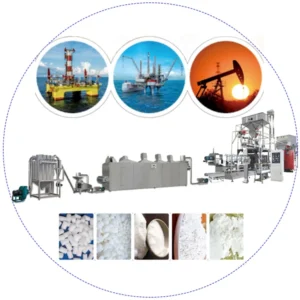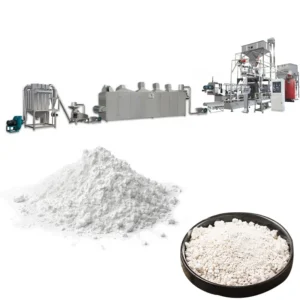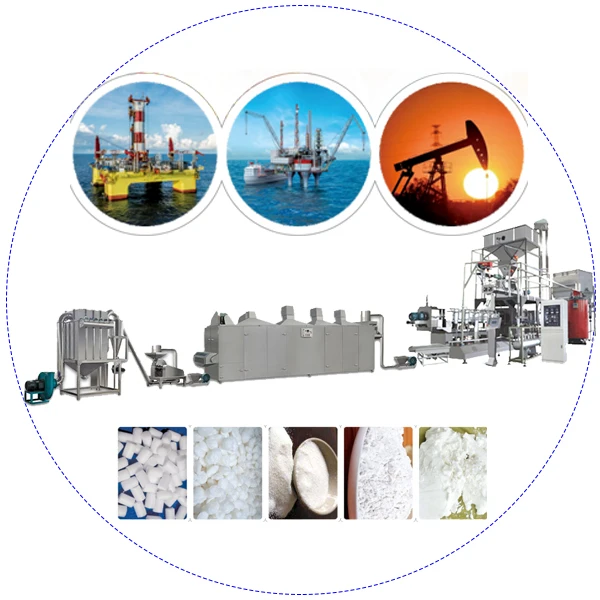
Full Line Station Coverage — Every mixer, extruder, dryer and grinder in this modified starch processing line is sourced from one manufacturer, eliminating throughput gaps between separately bought machines.
Technical Specifications
| Parameter | Value |
|---|---|
| Product Type | Twin-Screw Modified Starch Processing Line |
| Raw Materials | Wheat flour, corn starch, potato starch, cassava starch |
| Output Capacity | 80–500 kg/h (basis not stated in source — confirm raw material type, moisture content and target starch modification) |
| Process Flow | Mixer → Screw Conveyor → Twin Screw Extruder → Shifter → Air Conveyor → Dryer → Air Conveyor → Conditioning → Conveyor → Grinder |
| Mixer Motor Power | 4.0 kW |
| Mixer Batch Output | 3.0–4.0 kg/batch (basis not stated in source — confirm raw material and moisture) |
| Screw Conveyor Motor Power | 1.1 kW |
| Screw Conveyor Dimensions (L×W×H) | 2.5 × 0.6 × 2.3 m |
| Extruder Type | Twin-screw |
| Key Contact Material | Food-grade stainless steel 304 |
| Frame Material | Stainless steel 201 |
| Voltage & Frequency | Three-phase 380 V / 50 Hz; Single-phase 220 V / 50 Hz (customizable) |
| Total Installed Power (Electric Heating) | ~100 kW (basis to be confirmed against final configuration) |
| Total Installed Power (Gas/Diesel Heating) | ~50–60 kW (basis to be confirmed against final configuration) |
| Energy Options | Electricity, gas, diesel, or steam |
| Electrical Components | Siemens (China-made) or equivalent motors; Delixi or Delta inverters |
| Standards | CE, ISO |
Application Suitability
| Application | Material or Output |
|---|---|
| Pregelatinized starch for instant food bases | Corn starch, cassava starch at controlled moisture |
| Modified starch for papermaking and textiles | Wheat flour and potato starch blends |
| Functional ingredient for meat processing and sauces | Pregelatinized corn starch with target viscosity profile |
| Instant soup and gravy thickeners | Cassava and potato starch derivatives |
| Binding agents for tablet and capsule formulation | Modified wheat starch at pharmaceutical-grade settings |
What "80 to 500 kg/h" Actually Depends On
Capacity on a modified starch processing line is meaningless without naming the raw material, moisture content, and the specific modification target.
Buyers often compare twin-screw extruders by the number printed on the spec sheet, only to find actual throughput drops sharply once their local cassava or potato starch hits the barrel. A line rated at the upper end on refined corn starch may stall at half that figure when processing high-fiber cassava flour with different gelatinisation behaviour. This mismatch between quoted capacity and real output is one of the most common reasons starch processors delay commissioning or blame the equipment supplier [NEED_CITE: throughput discrepancies in starch extrusion projects]. The full equipment range must therefore be evaluated together — mixer batch size, conveyor feed rate, extruder screw speed, and dryer residence time all have to align with the buyer’s actual feedstock, not a laboratory sample.
Station-by-Station Throughput Mapping
The modified starch processing line full equipment range begins with a mixer that delivers 3.0–4.0 kg per batch. That batch output must synchronize with the screw conveyor, which feeds the twin-screw extruder at a controlled rate. If the conveyor pushes material faster than the extruder can gelatinise it, the barrel floods and product quality degrades. If it feeds too slowly, the extruder runs under capacity and energy consumption per kilogram rises. Mapping each station’s throughput on the buyer’s specific starch type prevents these mismatches before the line ships.
Energy Source Selection Across the Line
Drying and extrusion are the most energy-intensive stages in starch modification. The line supports electricity, gas, diesel, or steam heating, and the choice affects both operating cost and the temperature profile inside the dryer. Electric heating draws roughly 100 kW total installed power, while gas or diesel configurations reduce electrical load to approximately 50–60 kW. Steam may be preferable in facilities that already operate a boiler for other process lines. Selecting the right energy option at the quotation stage avoids costly rewiring or fuel infrastructure changes after delivery [NEED_CITE: industrial energy source standards for food processing plants].
How Screw Configuration Shapes Starch Gelatinisation
Twin-screw extruders rely on screw element arrangement — conveying, kneading, and reverse elements — to control shear, residence time, and temperature rise inside the barrel. For pregelatinized starch, the goal is complete gelatinisation without excessive dextrinisation that would lower the final viscosity. A screw combination optimized for corn starch may over-shear cassava starch, breaking the granule structure too early and producing a gummy mass that clogs the die. The die configuration on the extruder head is interchangeable, allowing operators to adjust the pressure drop and expansion ratio for different starch modification targets. Moisture content entering the barrel, typically adjusted at the mixer, directly controls how thoroughly the starch granules swell and rupture during extrusion. Food-grade stainless steel 304 contact surfaces resist the mild acidity that some modified starch processes introduce, protecting product purity across long production runs.
The Hidden Cost of Mismatched Line Stations
When a buyer sources the extruder from one vendor and the dryer from another, the dryer may lack the residence time or airflow to handle the extruder’s actual output moisture. The result is partially dried starch that clumps in the grinder, creating off-spec product and forcing unplanned downtime. Similar bottlenecks appear when the mixer batch cycle is slower than the extruder’s continuous feed demand, leaving the screw conveyor running empty between batches. These throughput gaps rarely show up in individual machine specifications but become obvious during commissioning [NEED_CITE: equipment integration failures in food processing lines].
Why Source the Complete Range Here
Every station in this modified starch processing line is manufactured under one quality system, so motor ratings, conveyor speeds, and dryer capacities are matched before the line leaves the factory. The in-house testing workshop runs trial production on the buyer’s actual raw material, verifying gelatinisation degree and final product texture before shipment. Screw and die configurations are recorded for each project, meaning replacement wear parts can be reproduced to the original specification. Electrical schematics are confirmed against the target market’s voltage and frequency, reducing on-site wiring disputes. Pre-sales engineering covers line layout and utility planning, so floor space and power supply are validated before production begins.
Documentation & Verification
- Line layout drawing with throughput calculation for your specific starch type and target modification
- Screw and die configuration record matched to your raw material trial results
- Electrical schematic with voltage and frequency confirmed for your facility
- Factory test report documenting gelatinisation degree and product texture from your feedstock
- CE declaration of conformity and ISO certificate available for customs and audit review
- Operation and maintenance manual with wear parts list for ongoing production
Installation, Commissioning & Support
- Foundation plan accounts for the 2.5 m screw conveyor footprint and extruder vibration isolation
- Dedicated circuit sizing confirmed against the ~100 kW electric heating load or reduced gas-heating draw
- Mixer and grinder stations arrive pre-assembled; extruder barrel sections are aligned on-site
- First-run commissioning verifies screw speed, barrel temperature zones, and dryer airflow against your starch target
- Operator training covers die changeover, screw element inspection, and daily cleaning of 304 stainless contact surfaces
- Wear parts list identifies screws, dies, and conveyor bearings with reorder intervals
What We Need to Configure Your Line
To size each station correctly, share the specific starch variety you plan to process, the moisture content of your incoming raw material, and the modification or gelatinisation property you need in the finished powder. Include your facility’s voltage, frequency, and available energy sources so the electrical design matches local supply. If you have existing upstream batching or downstream packing equipment, provide interface dimensions so the conveyor heights and discharge points align.
Frequently Asked Questions
Q: What equipment stations are included in a complete modified starch processing line and where does each fit?
A: The line covers a mixer for raw material blending, a screw conveyor for controlled feeding, a twin-screw extruder for gelatinisation and modification, a dryer for moisture reduction, a conditioning stage, and a grinder for final particle size. Each station’s motor power and throughput are matched so no single point bottlenecks the line.
Q: How do I compare extruder capacity options across different raw materials such as corn, cassava, and potato starch?
A: Capacity varies with starch granule size, amylose content, and incoming moisture. Corn starch typically gelatinises at a different barrel temperature profile than cassava, affecting screw speed and residence time. Request a trial run on your actual material to confirm realistic throughput rather than relying on generic spec sheet figures.
Q: Which energy source is most suitable for my modified starch drying and extrusion stations?
A: Electric heating simplifies installation but draws higher total installed power. Gas or diesel reduces electrical load and suits facilities with existing fuel infrastructure. Steam integrates well where a central boiler already operates. The choice depends on your local energy cost structure and available utility connections.
Q: What is the difference between food-grade 304 contact materials and 201 frame stainless steel in the line specification?
A: Stainless steel 304 is used on every surface that touches the starch, providing corrosion resistance and meeting food safety requirements. The 201 stainless frame supports structural loads at lower cost while still offering adequate durability in typical production environments.
Q: How do I match throughput between the mixer batch output, screw conveyor feed rate, and extruder capacity to avoid line bottlenecks?
A: The mixer delivers 3.0–4.0 kg per batch, and its cycle time must align with the screw conveyor’s continuous feed rate and the extruder’s processing speed. Capacity calculation during the engineering phase maps these values against your specific starch density and moisture, ensuring continuous flow without starvation or flooding at any station.