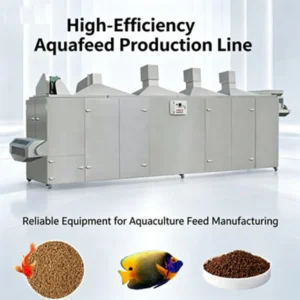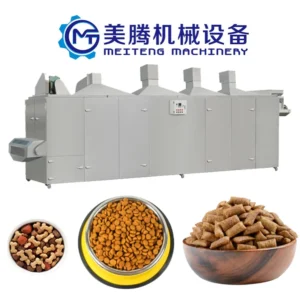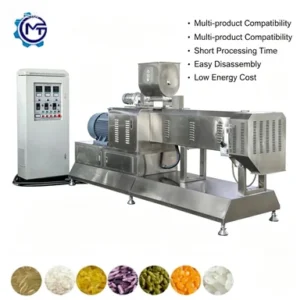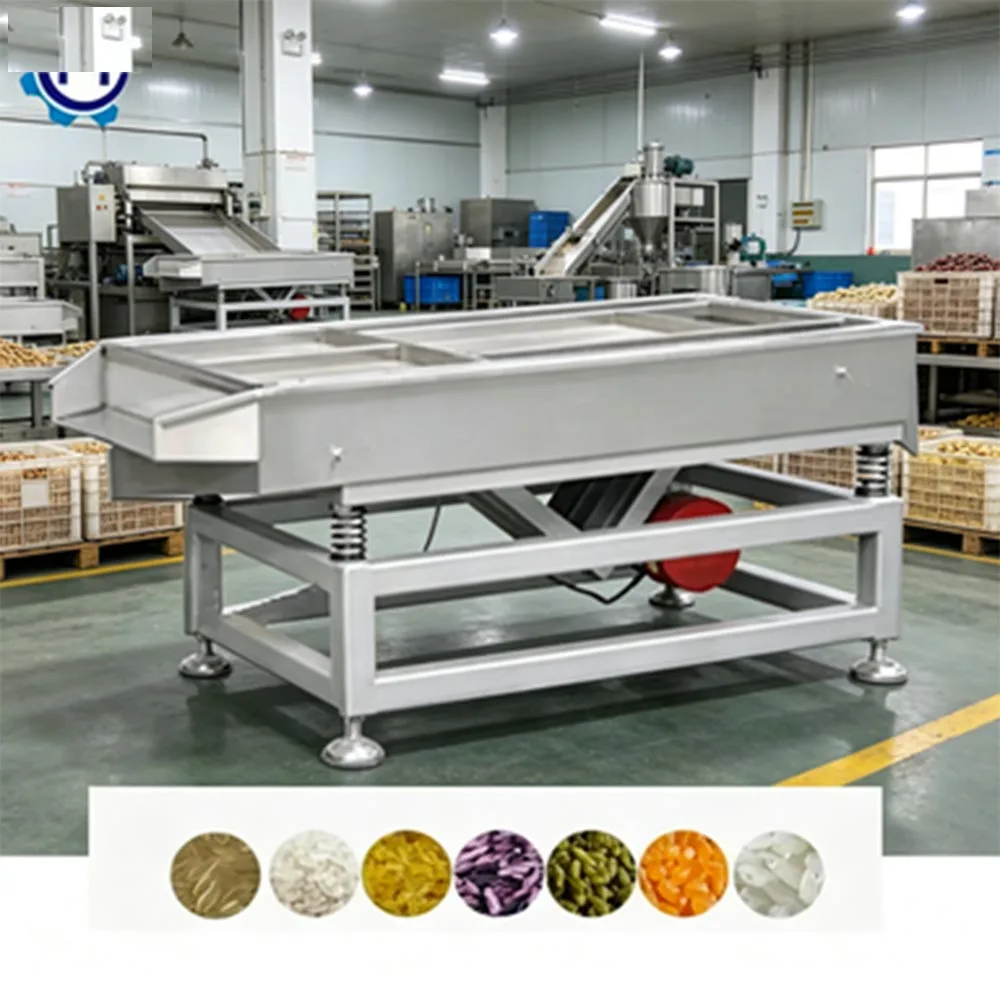
Integrated Station Matching — Every mixer, extruder, dryer, and coating drum in this aquatic feed production line full equipment range is sized to hold continuous throughput without bottlenecking adjacent stages.
Technical Specifications
| Parameter | Value |
|---|---|
| Product Type | Aquatic Feed Extrusion Production Line |
| Screw Type | Twin Screw |
| Control System | PLC Automatic Control |
| Material Contact Parts | Food Grade 304 Stainless Steel |
| Pellet Adjustment | Size, Hardness, Buoyancy (floating / sinking) |
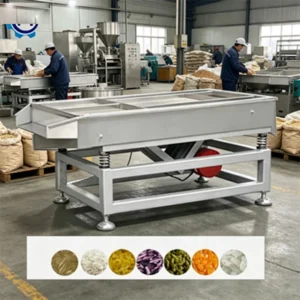
| Line Stations | Raw Material Mixer, Extruder, Dryer, Seasoning Coating Machine, Vibrating Sieve, Conveyor Equipment |
| Automation Level | Full Continuous Automatic Production |
| Capacity Range | Medium to large scale industrial production (basis to be confirmed) |
| Energy Features | Optimized energy saving transmission structure and heating system |
Application Suitability
| Application | Material or Output |
|---|---|
| Floating koi and goldfish pellets | Fish meal, soybean meal, corn powder, compound additives |
| Sinking freshwater fish feed | High-protein formulations requiring dense pellet structure |
| Tropical ornamental fish diets | Multi-ingredient blends with varied lipid and vitamin content |
| Hatchery and grow-out aquaculture | Crumble and pellet formats across developmental stages |
Why Nominal Line Capacity Fails on Real Formulations
A rated output figure means nothing when the extruder cannot sustain it on your specific fish meal ratio.
Buyers often receive a line proposal based on a standard corn starch test, only to find the actual aquatic feed production line full equipment range chokes when protein-heavy formulations enter the barrel. The extruder surges, the dryer cannot keep pace, and the coating drum overflows. I have watched facilities in Latin America run at half their expected volume because the screw profile was never matched to the local soybean and fish meal blend [NEED_CITE: twin-screw extrusion behavior on high protein aquatic formulations].
Station-by-Station Catalogue Logic
When surveying machinery for a new aquatic feed plant, the temptation is to compare extruder models in isolation. The reality is that an aquatic feed production line full equipment range must be evaluated as a chain. If the mixer discharges faster than the extruder can intake, surge bins become necessary. If the dryer cannot remove moisture at the rate the extruder produces wet pellets, product quality degrades before it even reaches the seasoning drum.
Upstream and Downstream Throughput Alignment
The conveyor equipment linking each station is often an afterthought in catalogue comparisons. Yet a belt running too slowly creates a backlog at the vibrating sieve, while one running too fast starves the coating machine. Every transfer point in this equipment range is specified so that material flow remains continuous under full load, eliminating the micro-stoppages that erode daily output [NEED_CITE: continuous production line material handling design].
Reading the Parameter Sheet for Pellet Quality
The twin-screw configuration provides the shear and residence time needed to gelatinize starch while maintaining protein integrity. Food grade 304 stainless steel contact parts prevent corrosion from saline and lipid-rich ingredients common in aquatic diets. PLC automatic control allows operators to store recipes for floating versus sinking pellets, adjusting barrel temperature zones and screw speed without manual guesswork. The pellet adjustment parameters — size, hardness, buoyancy — are determined jointly by die geometry and conditioning moisture, not by the extruder alone.
The Cost of Mismatched Station Capacity
Selecting an extruder at the top of its range while pairing it with a dryer sized for average output leads to wet pellets piling up in the cooling zone. Seasoning adhesion drops when pellets enter the coating drum above the target moisture threshold. Vibrating sieves overloaded with off-size material recirculate waste back into the mixer, contaminating fresh batches. These cascading failures do not appear in a brochure but surface within the first production week [NEED_CITE: aquatic feed pellet moisture and coating adhesion correlation].
Why Source the Full Range from One Supplier
Single-supplier responsibility means the line layout and capacity calculation are produced against your exact raw material formula, not a generic benchmark. Screw and die configuration records are matched to your target buoyancy before metal is cut. The in-house testing workshop runs trial batches on your actual fish meal and corn powder blend, generating a trial run report before shipment. Electrical schematics and PLC language are confirmed to match your facility, and wear parts lists ship with the first container so replacement screws and dies arrive before the originals reach end of life.
Documentation & Verification
- Line layout drawing showing station spacing and conveyor routing for your facility footprint
- Screw and die configuration record matched to your floating or sinking pellet target
- Trial run report produced on your raw material formula before dispatch
- Electrical schematic with confirmed voltage, frequency, and PLC control language
- Factory test record documenting continuous run performance at matched throughput
Installation, Commissioning & Support
- Foundation plan accounting for extruder and dryer weight distribution across your workshop slab
- Dedicated circuit sizing for the PLC-controlled heating zones and main drive motor
- Modular station delivery allowing phased assembly when workshop access is limited
- On-site screw speed and barrel temperature calibration against your local ingredient moisture
- Operator training covering recipe storage and buoyancy adjustment on the PLC interface
- Wear parts inventory list specifying replacement intervals for screws, dies, and dryer belts
What to Prepare Before Requesting a Quote
To size an aquatic feed production line full equipment range accurately, share your primary raw materials and their typical moisture content, the pellet diameter and buoyancy you need, and your target daily output. Include your workshop dimensions and the local voltage and frequency standard. If you plan to run multiple species formulations, list each recipe so the screw configuration can be evaluated against the most demanding blend.
Frequently Asked Questions
Q: How is line capacity verified against my specific fish meal and corn powder formula?
A: The supplier runs your actual raw material through the in-house testing workshop before shipment. A trial run report documents throughput, pellet density, and buoyancy under your exact recipe, so the capacity figure you receive reflects real conditions rather than a generic starch benchmark.
Q: How do you match dryer and seasoning drum throughput to the extruder output?
A: Each station in the aquatic feed production line full equipment range is sized using the extruder’s verified discharge rate on your formula. The dryer’s evaporation capacity and the coating drum’s residence time are calculated to handle peak output without moisture backlog or seasoning waste.
Q: What screw and die configuration produces reliable floating pellets for koi feed?
A: Floating pellets require a specific compression ratio achieved through screw element sequencing and die orifice geometry. The configuration record is built around your target koi pellet diameter and lipid content, then validated during the pre-shipment trial run.
Q: Can the line be expanded later with additional stations?
A: The initial layout drawing reserves conveyor routing and floor space for future additions such as a second coating drum or an expanded packaging station. Electrical panels include spare breaker positions and PLC I/O capacity to integrate new equipment without replacing the control cabinet.