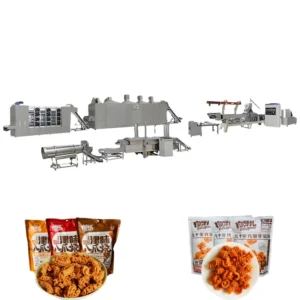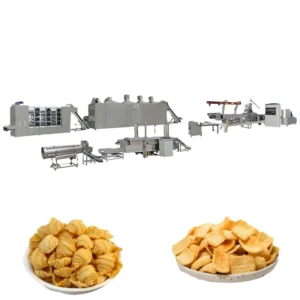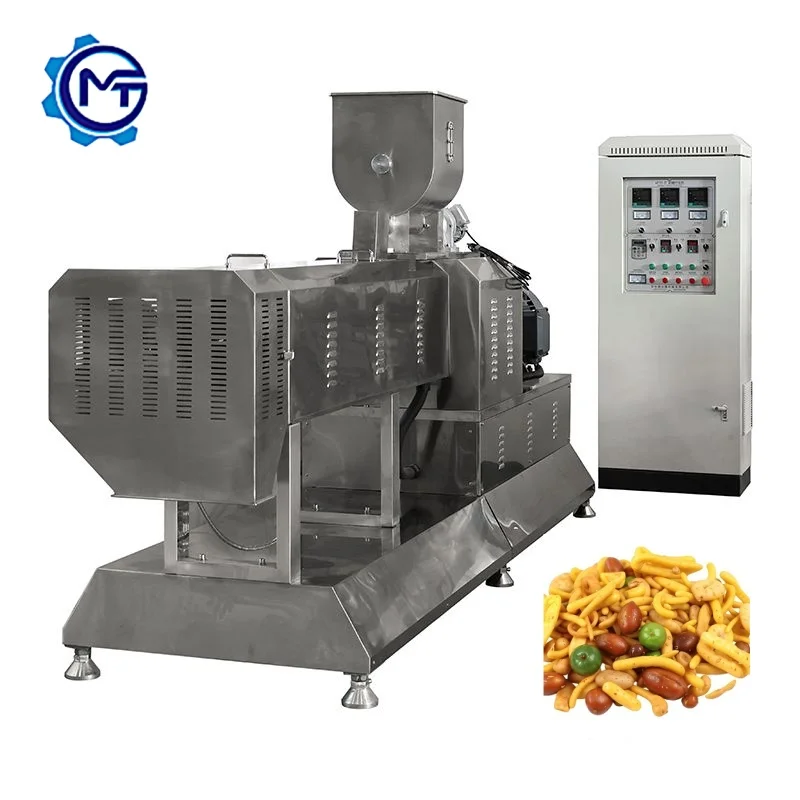
Integrated Line Matching — Every fryer we quote is calculated against upstream extruder throughput and downstream seasoning speed to eliminate bottlenecking across the snack processing line.
Technical Specifications
| Parameter | Value |
|---|---|
| Product Type | Continuous Deep Frying Machine for Snack Processing Line |
| Heating Method | Electricity Heating / Gas Heating |
| Heating Tube Power | 60 kW (electric heating variant) |
| Drive Power | 2.6 kW |
| Voltage & Frequency | 380V / 50Hz |
| Control System | PLC |
| Oil Capacity | 320 L |
| Belt System | Upper and lower double-layer mesh belt with frequency conversion stepless speed regulation |
| Lifting System | Automatic lifting for upper hood and mesh belt |
| Slag Discharge | Bottom slag discharge system |
| Oil Filtration | Continuous oil circulation filtration system |
| Material | Food-grade 304 Stainless Steel |
| Overall Dimensions (L×W×H) | 6700 × 2200 × 1200 mm |
| Net Weight | 2000 kg |
| Capacity | 100–1000 kg/h (basis to be confirmed by product type, moisture, and frying time) |
| Warranty | 1 Year |
| Certification | CE, ISO |
Application Suitability
| Application | Material or Output |
|---|---|
| Fried nimko production lines | Extruded wheat flour or gram flour pellets |
| Snack chip processing | Potato-based or corn-based formed slices |
| Extruded snack frying | Rice or corn grits pellets after drying stage |
| Coated snack products | Nuts, seeds, and legume-based snack substrates |
What "100–1000 kg/h" Leaves Out About Continuous Frying
Capacity is a moving target until your exact product formulation meets hot oil.
I have seen processors invest in a continuous frying machine for sale rated at an impressive number, only to discover that their specific nimko formulation — higher moisture, denser pellet — requires nearly double the residence time in oil. That nominal rating assumed a lighter substrate. The belt speed was slowed to achieve proper colour and crunch, and actual throughput dropped well below what was on the spec sheet. Before any quotation is sent out, we run your raw material through our testing workshop to establish the real frying curve and lock in a number you can plan production around [NEED_CITE: frying time variability by snack substrate density].
Matching Belt Speed to Snack Density and Oil Absorption
The frequency conversion stepless speed regulation on the double-layer mesh belt is the mechanism that lets operators dial in frying time precisely for each product format. A porous extruded nimko pellet may need only seconds submerged, while a denser formed chip requires a longer pass through the oil bath. Without variable belt control, a continuous frying machine for sale becomes limited to a single product profile — fine for dedicated lines, but restrictive for processors running multiple SKUs on the same equipment.
How Oil Filtration Directly Affects Product Shelf Life
The continuous oil circulation filtration system removes carbonised particles and free fatty acids that accumulate during extended production runs. When fines from seasoned products or starch residue from extruded pellets build up in the oil, acid value rises and transfers off-flavours into every subsequent batch. Processors running multi-shift operations find that uninterrupted filtration extends usable oil life substantially and keeps the sensory profile consistent from the first hour of production to the last [NEED_CITE: oil acid value impact on fried snack shelf stability].
Understanding the Heating Method Decision
The choice between 60 kW electric heating tubes and a gas-fired burner is not about which is better in isolation — it depends on your factory’s utility infrastructure and local energy costs. Facilities with stable three-phase power and higher electricity tariffs may favour gas heating for operating economy, while plants in regions with unreliable gas supply or strict emissions permitting may find the electric variant simpler to commission. Both options connect to the PLC for temperature profiling, but the utility infrastructure must be confirmed before production begins.
The Hidden Cost of Skipping Line Integration Calculations
A fryer that processes slower than the extruder upstream forces product to queue on conveyors, cooling and drying unevenly before it ever hits the oil. I have watched half-cooled nimko pellets enter a fryer and absorb oil unevenly, producing a batch with inconsistent colour and texture that was rejected at quality inspection. Conversely, a fryer that outpaces the downstream seasoning drum means hot, oily product piles up waiting for coating — oil soaks in beyond specification, and the seasoning adhesion fails. Every station must be calculated against its neighbours [NEED_CITE: throughput mismatch consequences in snack processing lines].
Why Procurement Decisions Should Start with Line Layout
Our engineering team builds the line layout and capacity calculation before quoting any individual station, ensuring this fryer’s belt speed range and oil volume align with the extruder’s output rate and the seasoning drum’s tumbling capacity. Screw configuration and die design on the upstream extruder are specified to the buyer’s raw material so that the pellet entering the fryer has the correct density and moisture for the frying parameters. The in-house testing workshop runs your actual formulation through the complete sequence — extrusion, drying, frying, seasoning — before shipment, generating a trial run report that documents real throughput and product quality. Pre-sales consultation covers utility planning, voltage confirmation, and control language to avoid commissioning delays on site. Every machine ships with factory test records, not just assembly checks.
Documentation & Verification
- Line layout showing fryer position relative to upstream extruder and downstream seasoning drum
- Machine specification sheet confirming heating method, oil capacity, and belt speed range
- Electrical schematic with voltage and frequency matched to your facility before production
- Trial run report on your specific snack formulation documenting actual frying parameters
- Factory test record and video outgoing inspection provided before dispatch
- Operation and maintenance manual with wear parts list and recommended spare intervals
Installation, Commissioning & Support
- Foundation must accommodate 6700 × 2200 mm footprint with clearance for automatic hood lifting
- Dedicated three-phase circuit required for 60 kW electric heating or gas line connection for gas variant
- Double-layer mesh belt and upper hood arrive assembled; oil tank filled and tested on site
- PLC parameters set during commissioning using trial run data from your product formulation
- Operator training covers belt speed adjustment, oil filtration maintenance, and bottom slag discharge cleaning
- Wear parts list includes mesh belt sections and heating elements with recommended stocking quantities
Requesting an Accurate Quotation
To size this continuous frying machine for sale correctly within your line, we need your target snack product format, the raw material formulation feeding the extruder, and the desired hourly output after frying. Share your workshop dimensions and ceiling height so we can confirm the automatic lifting system has adequate clearance for maintenance access. Specify your local voltage, frequency, and preferred control panel language so electrical configuration is locked before production begins.
Frequently Asked Questions
Q: How do you confirm the 100–1000 kg/h capacity applies to my specific snack product?
A: We conduct a trial run in our testing workshop using your actual raw material formulation. The extruded product is fried under controlled conditions, and belt speed, oil temperature, and residence time are recorded. The resulting trial run report documents the verified throughput for your specific substrate, replacing the generic range with a number you can plan around.
Q: Should I choose electricity or gas heating for this continuous fryer?
A: The decision depends on your factory’s existing utility infrastructure and local energy costs. If your facility already has a stable three-phase 380V supply and gas connections are unavailable or costly to permit, the 60 kW electric variant simplifies installation. We confirm your utility situation during the line layout phase and specify the heating method accordingly.
Q: How does the double-layer mesh belt handle products with different densities?
A: The upper and lower mesh belts clamp the product to prevent lighter pieces from floating and heavier pieces from sinking unevenly. Frequency conversion stepless speed regulation lets operators adjust frying time independently for each product type, so a porous extruded pellet and a denser formed chip can each receive the correct oil exposure on the same machine.
Q: What electrical details must be confirmed before the machine enters production?
A: We need your facility’s voltage, frequency, and phase configuration — the standard build is 380V/50Hz three-phase, but this must match your local supply. The PLC control panel language is also confirmed at this stage so that operators can navigate the interface in their working language from the first day of commissioning.
Q: How is this fryer integrated with upstream extruders and downstream seasoning stations?
A: Before any quotation, we calculate throughput at every station in the line. The fryer’s belt speed range and oil volume are matched to the extruder’s verified output and the seasoning drum’s tumbling capacity, ensuring product flows continuously without queuing or bottlenecking at any transfer point.