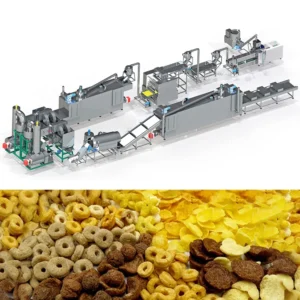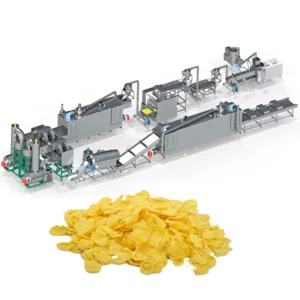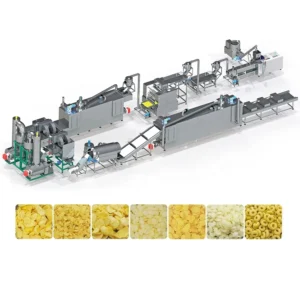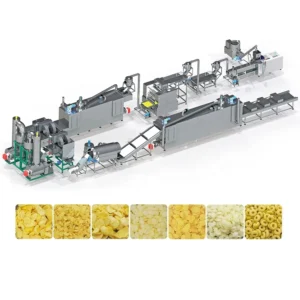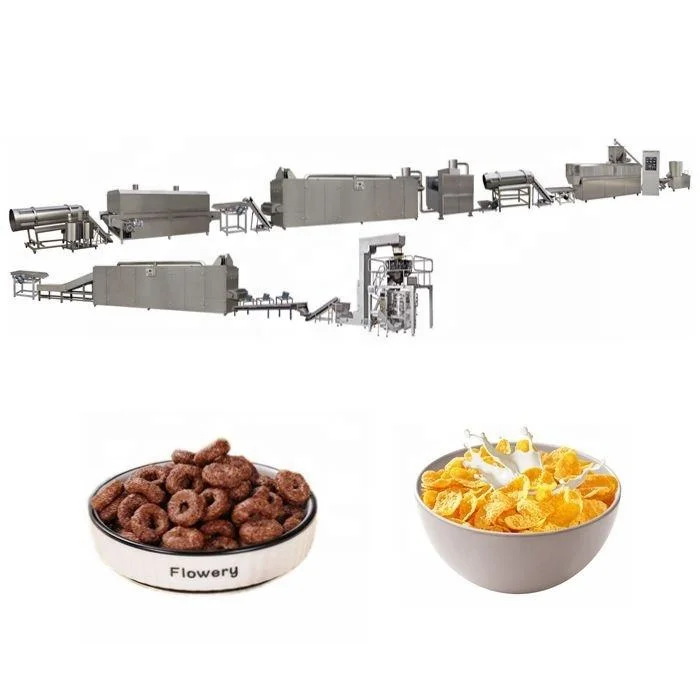
Throughput Matched End-to-End — every station from the twin-screw extruder through the flaking rollers to the roasting oven is sized against the same output baseline, eliminating the hidden bottlenecks that typically emerge when a corn flakes line is assembled from separate vendors.
Technical Specifications
| Parameter | Value |
|---|---|
| Product Type | Corn Flakes Breakfast Cereal Production Line |
| Available Models | MT70, MT85, MT75 |
| Screw Type | Twin-screw |
| Capacity Range | 100–500 kg/h (basis not stated in source — confirm raw material, moisture content and product format) |
| MT70 Installed Power | 160 kW |
| MT70 Power Consumption | 120 kW |
| MT70 Dimensions (L × W × H) | 41 × 1.5 × 2.2 m |
| MT85 Installed Power | 190 kW |
| MT85 Power Consumption | 140 kW |
| MT85 Dimensions (L × W × H) | 43 × 1.5 × 3.2 m |
| MT75 Installed Power | 210 kW |
| MT75 Power Consumption | 150 kW |
| MT75 Dimensions (L × W × H) | 45 × 1.5 × 3.5 m |
| Extruder Working Principle | Feeding, extruding, cutting, heating, gearing and controlling systems |
| Extruder Screw Feature | Wear-resistant technology with automatic lubricating and cooling |
| Dryer Heating Source | Gas or electric (selectable) |
| Flaking Machinery Control | PLC |
| Flaking Machinery Drive | Hydraulic system, double motors for separate roller driving |
| Flaking Temperature Sensing | Infrared sensor for even temperature pipe control |
| Hot Air Roasting Oven | Vibrating pan, conciliation burner combustion chamber, dual circulating fans, cyclone dust removal |
| Coating System | Double tumble sugar melter, elevator, coating drum, spraying nozzle |
| Control System | PLC |
| Layout | Customized to factory dimensions |
| Standards | CE, ISO |
Application Suitability
| Application | Material or Output |
|---|---|
| Natural corn flakes for breakfast cereal market | Corn grits or corn flour base |
| Sugar-coated corn flakes | Extruded corn flakes with sugar syrup glazing |
| Shaped breakfast cereals (rings, balls, stars, fruit loops) | Corn, rice, wheat, oat or barley powder blends |
| Extruded snack formats (tubes, sticks, wheels, flowers) | Grain-based raw material with adjustable die mould |
Why "Nominal Capacity" Can Wreck a Corn Flakes Line Before It Runs
Matching each station to the extruder’s real-world throughput — not its brochure number — is the single most important engineering decision in a corn flakes breakfast cereal machine full equipment range purchase.
When a buyer specifies a line based on catalogue capacity alone, the extruder may deliver its rated kilograms per hour while the dryer, flaking mill or roasting oven quietly falls behind. The result is product backing up at one station, sitting too long in the dryer, or entering the flaking rollers at the wrong temperature and moisture. I have walked into facilities where the extruder was working flat out and the downstream flaker was barely keeping up, producing cracked flakes that crumbled at the packing stage [NEED_CITE: typical bottleneck diagnosis in grain flaking lines]. The line technically runs, but the sellable yield drops sharply. That is why every component in this range is sized together before the quotation is issued, with the buyer’s actual raw material and target moisture profile defining the baseline.
How Each Station Connects to the Next
The corn flakes breakfast cereal machine full equipment range starts at the batching and mixing system, where raw grain powders are weighed and blended to a target moisture before entering the extruder. From there, the twin-screw extruder gelatinises the starch under controlled barrel temperature and shear, forcing the dough through a die that defines the initial pellet shape. The cut pellets then move to the flaking machinery, where the hydraulic double-roller system presses them to a uniform thickness — a step that directly determines whether the final flake holds together in the bowl or disintegrates.
Downstream, the dryer removes surface moisture to prevent sticking, the hot air roasting oven toasts the flakes to the required colour and crispness, and the coating system applies sugar syrup or other glazes. Each station’s belt speed, residence time and thermal capacity are calculated against the extruder’s confirmed output on the buyer’s raw material. If the MT75 is selected and the trial run confirms a given throughput on corn grits at a specific moisture, the dryer length, roasting oven volume and coating drum diameter are all proportioned to that figure — not to a generic chart [NEED_CITE: thermal sizing principles for grain drying and roasting equipment].
Reading Between the Spec Sheet Lines
The installed power and power consumption figures for each model tell a practical story. The MT70 draws 160 kW installed but consumes around 120 kW under normal operation, reflecting motor headroom for start-up load and momentary dough viscosity spikes. The MT75, with 210 kW installed and 150 kW consumption, suits larger-volume cereal plants where continuous three-shift operation is planned. Power consumption figures matter most when the buyer’s facility has a contracted transformer capacity; specifying an extruder whose running load exceeds the available supply leads to breaker trips during the heating ramp-up phase.
The screw design uses wear-resistant treatment and is paired with an automatic lubricating and cooling circuit. In twin-screw extrusion of starchy grain blends, the screws endure constant abrasive contact with corn and wheat particles. Automatic lubrication reduces unplanned stops for manual greasing, while the cooling loop prevents barrel overheating during prolonged runs — a factor that directly affects starch gelatinisation consistency from the first batch to the last.
Spec Choices That Shape the Final Flake
The hydraulic double-roller drive on the flaking machinery is a detail worth examining closely. Separate motors for each roller allow independent speed adjustment, which is critical when processing pellets of varying starch composition — corn behaves differently from oat or barley under compression. The infrared sensor monitoring roller surface temperature prevents the common problem of flakes sticking to a cold roller or scorching on an overheated one, both of which generate waste that operators often blame on the extruder when the real cause sits downstream.
The hot air roasting oven uses a conciliation burner with dual circulating fans and a cyclone dust removal device. The two fans create a cross-flow air pattern that toasts flakes evenly regardless of their position on the vibrating pan, while the cyclone captures fine particulate before it can settle back onto the product or escape into the workshop. For plants producing sugar-coated cereals, the double tumble sugar melter and spraying nozzle in the coating system deliver a consistent glaze thickness, avoiding the sticky clumps that form when syrup is applied by simpler gravity-feed methods [NEED_CITE: sugar coating uniformity requirements for breakfast cereal shelf life].
What Happens When Stations Are Mismatched
I once visited a plant that had purchased an extruder from one supplier and sourced the dryer and flaker separately to save on initial cost. The extruder pushed dough through at a rate the dryer could not handle; pellets arrived at the flaking rollers still too wet inside, and the resulting flakes cracked during roasting. The plant owner replaced the dryer, then discovered the roasting oven was now the constraint. Two rounds of equipment swaps and several months of sub-standard output later, the line cost far more than if every station had been specified together from the start [NEED_CITE: hidden costs of piecemeal line assembly in food processing]. These are the scenarios the corn flakes breakfast cereal machine full equipment range is designed to prevent.
Why Source the Entire Line From One Catalogue
Every station — mixing, extruding, flaking, drying, roasting, coating, cooling and packing — is available under a single specification, which means throughput calculations are cross-checked internally before the layout reaches the buyer. The screw configuration and die design are selected based on the buyer’s actual raw material and target flake thickness, not copied from a generic template. An in-house testing workshop allows trial runs on the customer’s grain blend before the line ships, so parameters are confirmed rather than guessed at commissioning. Twin-screw extrusion expertise extends across corn, rice, wheat, oat and barley applications, meaning the engineering team can advise on raw material adjustments rather than simply selling hardware. PLC control across the line ensures that recipe changes — switching from natural corn flakes to a sugar-coated variant, for example — are stored as repeatable programs rather than left to operator memory.
Documentation & Verification
- Line layout drawing scaled to your factory floor dimensions with utility connection points marked
- Machine specification sheet listing screw configuration and die selection matched to your grain blend
- Electrical schematic with voltage, frequency and PLC language confirmed before production begins
- Trial run report on your raw material documenting extruder parameters, flake thickness and moisture readings
- CE declaration of conformity and ISO certificate for customs and regulatory submission
- Operation and maintenance manual with wear parts list and replacement intervals
Installation, Commissioning & Support
- Foundation plan accounts for the MT75’s 45 m line length and vibrating pan load points
- Dedicated electrical circuit sized to the model’s installed power, up to 210 kW for the MT75
- Stations ship in modular sections for containerised transport and reassembly on site
- Commissioning includes first-run parameter tuning on your corn or barley blend through every station
- Operator training covers PLC recipe storage, hydraulic roller adjustment and roasting oven fan balance
- Wear parts list covers screws, dies and roller surfaces with lead times for reorder
Preparing Your Enquiry
To move from a catalogue review to a confirmed line configuration, the most useful starting points are your raw material type and its typical moisture content, your target daily output in kilograms, and the electrical supply available at your facility — including voltage, frequency and whether three-phase power is on site. If you are replacing an existing line or adding capacity alongside current equipment, noting the upstream and downstream machines already in place helps avoid interface conflicts. Buyers planning a corn flakes breakfast cereal machine full equipment range installation should also specify whether sugar coating is required, as this changes the downstream station configuration and the total line footprint.
Frequently Asked Questions
Q: How is each station’s capacity matched to the extruder model to prevent line bottlenecks?
A: Once the extruder model is selected and a trial run confirms throughput on your raw material, the dryer belt length, flaking roller width, roasting oven volume and coating drum diameter are all proportioned to that output figure. This cross-station sizing is completed before the quotation is issued, so no single station becomes a constraint during continuous production.
Q: What voltage, frequency and control language options are confirmed before building the line?
A: The electrical schematic is reviewed with the buyer before production starts. Voltage and frequency are set to match the facility’s supply, and the PLC interface language is chosen from available options. Confirming these details early avoids commissioning delays caused by transformer mismatches or operators unable to read the control screen.
Q: Can the layout be customised to my factory dimensions and utility connections?
A: Yes. The line layout is drawn to your factory floor plan, accounting for ceiling height, column positions, drainage points and electrical panel locations. Models like the MT70 at 41 m and the MT75 at 45 m in overall length require different footprint strategies, and the layout drawing reflects your specific building constraints.
Q: What supporting equipment is included and how is it sized?
A: The range covers mixing and batching systems, the twin-screw extruder, flaking machinery, dryer (gas or electric heated), hot air roasting oven, coating system with sugar melter, cooling conveyor and packing station. Each piece of supporting equipment is sized relative to the confirmed extruder output, not selected from a standalone catalogue.
Q: How do I choose between the MT70, MT85 and MT75 models for my production target?
A: The choice depends on your confirmed throughput requirement after a trial run on your raw material. The MT70 suits lower-volume or pilot-scale cereal production, the MT85 fits mid-range output, and the MT75 is specified for higher-capacity plants. Power consumption and factory footprint scale accordingly, so your available electrical supply and floor space also inform the selection.