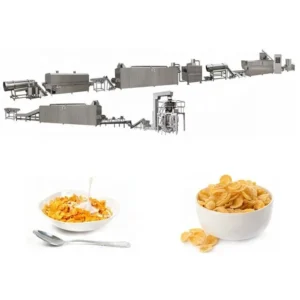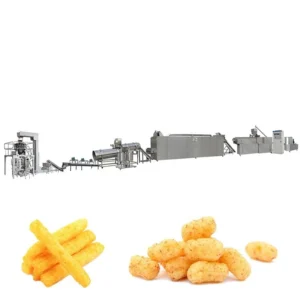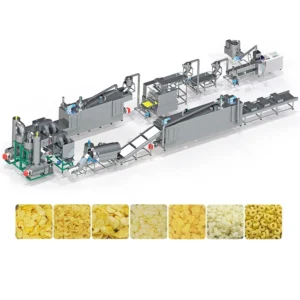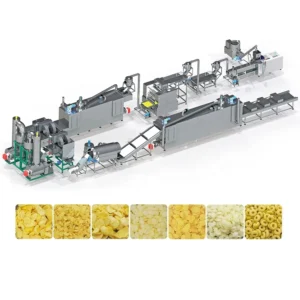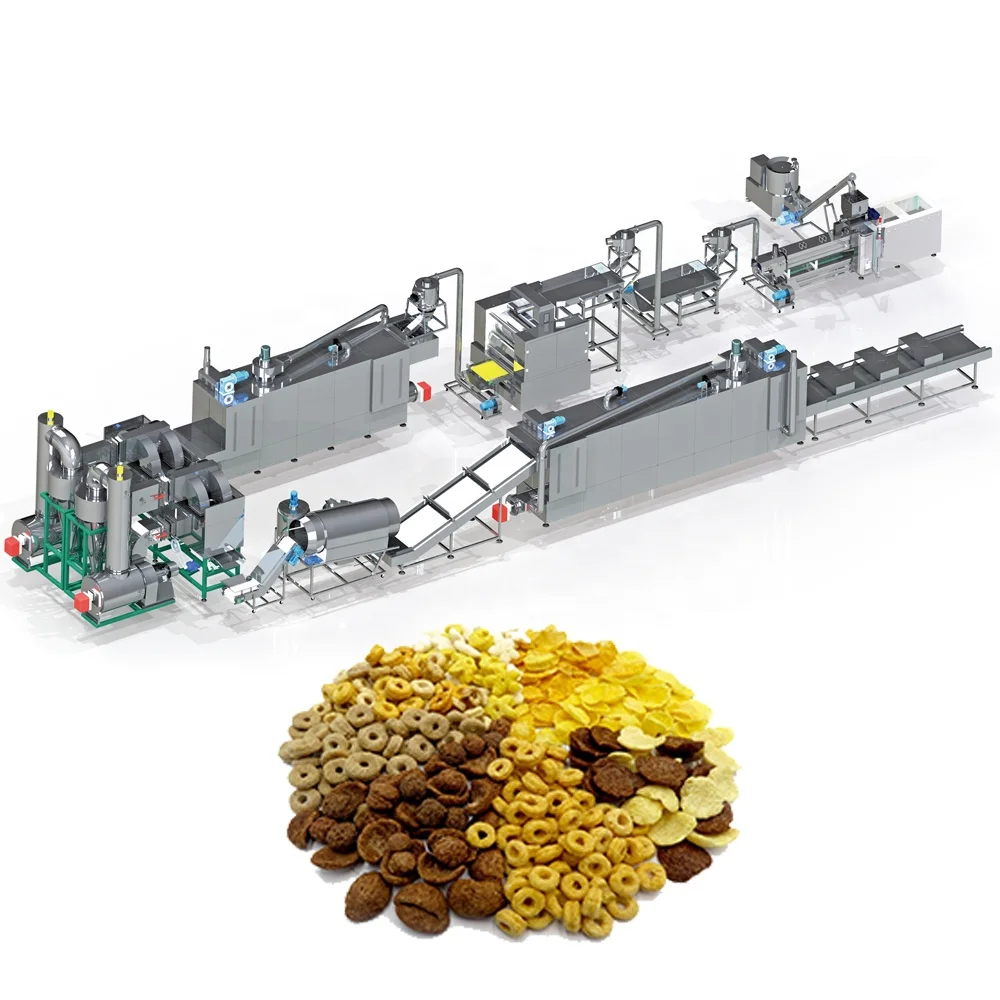
Screw and die configuration matched to your grain blend — our MT-65 twin-screw extruder arrives with sectional modules selected after trial runs on your actual corn, rice, or oat flour, not a generic catalog build.
Technical Specifications
| Parameter | Value |
|---|---|
| Product Type | Twin Screw Extruder Breakfast Cereal Production Line |
| Model | MT-65 |
| Screw Type | Double (twin) screw, co-rotating, sectional modules |
| Extruder Functions | Forward/backward transport, mixing, de-gassing, cooking, forming |
| Mixer Tank Size | φ600 × 500 mm |
| Mixer Power | 4 kW |
| Mixer Output | 10-30 kg/load |
| Screw Conveyor Power | 0.75 kW |
| Flaking Press Power | 16.12 kW |
| Flaking Press Roller Size | 510 × 310 × 1050 mm |
| High-temperature Oven Heating | Gas, both-side baking system |
| High-temperature Oven Power | 3.75 kW |
| Sugar Spraying System Power | 28.75 kW |
| Sugar Spraying System Roller | Ø600 × 2700 mm |
| Control System | Separate controller box (basis not stated in source) |
| Output Capacity | (basis to be confirmed on raw material and target product) |
| Voltage & Frequency | Customizable (e.g., 3ph 380V 50Hz, 415V 60Hz, 220V 60Hz) |
| Certification | CE |
Application Suitability
| Application | Material or Output |
|---|---|
| Traditional corn flakes | Corn flour, corn grits, maize blends |
| Multi-grain cereal rings and stars | Rice flour, oat flour, wheat blends with vitamin fortification |
| Direct-consumption coated snacks | Puffed pellets with sugar syrup or honey glaze |
| High-fiber breakfast cereals | Whole grain powders and bran-enriched mixtures |
Why Matching Dryer Length to Extruder Output Matters Before You Sign
A breakfast cereal processing machine complete equipment range only performs when every station is sized for the same actual throughput, not just the extruder nameplate.
Many buyers focus on the twin-screw extruder capacity and overlook whether the downstream dryer and oven can handle the continuous moisture load. If the high-temperature oven cannot remove enough water from the flaked bed, the corn flakes arrive at the coating drum still damp. The sugar syrup then slides off instead of adhering, and the final packaging contains a product that stales within days. I have reviewed lines where the extruder ran fine but the dryer bottleneck cut real output in half, leaving the buyer with an expensive bottleneck they could not fix without replacing entire stations [NEED_CITE: throughput matching between extrusion and drying stations].
How the MT-65 Barrel Profile Handles Grain Variability
The MT-65 uses co-rotating sectional screw modules that allow us to rearrange the conveying, kneading, and de-gassing elements inside the barrel. When your corn flour has a coarser grind, we extend the mixing zone so starch gelatinisation completes before the material reaches the die. This is the core engineering decision that defines our breakfast cereal processing machine complete equipment range approach. A fixed screw build would force you to change your raw material supplier instead of letting the machine adapt to what is locally available.
Flaking Press and Oven Integration for Uniform Texture
The flaking press features a 510 × 310 × 1050 mm roller with an integrated cooling system and adjustable roller distance. Flake thickness directly determines how the high-temperature gas oven bakes the product. Thicker flakes need longer residence time and higher gas input on both baking sides; thinner flakes burn at the edges if the oven profile is not adjusted. The press and oven must be commissioned together, reading flake density at the oven exit and feeding that data back to the roller gap setting [NEED_CITE: relationship between flake thickness and oven residence time].
Reading the Specs That Actually Determine Line Performance
The 4 kW mixer with a φ600 × 500 mm tank delivers 10-30 kg per load, which sets the batch rhythm for the entire line. If your target output requires shorter batch intervals, the mixer becomes the constraint long before the extruder does. The 16.12 kW flaking press motor must generate enough pressure to flatten the extruded pellets without cracking them, and the stainless steel construction prevents contamination during food contact. The sugar spraying system draws 28.75 kW across its melting tank, temperature-keeping roller, and conveyor, which is a substantial utility load that your facility electrical plan must accommodate. Voltage customization across 380V, 415V, and 220V three-phase options means we confirm your site supply before production starts, avoiding a situation where the control panel transformers are wrong for the local grid [NEED_CITE: industrial voltage and frequency standards by region].
The Hidden Cost of Skipping a Raw Material Trial
When a buyer orders a cereal line based on a catalog capacity figure and skips the raw material trial, the first production run often reveals that the local corn flour has a different fat content or particle size distribution than what was assumed. The extruder then produces pellets that either expand too much and shatter in the flaking press, or do not expand enough and come out as hard beads. Correcting this after installation means flying in an engineer, waiting for replacement screw modules, and losing weeks of production time while the line sits idle [NEED_CITE: impact of raw material variability on extrusion output].
Why Source the Full Line From One Equipment Supplier
We design the breakfast cereal processing machine complete equipment range so that the mixer batch cycle, extruder screw speed, dryer belt speed, and coating drum rotation are all calculated against the same target throughput. Our in-house testing workshop runs your actual corn flour or oat blend through the MT-65 before shipment, generating a trial run report that documents the screw configuration, barrel temperature profile, and resulting flake density. We provide the electrical schematic with your confirmed voltage and frequency, the CE declaration of conformity for European import, and the screw and die configuration record so you can reorder wear parts accurately. The entire line ships with factory-assembled stations, reducing on-site mechanical work.
Documentation & Verification
- Line layout drawing with every station dimension and utility connection point
- Screw and die configuration record matched to your grain type and target flake size
- Trial run report from our testing workshop on your supplied raw material
- Electrical schematic confirming voltage, frequency, and control language before production
- CE declaration of conformity for import clearance in regulated markets
- Operation and maintenance manual covering each station from mixer to cooling conveyor
Installation, Commissioning & Support
- Foundation plan accounting for the 4500 × 1400 × 1800 mm oven footprint and gas supply routing
- Dedicated circuit sizing for the 28.75 kW sugar spraying system and 16.12 kW flaking press
- Factory-assembled stations arrive ready for utility hookup, minimizing on-site welding
- Commissioning includes barrel temperature profiling and roller gap calibration on your material
- Operator training covers screw module replacement and die changeover for shape switching
- Wear parts list specifies screw sections, die inserts, and press roller bearings for first reorder
What We Need to Configure Your Line
To specify the right breakfast cereal processing machine complete equipment range for your facility, share your primary grain material and its particle size, your target hourly output in kilograms, and your available workshop floor area with ceiling height. We also need your local three-phase voltage and frequency, the preferred control panel language, and whether you plan to run sugar-coated snack variants on the same line. If you can send a sample of your corn flour or oat blend, we will run it through the MT-65 in our testing workshop and include the results with our proposal.
Frequently Asked Questions
Q: What equipment stations are included in the full breakfast cereal line and what does each one do?
A: The line includes a flour mixer for batch blending, a screw elevator for material transfer, the MT-65 twin-screw extruder for cooking and forming, a dryer for moisture reduction, a flaking press for flattening pellets into flakes, a high-temperature gas oven for baking, a sugar spraying system for coating, and a cooling conveyor for stabilization before packing. Each station is sized to match the others.
Q: How do I match mixer batch size, extruder output and dryer capacity to avoid bottlenecks?
A: The mixer delivers 10-30 kg per load, which sets the upstream rhythm. The extruder must consume those batches at a rate the downstream dryer and oven can sustain. We calculate the line layout based on your target product moisture at each stage, so no single station forces the others to idle or overflow.
Q: Can the same line produce corn flakes and other shapes like rings, balls, or stars?
A: Yes. The MT-65 extruder forms product through interchangeable die plates at the barrel end. By swapping the die and adjusting the screw configuration, the same barrel produces rings, balls, stars, or sticks. The flaking press is bypassed for non-flake shapes, and the oven profile is adjusted accordingly.
Q: What voltage and frequency options are available for different export markets?
A: The line is configurable for three-phase supplies including 380V 50Hz, 380V 60Hz, 415V 60Hz, and 220V 60Hz. We confirm your site electrical specification before production so that motors, heaters, and the separate controller box are all wound and rated for your local grid.
Q: How is packaging handled for container loading and fumigation-required destinations?
A: Stations are packed in wooden boxes that are fumigated for European and other regulated import markets. For tight container loading where weight and volume are constrained, PE film wrapping is available as an alternative. Packaging photographs are provided before the container is sealed.