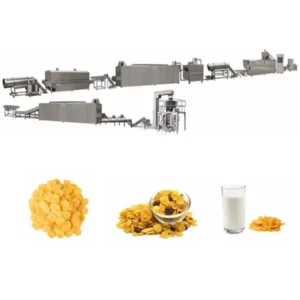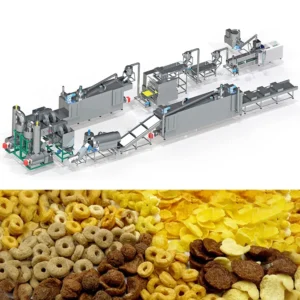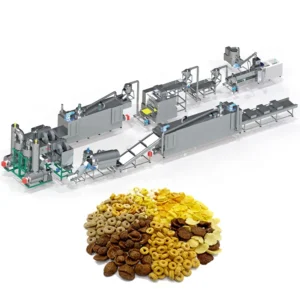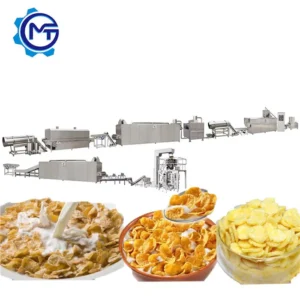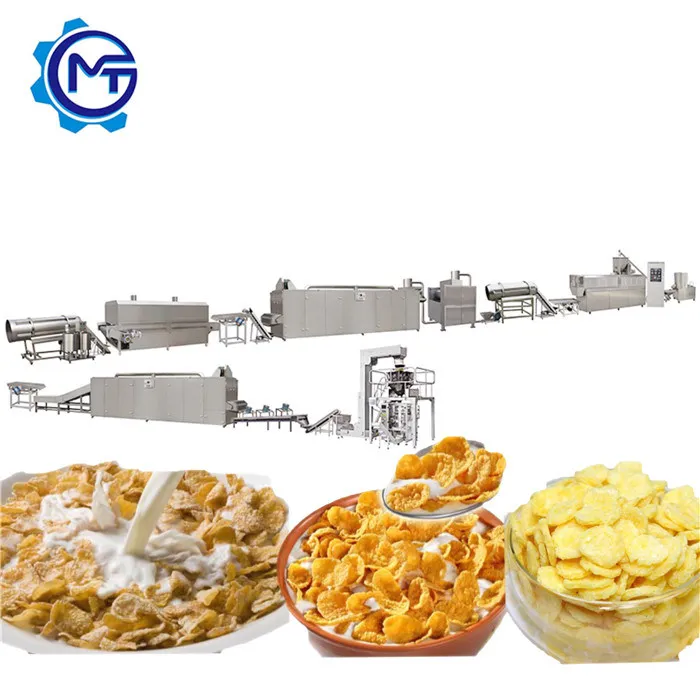
Integrated Line Matching — Every station from mixer to packer is specified to the same throughput target, so no single machine holds back the rest of the corn flakes production line.
Technical Specifications
| Parameter | Value |
|---|---|
| Product Type | Corn Flakes Production Line |
| Models Available | MT70, MT75, MT85 |
| Extruder Type | Twin Screw |
| MT70 Installed Power | 160 kW |
| MT70 Power Consumption | 120 kW |
| MT70 Output Capacity | 150–200 kg/h (basis not stated in source — confirm raw material and moisture content) |
| MT70 Overall Dimensions | 41 × 1.5 × 2.2 m |
| MT75 Installed Power | 210 kW |
| MT75 Power Consumption | 150 kW |
| MT75 Output Capacity | 300–500 kg/h (basis not stated in source — confirm raw material and moisture content) |
| MT75 Overall Dimensions | 45 × 1.5 × 3.5 m |
| MT85 Installed Power | 190 kW |
| MT85 Power Consumption | 140 kW |
| MT85 Output Capacity | 300–400 kg/h (basis not stated in source — confirm raw material and moisture content) |
| MT85 Overall Dimensions | 43 × 1.5 × 3.2 m |
| Flaking Machine Control | PLC with hydraulic double rollers, infrared temperature sensing |
| Dryer Heating Source | Gas or Electric (configurable) |
| Roasting Oven | Hot air with vibrating pan, dual circulating fans, cyclone dust removal |
| Coating System | Double tumble sugar melter, elevator, coating drum, spraying nozzle |
| Control System | PLC |
| Key Features | Automatic screw lubrication and cooling, separate roller motors on flaker, die-changing for multiple shapes |
| Standards | CE, ISO |
Application Suitability
| Application | Material or Output |
|---|---|
| Natural corn flakes production | Corn grits and corn flour |
| Sugar-coated breakfast cereal | Corn, rice, wheat, oat, barley powder bases with sugar or syrup coating |
| Multi-shape puffed cereal | Same grain bases, formed via die changes into balls, tubes, rings, stars, wheels, and other profiles |
| Fortified breakfast cereal lines | Grain blends with added vitamin and mineral premix |
| Existing line station replacement | Individual flakers, roasters, or coating drums integrated into running cereal lines |
Why a Corn Flakes Machine Needs Every Station Sized Right
A mismatched dryer or coating drum quietly caps the output of an otherwise capable extruder.
When buyers focus only on extruder capacity, the downstream stations often cannot keep up. A flaker that cannot handle the throughput creates a pile-up of hot, sticky extrudate. A roaster with insufficient belt area leaves flakes under-toasted or forces the line to slow down. I have walked into plants where the extruder was rated well above what the coating drum could actually process, and the operator was simply running the whole corn flakes machine full equipment range at half speed without realizing it [NEED_CITE: throughput balancing principles in cereal processing lines]. The result is a line that never reaches the output the buyer paid for.
How the Stations Connect Across the Full Range
A breakfast cereal processing line built around this equipment starts with a batching and mixing station where grain powders, water, and any fortification premix are blended to a target moisture. The mix feeds into the twin-screw extruder, where screw configuration and barrel temperature profile gelatinise the starch and form a continuous dough. The extrudate is cut and transferred to the flaking machine, where hydraulic double rollers press it into thin flakes under PLC-regulated pressure and infrared-monitored temperature.
From the flaker, the product moves through a dryer to reduce moisture before entering the hot air roasting oven. The roaster uses a vibrating pan and dual circulating fans to move flakes evenly through the heating zone, while the cyclone dust removal device captures fines. If sugar coating is required, the product passes through the double tumble sugar melter and into the coating drum, where spraying nozzles apply syrup as the flakes tumble. A final cooling station brings the product to packing temperature. Every one of these stations appears in the corn flakes machine full equipment range so buyers can see the complete process flow before committing to a layout.
Where Capacity Mismatches Hide in Cereal Lines
The most common bottleneck I see in breakfast cereal projects is not the extruder — it is the dryer and roaster. Extrusion happens fast, but moisture removal takes time, and if the dryer belt is too short or the roaster pan too small, flakes leave the oven still soft [NEED_CITE: moisture reduction targets for shelf-stable corn flakes]. The operator then slows the extruder feed to compensate, and the line never reaches its nameplate output.
Another frequent issue is coating capacity. A sugar-coated cereal requires the flakes to spend enough time in the drum for even coverage, and if the drum is undersized relative to the upstream throughput, the coating becomes patchy. When specifying a breakfast cereal processing line, it is worth confirming that the flaker roller width, dryer belt area, and coating drum volume are all calculated against the same hourly throughput figure, not just the extruder’s rated capacity.
Reading the Spec Sheet for Real-World Conditions
The twin-screw design matters here because corn-based doughs are viscous and demand high torque at relatively low screw speeds. The automatic lubrication and cooling function on the screw assembly helps maintain consistent barrel temperature during long production runs, which directly affects starch gelatinisation and, ultimately, flake texture. Single-screw extruders can struggle with the same formulations, especially when oat or barley is blended in, because these grains alter the dough’s friction characteristics.
The flaking machine’s hydraulic double rollers with separate motor drives allow each roller to be adjusted independently, which is important when targeting a specific flake thickness. Infrared temperature sensing on the roller surface prevents overheating that can cause the dough to stick rather than press cleanly. On the roasting oven, the conciliation burner and two separate circulating fans create a cross-flow air pattern that toasts flakes more uniformly than single-fan designs [NEED_CITE: hot air circulation patterns in industrial cereal roasters].
What Happens When Downstream Equipment Is Underspecified
Skipping the line-level capacity calculation is the fastest way to end up with a bottleneck. An extruder producing at full output feeds a flaker that cannot press flakes quickly enough, so semi-processed dough accumulates, cools, and becomes waste. A roaster that cannot keep up means partially dried flakes go to packing, where they stale faster and trigger quality complaints [NEED_CITE: moisture and shelf life correlation in breakfast cereals].
I once worked with a producer who replaced only the extruder on an existing line without upgrading the coating drum. The new extruder pushed more throughput than the drum could handle, and the sugar coating came out uneven — some flakes were bare, others clumped together. The fix was not a bigger extruder but a correctly matched coating station. That is why surveying the full equipment range before specifying any single machine prevents expensive rework later.
Why Sourcing the Full Range from One Supplier Matters
When every station in a corn flakes machine full equipment range comes from the same engineering team, throughput figures are calculated once and applied consistently. There is no gap where one vendor’s extruder output exceeds another vendor’s dryer capacity, because the same layout drawing governs both. The screw configuration and die design are specified to the buyer’s exact raw material blend and target flake shape, not copied from a generic template.
An in-house testing workshop allows trial runs on the buyer’s actual corn, rice, or oat formulation before the line ships. This means flake thickness, roasting colour, and coating coverage are confirmed in advance, not discovered during on-site commissioning. PLC control across stations means the entire breakfast cereal processing line speaks one control language, simplifying operator training and troubleshooting. Electrical schematics and voltage are confirmed for the destination market before production begins, avoiding delays at the installation stage.
Documentation & Verification
- Line layout drawing with station-by-station throughput matching for your target output
- Machine specification sheet covering every station from mixer to packing conveyor
- Screw and die configuration record matched to your grain blend and flake shape
- Electrical schematic with voltage and frequency confirmed for your facility
- Factory trial run report on your raw material showing flake density and coating result
- CE declaration of conformity and ISO certificate for the complete line
Installation, Commissioning & Support
- Foundation plan accounts for the 45 m line length and vibration loads from the roaster vibrating pan
- Dedicated electrical circuit sized for the MT75’s 210 kW installed power and PLC control cabinet
- Equipment ships in modular sections for assembly inside existing factory doorways
- Commissioning includes first-run parameter setting on your corn or oat formulation
- Operator training covers die changes, roller gap adjustment, and PLC fault diagnostics
- Wear parts list identifies screw segments, roller surfaces, and spraying nozzles with reorder codes
- Scheduled maintenance intervals provided for hydraulic system and automatic screw lubrication
What to Prepare Before Requesting a Quote
To configure a breakfast cereal processing line that matches your actual production environment, share your primary grain materials and any blend ratios, your target hourly output, and whether the end product is natural, sugar-coated, or both. Include your factory floor dimensions and ceiling height so the layout can be drawn to scale. Confirm your local voltage and frequency, the control language your operators prefer, and whether any upstream silos or downstream packing machines need to be integrated into the new line.
Frequently Asked Questions
Q: What equipment stations are included in a complete corn flakes production line?
A: The full range covers batching and mixing, twin-screw extrusion, cutting, flaking with hydraulic rollers, drying, hot air roasting, sugar coating with tumble melter and spray drum, cooling, and packing. Each station is specified so throughput matches across the entire breakfast cereal processing line, preventing bottlenecks at any single stage.
Q: How is throughput matched between the extruder, flaker, and roaster?
A: Throughput matching starts with the target output based on your raw material and moisture content. The flaker roller width, dryer belt area, and roaster pan volume are all calculated against that same figure. If the extruder model changes, downstream stations are re-evaluated to ensure no single machine limits the corn flakes machine full equipment range.
Q: Can the dryer and roaster run on gas or electric heating?
A: Both gas and electric heating sources are available for the dryer and roasting oven. The choice typically depends on local utility costs and facility infrastructure. Gas heating is often specified where natural gas is readily available and cheaper, while electric heating suits facilities without gas lines or with strict emission requirements.
Q: Is it possible to order individual machines to upgrade an existing cereal line?
A: Yes. Individual stations such as the flaking machine, roasting oven, or coating drum can be supplied separately and integrated into a running breakfast cereal processing line. Specifications are reviewed against your existing upstream and downstream equipment to ensure the new station matches current throughput and control systems.
Q: What product shapes can be produced beyond standard corn flakes?
A: By changing the extruder die and adjusting downstream settings, the line can produce balls, tubes, sticks, rings, fruit loops, stars, wheels, and flower shapes. Each shape requires a specific die configuration and may affect throughput, which is confirmed during the pre-shipment trial run on your raw material.