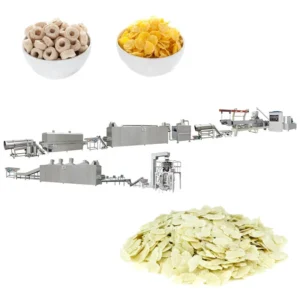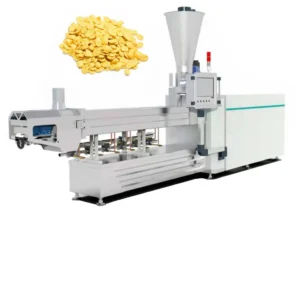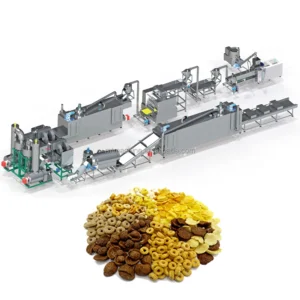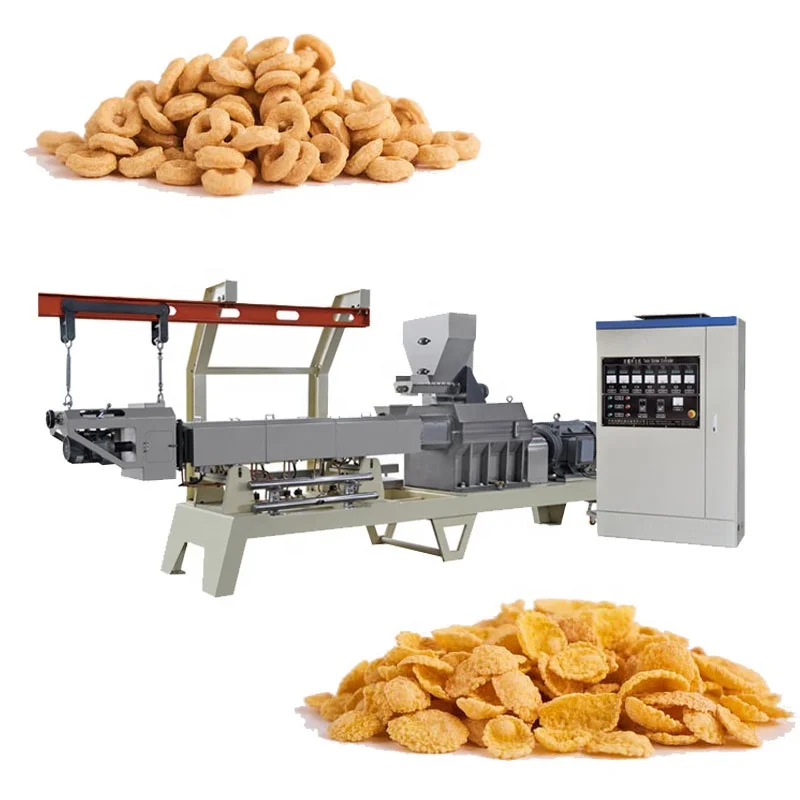
Integrated throughput matching — Every station from the batching mixer to the packing machine is sized against the extruder’s actual output rather than quoted as independent nominal capacities.
Technical Specifications
| Parameter | Value |
|---|---|
| Model | MT-65 |
| Product Type | Corn Flakes Production Line |
| Installed Power | 84 kW |
| Real Power Consumption | 59 kW |
| Output Capacity | 120–150 kg/h (basis not stated in source — confirm raw material formulation and moisture content) |
| Overall Dimensions (L×W×H) | 21,000 × 1,200 × 2,200 mm |
| Screw Type | Twin-screw, co-rotating, sectional modules |
| Control System | PLC and MCC control |
| Corn Flakes Press Machine Power | 16.12 kW |
| Corn Flakes Press Machine Dimensions | 1,550 × 1,300 × 2,000 mm |
| Corn Flakes Press Machine Roller Size | 510 × 310 × 1,050 mm |
| High-Temperature Oven Dimensions | 4,500 × 1,400 × 1,800 mm |
| High-Temperature Oven Power | 3.75 kW |
| High-Temperature Oven Heating | Gas-fired, both-side baking system |
| Certifications | CE, ISO |
Application Suitability
| Application | Material or Output |
|---|---|
| Traditional corn flakes from maize grits | Corn grits or corn flour, toasted and pressed |
| Multi-grain breakfast cereals | Rice, wheat, oat, millet, barley in powder or grits form |
| Fortified breakfast cereal lines | Grain blends with added vitamin and mineral premix |
| Nutritional convenient food production | Composite grain formulations requiring controlled gelatinisation |
What "120–150 kg/h" Leaves Out About Corn Flakes Line Capacity
Throughput only holds when every downstream station — dryer, press, oven, cooler — is matched to the extruder’s real output on your specific grain formulation.
A corn flakes making machine full equipment range quoted at a single number rarely tells you what happens when local maize has lower starch content than the test grain, or when ambient humidity pushes drying times beyond the dryer’s belt speed. I once spent three days in a Nigerian workshop re-tuning screw pitch and barrel zones because the corn flour on hand gelatinised at a different rate than the supplier’s reference material. The extruder ran fine; the flakes coming off the press were too dense for the oven to crisp evenly. That kind of bottleneck only shows up when you run the buyer’s actual grain through the complete sequence before the crate is nailed shut [NEED_CITE: raw material variability in extrusion processing].
Station Sequence and Throughput Balancing Across the Line
The MT-65 line moves material through nine discrete stations: mixer, screw conveyor, twin-screw extruder, air conveyor, dryer, hoister, flavouring drum with oil sprayer, cooling machine, and packing machine. Each station is specified so that its throughput ceiling sits above the extruder’s real output, preventing the kind of backlog that forces operators to slow the screw speed and compromise cook quality.
Because the entire corn flakes making machine full equipment range ships from one supplier, the conveyor transfer heights, dryer belt width, and flavouring drum volume are all calculated against the same capacity baseline. There is no guesswork about whether the hoister can keep up with the dryer discharge or whether the cooling machine has enough residence time before packing.
Extruder Screw Configuration and Barrel Zone Control
The twin-screw extruder uses co-rotating sectional screw modules that can be rearranged to adjust the balance between transport, mixing, de-gassing, cooking, and forming. Barrel sections carry independent heating and cooling circuits, so the temperature profile can be tuned zone by zone to match the gelatinisation window of the grain being processed [NEED_CITE: twin-screw extrusion barrel temperature profiling for cereal grains].
For corn grits, a longer cooking zone with moderate shear typically gives the flake enough plasticity to press without cracking. Switching to an oat-heavy formulation usually means shortening the high-shear section and extending the de-gassing zone to manage the higher lipid content. These adjustments are recorded in the screw and die configuration document supplied with each line.
Reading the Power, Press, and Oven Specs
The gap between installed power (84 kW) and real power consumption (59 kW) reflects the fact that heaters, drive motors, and the press roller motor do not all draw peak current simultaneously. For electrical planning, the real power figure gives a more reliable basis for sizing transformers and switchgear at the installation site.
The corn flakes press machine carries a 16.12 kW drive and features an adjustable roller gap, letting operators set flake thickness between runs without changing hardware. Its integrated cooling system keeps roller temperature stable during long shifts, which matters because thermal expansion of the rollers changes the effective gap and therefore flake density.
The gas-fired high-temperature oven uses a both-side baking system across a 4.5-metre chamber. Both-side heat delivery reduces the moisture gradient through the flake bed, giving more uniform crispness than single-side radiant ovens where flakes at the centre of the belt dry slower than those at the edges.
When Mismatched Stations Become Expensive
Sourcing the extruder from one vendor and the dryer or oven from another often produces a line where the weakest link dictates actual output. Operators end up running the extruder below its comfortable range because the dryer cannot remove moisture fast enough, or the oven cannot toast evenly at full belt speed. The result is lower yield, higher energy cost per kilogram, and flake quality that drifts through the shift [NEED_CITE: throughput imbalance in multi-vendor food processing lines].
Choosing the wrong press roller gap or skipping the roller cooling circuit leads to flakes that vary in thickness mid-run, which the oven then toasts unevenly. Buyers who discover these mismatches after installation face weeks of re-commissioning that could have been avoided with a single-supplier line validated on the actual raw material.
Why Source This Line from a Single Equipment Supplier
The complete station sequence is engineered under one roof, so throughput calculations are internally consistent rather than stitched from separate vendor data sheets. Screw configuration and die design are specified to the buyer’s raw material, not copied from a generic build.
An in-house testing workshop allows trial runs on the customer’s actual grain before the line is dismantled for shipping. Voltage, frequency, and control language are confirmed against the destination market before production begins, not discovered during commissioning. PLC and MCC control panels are wired and labelled to match the agreed electrical schematic, reducing on-site wiring disputes.
Documentation & Verification
- Line layout drawing showing station spacing and throughput match across mixer, extruder, press, and oven
- Screw and die configuration record tied to the buyer’s grain type and target flake density
- Trial run report from in-house testing workshop using customer-supplied raw material
- Electrical schematic with confirmed voltage, frequency, and control language for the target market
- CE declaration of conformity and ISO certificate for customs and regulatory clearance
- Operation and maintenance manual with wear parts list for screws, dies, and press rollers
Installation, Commissioning & Support
- Foundation plan accounts for the 21-metre line length and press machine vibration isolation
- Dedicated circuit sized for 59 kW real draw with headroom for the 16.12 kW press motor start-up surge
- Line ships in modular station units; on-site assembly aligns conveyor transfer points to the approved layout
- First-run commissioning includes barrel zone temperature mapping on the buyer’s grain formulation
- Operator training covers screw module swaps, press roller gap adjustment, and PLC fault diagnostics
- Wear parts list identifies screws, dies, and press roller sleeves with reorder intervals based on grain abrasiveness
Preparing Your Inquiry
To configure a corn flakes making machine full equipment range that holds its rated output on your grain, share the raw material type and form (grits or flour), typical moisture content, target flake thickness, and daily production volume. Include workshop dimensions, available voltage and frequency, preferred control language, and whether an in-house trial run on your material is required before shipment.
Frequently Asked Questions
Q: What supporting equipment sits between the extruder and the packing station, and how is throughput balanced?
A: After the twin-screw extruder, material passes through an air conveyor, dryer, hoister, flavouring drum with oil sprayer, and cooling machine before packing. Each station’s belt speed, volume, and residence time are calculated against the extruder’s confirmed output so that no single station throttles the line. Throughput balance is documented in the line layout drawing provided with the quotation.
Q: Can the line process different grains, and does it require flour or grits?
A: The MT-65 accepts corn, rice, wheat, oat, millet, and barley in either powder or grits form. Screw module arrangement and barrel temperature profile are adjusted to suit the starch and lipid characteristics of each grain. The buyer specifies the target formulation during the inquiry stage, and a trial run on the actual material confirms the configuration before shipment.
Q: What is the difference between installed power and real power consumption?
A: Installed power (84 kW) is the sum of all motor and heater nameplate ratings. Real power (59 kW) reflects simultaneous operating load, since not every component draws peak current at the same time. Electrical infrastructure — transformers, switchgear, cabling — should be planned around the real power figure with an appropriate safety margin.
Q: How are voltage, frequency, and control language confirmed before production?
A: During the specification confirmation stage, the buyer provides the destination market’s electrical standards and preferred HMI language. The electrical schematic is then drawn to match, and the PLC programme is loaded with the agreed language before factory testing. This prevents re-wiring and software changes during on-site commissioning.
Q: What documentation is provided for customs clearance and on-site commissioning?
A: The documentation package includes the CE declaration of conformity, ISO certificate, electrical schematic, machine specification sheet, trial run report, operation and maintenance manual, wear parts list, and packing photographs. Together these cover customs entry requirements and give the installation team the technical references needed for first-run commissioning.