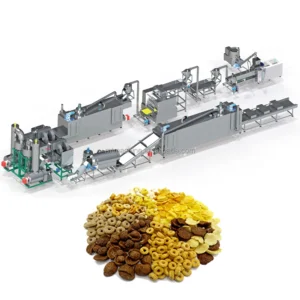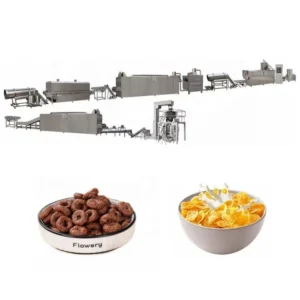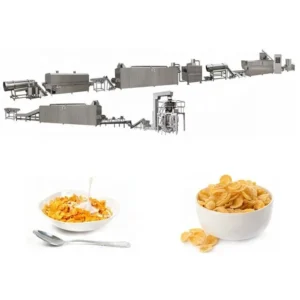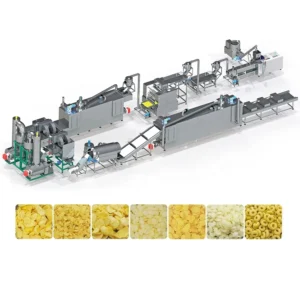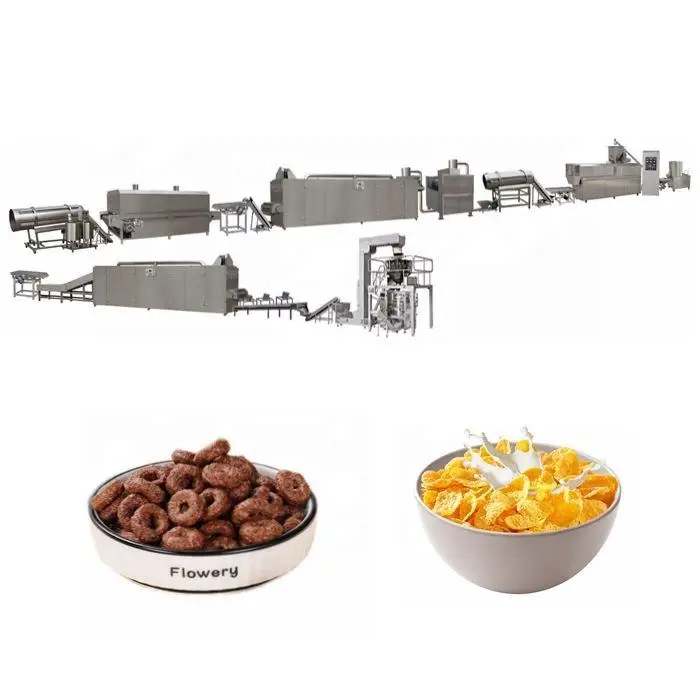
Twin-Screw Extrusion Expertise Across Applications — our MT70, MT85, and MT75 extruder range covers breakfast cereal processing from corn, rice, wheat, oat, and barley with screw configurations matched to your specific raw material behavior.
Technical Specifications
| Parameter | Value |
|---|---|
| Model | MT70 / MT85 / MT75 |
| Product Type | Corn Flakes Production Line |
| Screw Type | Twin-screw |
| Installed Power | MT70 — 160 kW; MT85 — 190 kW; MT75 — 210 kW |
| Power Consumption | MT70 — 120 kW; MT85 — 140 kW; MT75 — 150 kW |
| Output Capacity | MT70 — 150–200 kg/h (basis to be confirmed); MT85 — 300–400 kg/h (basis to be confirmed); MT75 — 300–500 kg/h (basis to be confirmed) |
| Overall Dimensions (L×W×H) | MT70 — 41 × 1.5 × 2.2 m; MT85 — 43 × 1.5 × 3.2 m; MT75 — 45 × 1.5 × 3.5 m |
| Control System | PLC control (flaking machinery); MCC and PLC available for line |
| Extruder Working Principle | Feeding system, extruding system, cutting system, heating system, gearing system, controlling system |
| Screw Feature | Wear-resistant manufacturing technology; automatic lubricating and cooling function |
| Flaking Machinery Drive | Double motors for separate roller driving; hydraulic system for double rollers |
| Flaking Machinery Temperature Control | Infrared sensor for even temperature pipe control |
| Dryer Heating Source | Gas or Electric |
| Roasting Oven | Hot air roasting with vibrating pan, high-temperature spraying tubes, conciliation burner, two separate circulating fans, cyclone dust removal device |
| Coating System | Double tumble for sugar melting, elevator, coating drum, spraying nozzle |
| Line Stations | Mixing → Extruding → Flaking → Drying → Hot Air Roasting → Cooling → Packing (Natural); additional Sugar Spraying → Sugar Coating → Drying (Coated) |
| Raw Materials | Corn, rice, wheat, oat, barley powder |
| Final Product Shapes | Natural corn flakes, sugar-coated corn flakes; ball, tube, stick, ring, fruit loop, star, wheel, flower, heart (by adjusting extruder mould) |
| Assembly State | Complete production line |
| Standards | CE; ISO |
Application Suitability
| Application | Material or Output |
|---|---|
| Natural corn flakes for breakfast cereal market | Corn grits or corn flour |
| Sugar-coated corn flakes for retail packaging | Corn base with sugar glaze coating |
| Multi-grain extruded cereal shapes | Rice, wheat, oat, barley powder blends |
| Alternative breakfast cereal formats | Ball, tube, ring, fruit loop, star shapes from grain powders |
| Fortified breakfast cereal production | Grain powder blended with nutritional additives |
Why an Extruder Quoted Alone Will Bottleneck Your Flakes Line
A corn flakes production line full equipment range must be throughput-matched at every station, or the slowest machine dictates your actual output.
When buyers focus only on extruder capacity and treat downstream equipment as an afterthought, the flaking rollers cannot keep pace, the dryer becomes a chokepoint, or the coating drum leaves product waiting in holding bins. I have walked into workshops where a perfectly capable twin-screw extruder sat idle for hours each shift because the roasting oven could not circulate hot air fast enough to match upstream volume. Specifying a corn flakes production line full equipment range as a coordinated system prevents this mismatch from the start [NEED_CITE: throughput balancing principles in continuous food processing lines].
Every Station Mapped From Raw Material Intake to Final Packing
This corn flakes production line full equipment range sequences seven core stations for natural flakes — mixing, extruding, flaking, drying, hot air roasting, cooling, and packing — with three additional stations for sugar-coated variants. Each station connects to the next through conveying systems sized to carry the extruder’s output without accumulation or starvation. The sequence is fixed by proce*indow before roasting, and roasting must achieve surface blistering before cooling locks in the crisp texture.
How the Flaking and Roasting Stations Protect Flake Quality
The flaking machinery uses double motors driving each roller independently, with a hydraulic system controlling roller gap pressure. An infrared sensor monitors pipe temperature to maintain consistent dough plasticity entering the rollers, which is critical because cold dough cracks and overheated dough sticks. Downstream, the hot air roasting oven employs a vibrating pan with conciliation burner and two separate circulating fans to move heated air across the flake bed uniformly. The cyclone dust removal device pulls fines out of the air stream, preventing burnt particles from recirculating onto product surfaces [NEED_CITE: hot air circulation design in cereal roasting ovens].
Reading the Power and Capacity Figures Correctly
The three extruder models — MT70 at 160 kW installed, MT85 at 190 kW, and MT75 at 210 kW — span different output ranges, but the actual throughput depends on raw material density, moisture content entering the barrel, and target flake thickness. Twin-screw extrusion relies on the intermeshing screw geometry to convey, shear, and cook the grain dough simultaneously; changing screw elements alters residence time and gelatinisation degree. The automatic lubricating and cooling function on the screw shaft extends wear life under continuous operation, which matters because worn screws lose pumping efficiency and produce inconsistent expansion. Flaking machinery dimensions and roller width determine how many kilograms of cooked dough can be sheeted per hour, and this must align with the extruder output to avoid buffer buildup.
What Happens When Stations Are Specified Independently
Buyers who source an extruder from one vendor and a dryer from another often discover during commissioning that the dryer’s belt speed and air volume were rated for a different product density. The roasting oven may reach temperature but lack the air exchange rate needed for uniform blistering at the line’s actual throughput. Sugar coating drums that are undersized leave flakes tumbling too long, breaking them into pieces too small for retail packaging. These mismatches do not show up on individual machine spec sheets — they only appear when the full line runs together under production conditions [NEED_CITE: equipment integration risks in multi-vendor food lines].
Why Buyers Source the Full Range Here
Complete line supply from a single source means throughput calculations are verified across every station before fabrication, not reconciled during installation. Screw configuration and die design are specified against the buyer’s actual grain powder and target flake dimension, not copied from a generic build. The in-house testing workshop runs your raw material through the extruder and flaking stations before shipment, catching texture and density issues while adjustments still cost days instead of weeks. Twin-screw expertise covers the full spectrum from corn and rice through wheat, oat, and barley, so the same engineering team handles your product development questions. Electrical schematics confirm voltage, frequency, and control language before production begins, eliminating the commissioning delays that occur when a PLC interface arrives in the wrong language.
Documentation & Verification
- Line layout drawing with throughput matched across all corn flakes stations
- Machine specification sheet for each model in the MT70/MT85/MT75 range
- Screw and die configuration record matched to your grain material
- Electrical schematic with voltage and frequency confirmation for your site
- Trial run report produced on your raw material in our testing workshop
- Operation and maintenance manual with wear parts list included
Installation, Commissioning & Support
- Foundation plan accounts for the MT75 line length up to 45 meters with leveling points at each station
- Dedicated power circuits sized for the MT85 at 190 kW installed with separate breaker for the roasting oven burner
- Stations ship as modular assemblies requiring on-site mechanical connection and electrical termination
- First production run supervised by our engineer to set flaking roller gap and roasting temperature profile
- Operator training covers PLC interface navigation, screw element inspection, and hydraulic roller adjustment
- Wear parts list identifies screws, dies, and roller surfaces with reorder part numbers
What We Need to Configure Your Line
Share your grain material type and particle size distribution, along with your target daily output and the number of operating shifts. Provide your workshop floor dimensions with ceiling height clearance, and confirm your local voltage and frequency so we can specify motors and controls accordingly. If you have existing upstream milling or downstream packing equipment, tell us the interface points so the conveying system connects properly.
Frequently Asked Questions
Q: How is throughput matched between extruder, flaker, dryer, and roasting oven to prevent line bottlenecks?
A: Each downstream station is sized using the extruder’s confirmed output as the baseline. The flaking roller width, dryer belt area, and roasting oven air volume are all calculated to handle that throughput with a margin, so no single station restricts the line. This matching is documented in the line layout proposal before production begins.
Q: Which extruder model fits my target capacity, and what are the power and footprint differences?
A: The MT70, MT85, and MT75 span increasing installed power and overall line length. Selection depends on your raw material characteristics and target hourly output confirmed through a trial run. We recommend a specific model after reviewing your grain type, moisture content, and desired flake thickness rather than quoting based on catalog figures alone.
Q: What voltage and frequency options are available, and is the control interface available in my local language?
A: Motors and heating elements are specified to your site voltage and frequency before production. The PLC control interface on the flaking machinery and the MCC panel for the full line can be configured with your preferred language. We confirm these details in the electrical schematic review stage to prevent commissioning delays.
Q: Can the line produce both natural and sugar-coated corn flakes on the same extruder platform?
A: Yes. The natural corn flakes line includes mixing, extruding, flaking, drying, roasting, cooling, and packing. Adding sugar-coated capability inserts a sugar spraying station, coating drum, and additional drying stage after roasting. The extruder and upstream stations remain identical; only the downstream configuration changes.
Q: What spare wear parts are supplied with the first shipment, and how are replacements ordered?
A: The initial shipment includes a wear parts list identifying screws, dies, and flaking roller surfaces that experience normal abrasion. A starter set of these consumables ships with the line. Replacement parts carry the same part numbers and are manufactured to the original specification, ensuring consistent performance across change intervals.