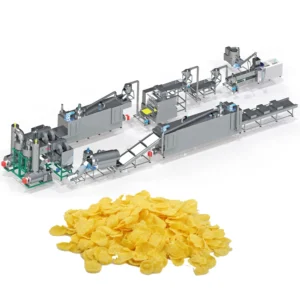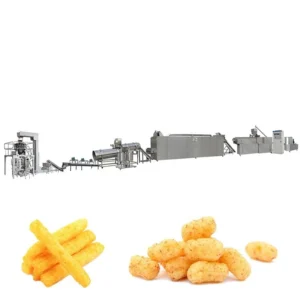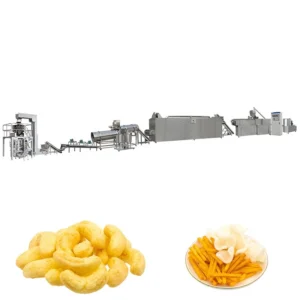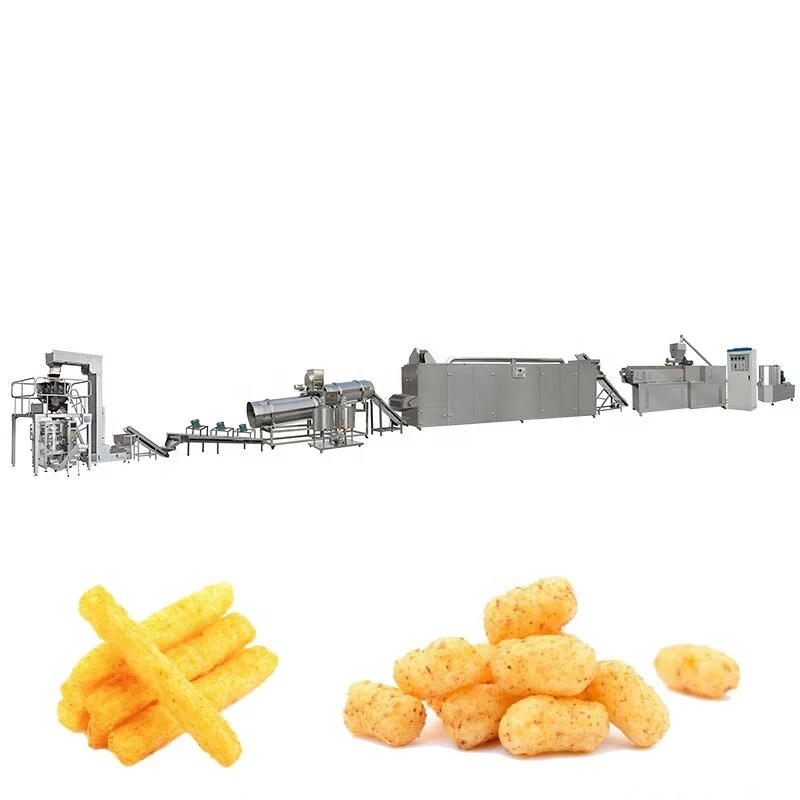
Station-Matched Line Design — every mixer, extruder, flaker, and roaster in this corn flakes line is sized to the same throughput so no single machine becomes a bottleneck.
Technical Specifications
| Parameter | Value |
|---|---|
| Product Type | Corn Flakes Extruder Production Line |
| Extruder Type | Twin Screw |
| Available Models | MT70 / MT85 / MT75 |
| Installed Power | 160 kW (MT70) / 190 kW (MT85) / 210 kW (MT75) |
| Power Consumption | 120 kW (MT70) / 140 kW (MT85) / 150 kW (MT75) |
| Capacity | 150–200 kg/hr (MT70) / 300–400 kg/hr (MT85) / 300–500 kg/hr (MT75) (basis not stated in source — confirm raw material formulation and moisture content) |
| Overall Dimensions | 41 × 1.5 × 2.2 m (MT70) / 43 × 1.5 × 3.2 m (MT85) / 45 × 1.5 × 3.5 m (MT75) |
| Flaking Drive | Double motors for separate roller driving; hydraulic system |
| Flaking Temperature Control | Infrared sensor |
| Dryer Heating Source | Gas or electric, configurable |
| Roasting Oven | Hot air with conciliation burner, dual circulating fans, cyclone dust removal |
| Coating System | Double tumble for sugar melting, elevator, coating drum, spraying nozzle |
| Control System | PLC control on flaking machinery; MCC integration available across line |
| Screw Feature | Automatic lubricating and cooling function |
Application Suitability
| Application | Material or Output |
|---|---|
| Natural corn flakes | Corn grits, corn flour, degerminated corn meal |
| Sugar-coated corn flakes | Corn base with sugar syrup coating |
| Multi-grain breakfast cereals | Rice, wheat, oat, and barley powder blends |
| Shaped cereal pieces | Ball, tube, stick, ring, fruit loop, star, wheel, flower, heart shapes via die changes |
Why Extruder Capacity Alone Never Tells the Full Story
A 400 kg/hr extruder feeding a 200 kg/hr dryer is not a 400 kg/hr line.
When buyers compare corn flakes machine full equipment range options, the first number they look at is extruder output. But breakfast cereal extruder production line throughput depends on every downstream station keeping pace. I once watched a Middle East installation where the extruder was rated well above the dryer capacity — corn flakes piled up on the conveyor, cooled unevenly, and entered the flaking rolls at inconsistent moisture, producing cracked sheets that shattered in the roasting oven. The fix was not a bigger extruder but matching every station from mixing through to packing. [NEED_CITE: throughput balancing across food extrusion line stations]
How Each Station Fits the Next
The mixing station prepares a uniform blend of corn flour, sugar, salt, and malt extract before the twin-screw extruder cooks and shapes the dough. The corn flakes machine full equipment range begins here because inconsistent feed moisture causes the extruder to surge, producing pellets of varying density that the flaking rolls cannot flatten evenly.
From the extruder, pellets drop into the flaking machinery where the hydraulic double-roller system and infrared temperature sensor maintain consistent sheet thickness. The PLC control adjusts roller gap in real time. Flaked sheets then move into the dryer where gas or electric heating removes surface moisture before the hot air roasting oven crisps each flake with dual circulating fans and cyclone dust removal.
Where Natural and Sugar-Coated Lines Diverge
A natural corn flakes line ends after the roasting oven with a cooling conveyor and packing station. Adding sugar coating introduces a double tumble sugar melter, an elevator, a dedicated coating drum, and a spraying nozzle system. The corn flakes machine full equipment range accommodates both configurations, but the coating station adds thermal load and requires additional floor space. [NEED_CITE: sugar coating station footprint and utility requirements for cereal lines]
Buyers who anticipate future sugar-coated production should confirm the roasting oven output leaves headroom for the coating drum’s residence time, otherwise the entire line slows to match the slowest station.
Reading the Power and Dimension Numbers
The three extruder models — MT70, MT85, and MT75 — span installed power from 160 kW to 210 kW, with actual consumption running lower at 120 kW to 150 kW. This gap reflects the automatic lubricating and cooling function that reduces parasitic drag on the screw assembly during continuous operation. Line length stretches from 41 m to 45 m, driven mainly by the roasting oven and cooling conveyor, so workshop ceiling height and linear space must be confirmed before layout finalization.
Flaking machinery uses separate motors for each roller rather than a single shared drive, which means the nip pressure stays balanced even when sheet thickness varies slightly from batch to batch. The infrared sensor on the flaking station feeds temperature data back to the PLC, preventing the sheets from sticking to the rolls when residual moisture is high. [NEED_CITE: infrared temperature control benefits in cereal flaking applications]
The Hidden Cost of Mismatched Supporting Equipment
An extruder that produces flakes faster than the roasting oven can crisp them forces operators to either slow the entire line or accept under-roasted product with poor shelf stability. I have seen lines where the coating drum could not keep pace with the roaster output, leaving hot flakes sitting on the cooling conveyor long enough to absorb ambient moisture and go limp before packing. Every such bottleneck traces back to selecting stations independently rather than as a matched set. Buyers who skip the line layout and capacity calculation step often discover the mismatch only after commissioning. [NEED_CITE: common causes of throughput bottlenecks in breakfast cereal production lines]
Why Procurement Goes Through a Single Equipment Range
The MT70, MT85, and MT75 extruder models share the same twin-screw architecture, meaning screw and die configuration knowledge transfers across the range — a formulation dialed in on the MT70 scales to the MT85 without starting from scratch.
Each station from mixing to packing is sourced under one supplier responsibility, so throughput is calculated end to end rather than assembled from independent vendors who each guarantee only their own machine.
An in-house testing workshop runs trial batches on the buyer’s actual raw material before shipment, catching formulation issues like the degerminated corn grits problem I encountered on a Middle East project where starch content differences caused uneven flake thickness.
Electrical schematics and voltage confirmation are completed before production so the control panel matches the destination country’s frequency and plug standards, avoiding on-site rewiring delays.
Screw configuration and die design records are documented per order, so replacement wear parts match the original setup when the first changeover arrives.
Documentation & Verification
- Line layout drawing with station-by-station capacity matched to your corn flour formulation
- Machine specification sheet confirming power, dimensions, and flaking roller drive per model
- Screw and die configuration record for your target cereal shape and flake thickness
- Electrical schematic with voltage and frequency confirmed for your local grid standard
- Factory trial run report using your raw material before the line leaves the workshop
Installation, Commissioning & Support
- Linear footprint of 41 to 45 m requires a clear workshop bay with minimum 3.5 m ceiling height for the MT75 roasting oven
- Power supply must accommodate up to 210 kW installed capacity with dedicated circuit breakers per station
- Flaking machinery ships with hydraulic system pre-filled; roller alignment verified again after on-site leveling
- PLC control language and HMI labels configured to operator preference before commissioning begins
- Twin-screw barrels and die plates inspected at first start-up; wear parts list provided with reorder codes
- Gas-heated dryer burners tuned to local supply pressure during commissioning week
What to Share Before Requesting a Quote
To size the right extruder model and confirm every supporting station matches, we need your raw material specification including moisture content and particle size, your target hourly output, workshop dimensions with ceiling height, and the local voltage and frequency standard. If you plan to produce both natural and sugar-coated variants on the same line, let us know so the roasting oven and coating drum are sized for the combined flow.
Frequently Asked Questions
Q: How do I choose between MT70, MT85, and MT75 for my target output?
A: Start with your confirmed raw material formulation and moisture content, then compare the capacity ranges — MT70 covers 150–200 kg/hr while MT85 and MT75 reach higher volumes. Factory floor length also matters since the full line stretches up to 45 m. A trial run on your material in the testing workshop gives the most reliable basis for model selection.
Q: What supporting equipment prevents bottlenecks after the extruder?
A: The flaking machinery must match extruder pellet output, and the roasting oven must handle the full flake volume without pile-up. The dryer heating source — gas or electric — should be selected based on your utility costs and available supply capacity. Mismatched stations are the most common reason a line cannot hold its rated output.
Q: Can the same line produce different breakfast cereal shapes?
A: Yes. Adjusting the extruder die changes the pellet cross-section, enabling shapes like rings, stars, tubes, and fruit loops on the same twin-screw platform. Each shape requires its own die plate and may need a different screw configuration record, which is documented per order for repeat production.
Q: What is different between a natural corn flakes line and a sugar-coated line?
A: A sugar-coated line adds a double tumble sugar melter, an elevator, a coating drum, and a spraying nozzle station after the roasting oven. This section adds thermal load and floor space. The roasting oven must have enough output headroom to feed both the cooling conveyor and the coating drum without slowing the upstream stations.
Q: How are voltage and control language handled for export markets?
A: Electrical schematics are prepared with your destination voltage and frequency before production. The PLC control panel and HMI labels are configured to the operator’s preferred language. Confirming these details at the quotation stage prevents on-site rewiring and reprogramming delays during commissioning.